































Complete Mutation Outcomes Worksheet | Grade 10 Biology

Paste this activity's link or code into your existing LMS (Google Classroom, Canvas, Teams, Schoology, Moodle, etc.).
Students can open and work on the activity right away, with no student login required.
You'll still be able to track student progress and results from your teacher account.
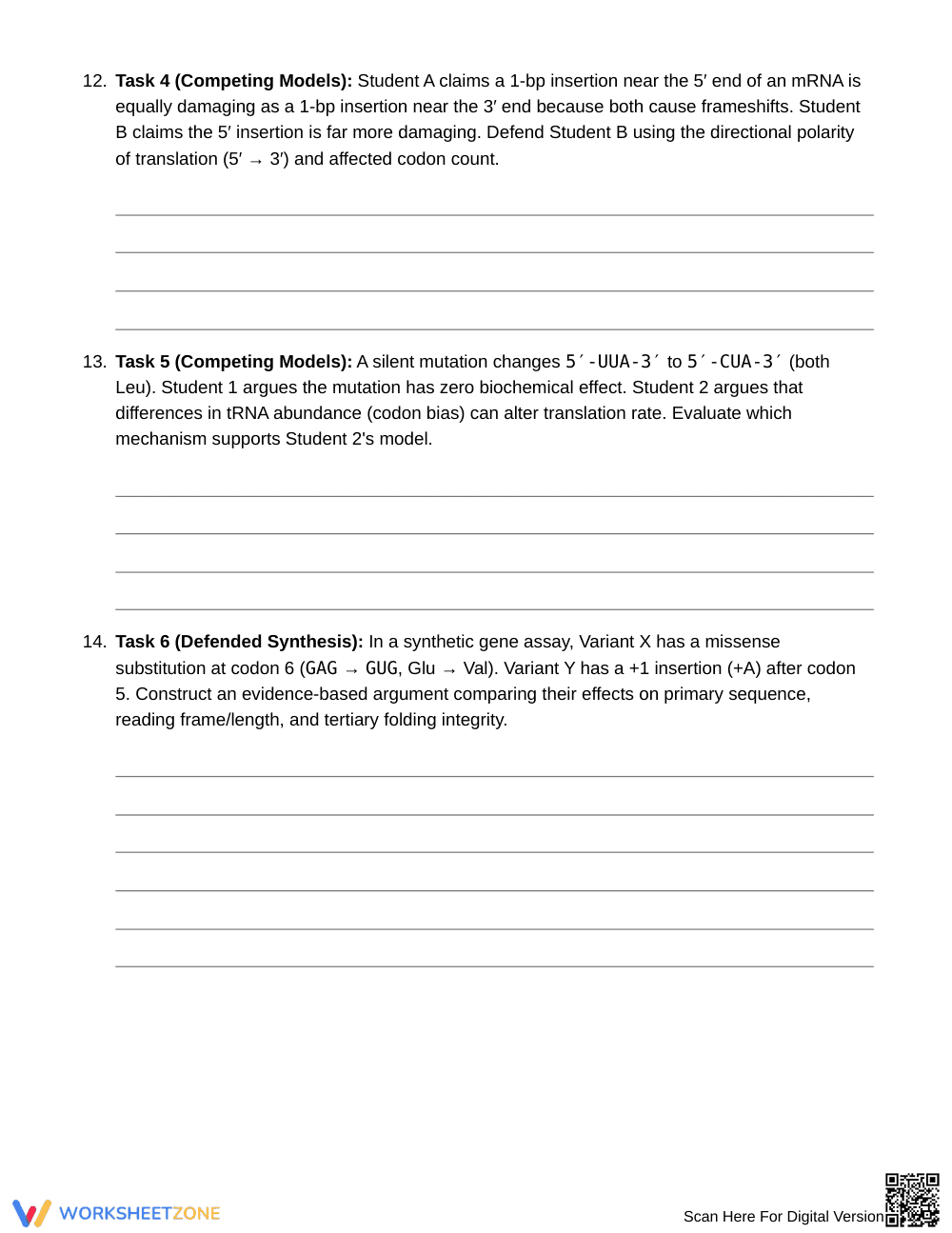
This molecular genetics worksheet guides tenth-grade biology students through evaluating the phenotypic outcomes of genetic mutations. Learners analyze how nucleotide substitutions cause silent, missense, or nonsense effects, while insertions trigger reading frameshifts. Transcribing template strands and decoding mRNA codons allows students to directly link sequence alterations to polypeptide changes.
At a Glance
- Grade: 10 · Subject: Biology
- Standard: High School Life Science — Model how gene mutations alter mRNA codons and translated proteins
- Skill Focus: Outcomes of nucleotide substitutions and insertions
- Format: 5 pages · 14 problems · Answer key included · PDF
- Best For: Post-lecture practice and mutation analysis review
- Time: 45–60 minutes
What's Inside
The 5-page worksheet provides a codon reference table and 14 analytical problems. Students transcribe 3′-to-5′ template DNA into 5′-to-3′ mRNA strands and translate them into peptides. The resource features classification questions, sequence comparisons, codon engineering tasks, and competing models, accompanied by a 3-page answer key.
Skill Progression
- Guided practice (Part A, 4 tasks): Multiple-choice and short-answer prompts introduce substitution types (silent, missense, nonsense) and frameshift rules using the codon table.
- Supported practice (Part B, 4 tasks): Structured sequence workflows require students to transcribe wild-type and mutated templates, determine peptide chains, and contrast point mutations with insertions.
- Independent practice (Part C, 6 tasks): Extension problems challenge students with inverse translation, codon engineering, and defended scientific arguments comparing 5′ versus 3′ frameshifts.
This progression follows a gradual-release model, advancing from basic mutation identification to complex molecular deduction.
Standards Alignment
This resource aligns with high school life science standards addressing how DNA sequence changes alter translated amino acid chains and affect protein function. Standard statements can be copied directly into lesson plans, IEP goals, or district curriculum mapping tools.
How to Use It
Use this worksheet following direct instruction on transcription and translation. Assign Parts A and B during paired classwork, observing whether students maintain proper 5′-to-3′ polarity during translation. Part C serves as an extension or individual assessment. Students typically complete the 14 problems in 45 to 60 minutes.
Who It's For
Designed for tenth-grade biology students learning molecular genetics, this practice set easily adapts for honors and introductory AP Biology. Provide codon charts for extra support, or pair the worksheet with physical transcription-translation kits to reinforce base-pairing concepts.
According to Fisher & Frey (2014), purposeful instructional design requires a gradual release of responsibility that moves secondary students from conceptual modeling to independent problem-solving. This high school biology resource operationalizes that evidence-based pedagogy across 14 sequential molecular genetics tasks. By tracking how single-nucleotide substitutions and base insertions modify mRNA reading frames and polypeptide primary structures, learners build deep mechanistic comprehension rather than superficial rote recall. Students evaluate silent, missense, and nonsense point mutations alongside frameshift disruptions, systematically testing scientific predictions against an included mRNA codon matrix. The progression from foundational codon identification to constrained codon engineering and competing model evaluation ensures students synthesize abstract molecular mechanisms into concrete biological arguments. Teachers gain clear, actionable formative assessment data on student transcription accuracy, translation fluency, and structural protein analysis, fulfilling high school life science expectations through rigorous sequence analysis.


