





























Complete Multi-Step Signed Changes Worksheet | Grade 7 Math
Paste this activity's link or code into your existing LMS (Google Classroom, Canvas, Teams, Schoology, Moodle, etc.).
Students can open and work on the activity right away, with no student login required.
You'll still be able to track student progress and results from your teacher account.
Master multi-step rational number operations and signed change modeling with this rigorous Grade 7 math resource. Students formulate signed numerical expressions, combine fractions and decimals across sequential steps, and interpret net directional changes in authentic real-world systems ranging from financial accounts to scientific temperature chambers.
At a Glance
- Grade: 7 · Subject: Math
- Standard:
7.EE.B.3— Solve multi-step real-life problems with positive and negative rational numbers in any form- Skill Focus: Multi-step signed rational number changes
- Format: 5 pages · 10 problems · Answer key included · PDF
- Best For: Targeted skill practice and concept consolidation
- Time: 45–60 minutes
What's Inside
This 5-page printable resource delivers 10 structured multi-step problems that bridge conceptual understanding and procedural fluency with positive and negative rational numbers. It begins with a core conventions reference box and a fully worked modeling example, followed by three progressive sections of real-world scenarios incorporating mixed numbers, decimals, and operational rates. A comprehensive 2-page answer key provides complete intermediate calculations and unit-accurate final states.
Skill Progression
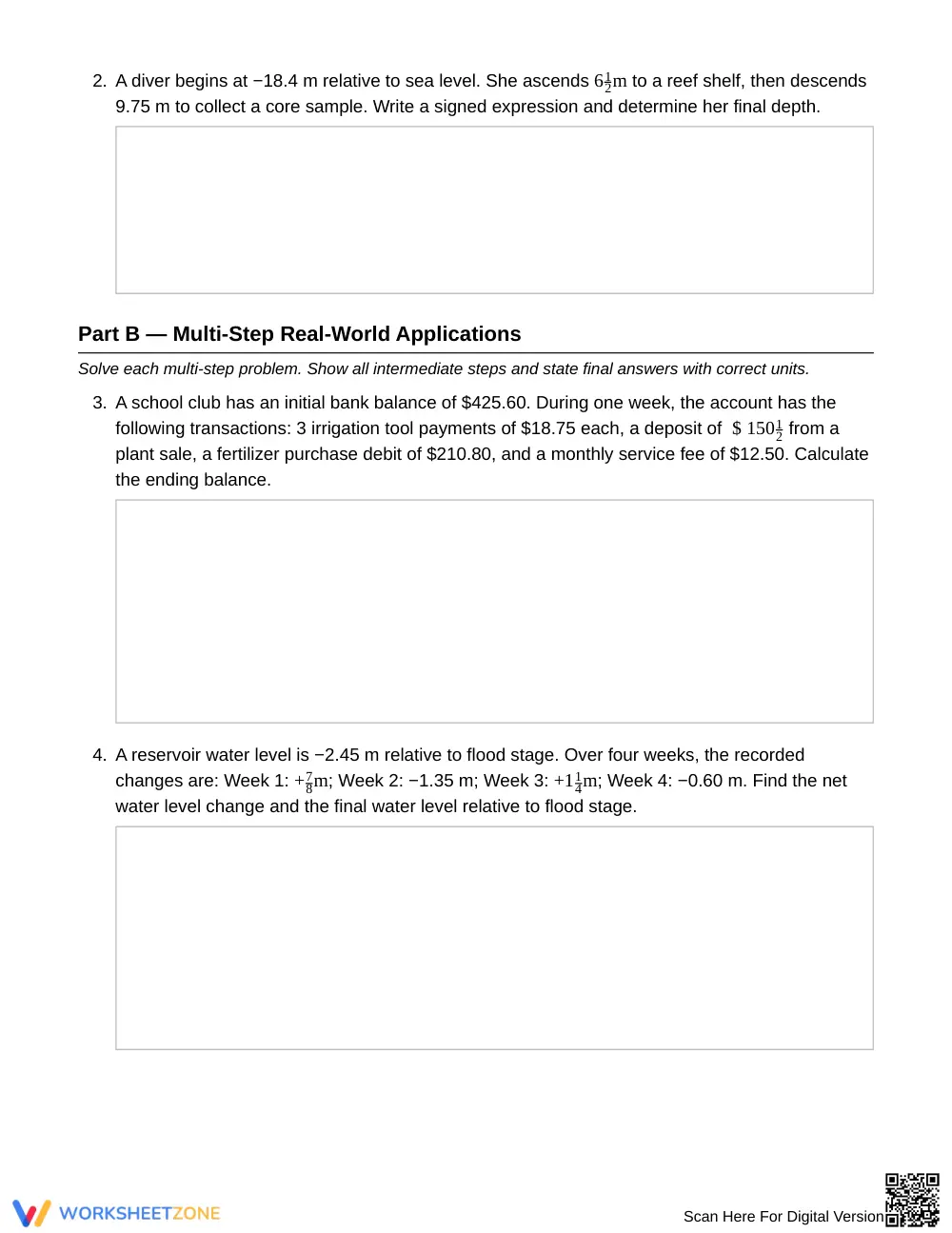
- Guided Practice (Part A, Problems 1–2): Direct scenario modeling where students translate thermal shifts and ocean depths into signed addition expressions with single-step evaluation.
- Supported Practice (Part B, Problems 3–8): Multi-step contextual word problems combining account balances, water reservoir fluctuations, excavation elevations, and variable rates.
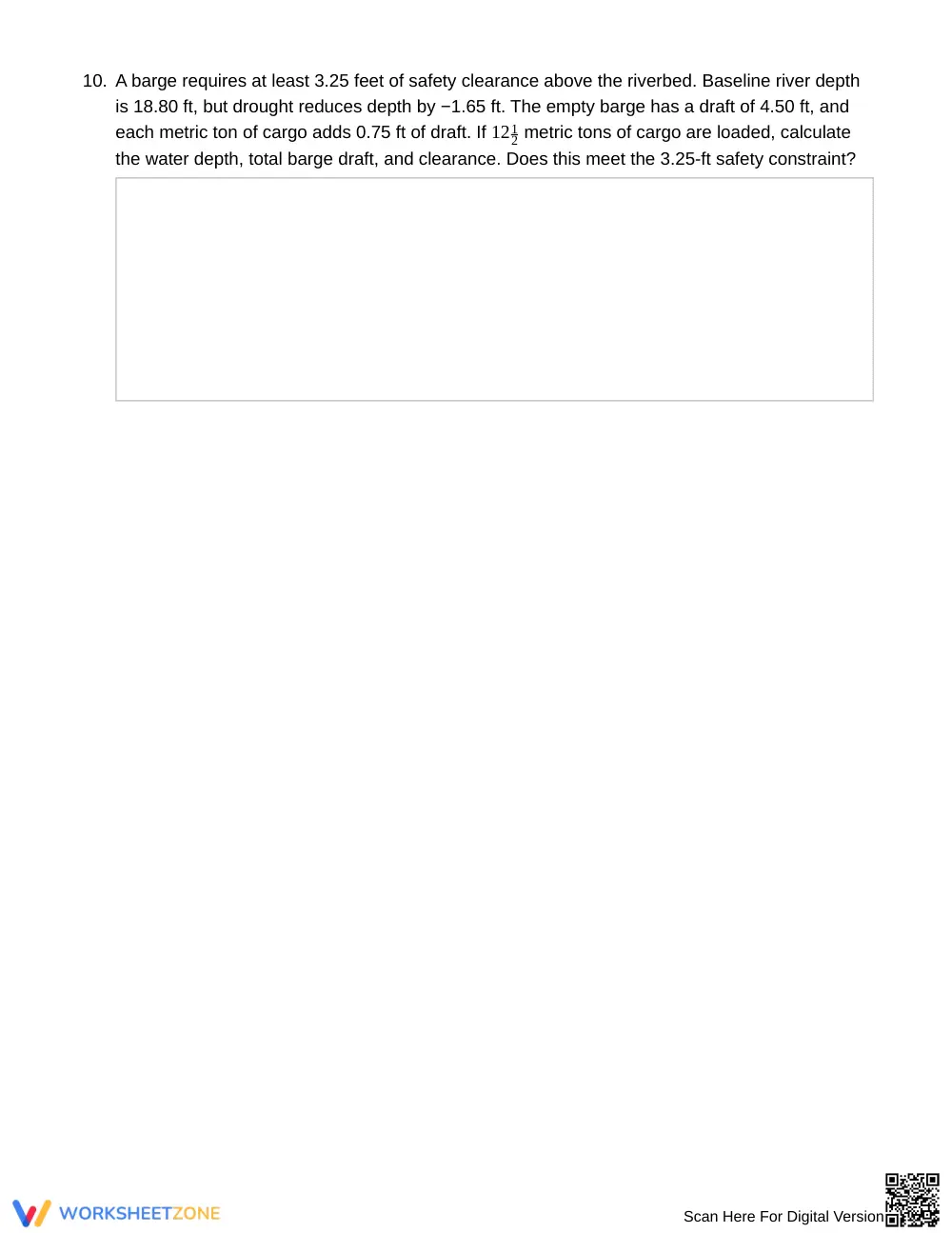
- Independent Practice (Part C, Problems 9–10): High-cognitive-demand constraint tasks requiring multi-step calculation and mathematical justification against safety limits.
This structured progression reflects the gradual release of responsibility framework, guiding learners from initial algebraic translation to complex mathematical justification.
Standards Alignment
This activity directly targets 7.EE.B.3: Solve multi-step real-life and mathematical problems posed with positive and negative rational numbers in any form (whole numbers, fractions, and decimals), using tools strategically, applying properties of operations to calculate with numbers in any form, and converting between forms as appropriate. It also supports 7.NS.A.1 by reinforcing operations with signed quantities. Both standard codes can be copied directly into lesson plans, IEP goals, or district curriculum mapping tools.
How to Use It
Implement this worksheet after direct instruction on rational number arithmetic as an intensive small-group workshop or post-lesson consolidation task. During independent or paired completion, conduct formative assessment observations on whether students consistently convert fractions and decimals to a common representation before computing net sums. Expect a completion time of 45 to 60 minutes across the full 10-task progression.
Who It's For
This resource is designed for standard 7th grade math classrooms, accelerated Grade 6 learners, and Tier 2 algebra-readiness interventions. For students requiring additional scaffolding, pair this resource with an integer operations anchor chart and physical number lines to visualize directional transitions.
According to research by Fisher & Frey (2014) on structured instructional frameworks, learners achieve significantly greater conceptual retention when complex problem solving progresses deliberately from direct modeling to independent application. This 10-problem Grade 7 mathematics resource operationalizes standard 7.EE.B.3 by systematically structuring multi-step signed rational number operations across scientific, financial, and environmental contexts. By requiring students to reconcile mixed forms—converting between non-terminating fractions, terminating decimals, and contextual rates—the task sequence eliminates algorithmic guessing in favor of rigorous mathematical modeling. Students must not only calculate net change through intermediate sums but also evaluate boundary constraints, reinforcing deep computational fluency and proportional reasoning. The explicit reference framework and complete 2-page answer key provide the systematic feedback loops essential for building student autonomy during high-cognitive-demand middle school algebraic tasks.


