




























Views
Downloads





Complete MLA Containers Worksheet | Grade 11 English III

Paste this activity's link or code into your existing LMS (Google Classroom, Canvas, Teams, Schoology, Moodle, etc.).
Students can open and work on the activity right away, with no student login required.
You'll still be able to track student progress and results from your teacher account.
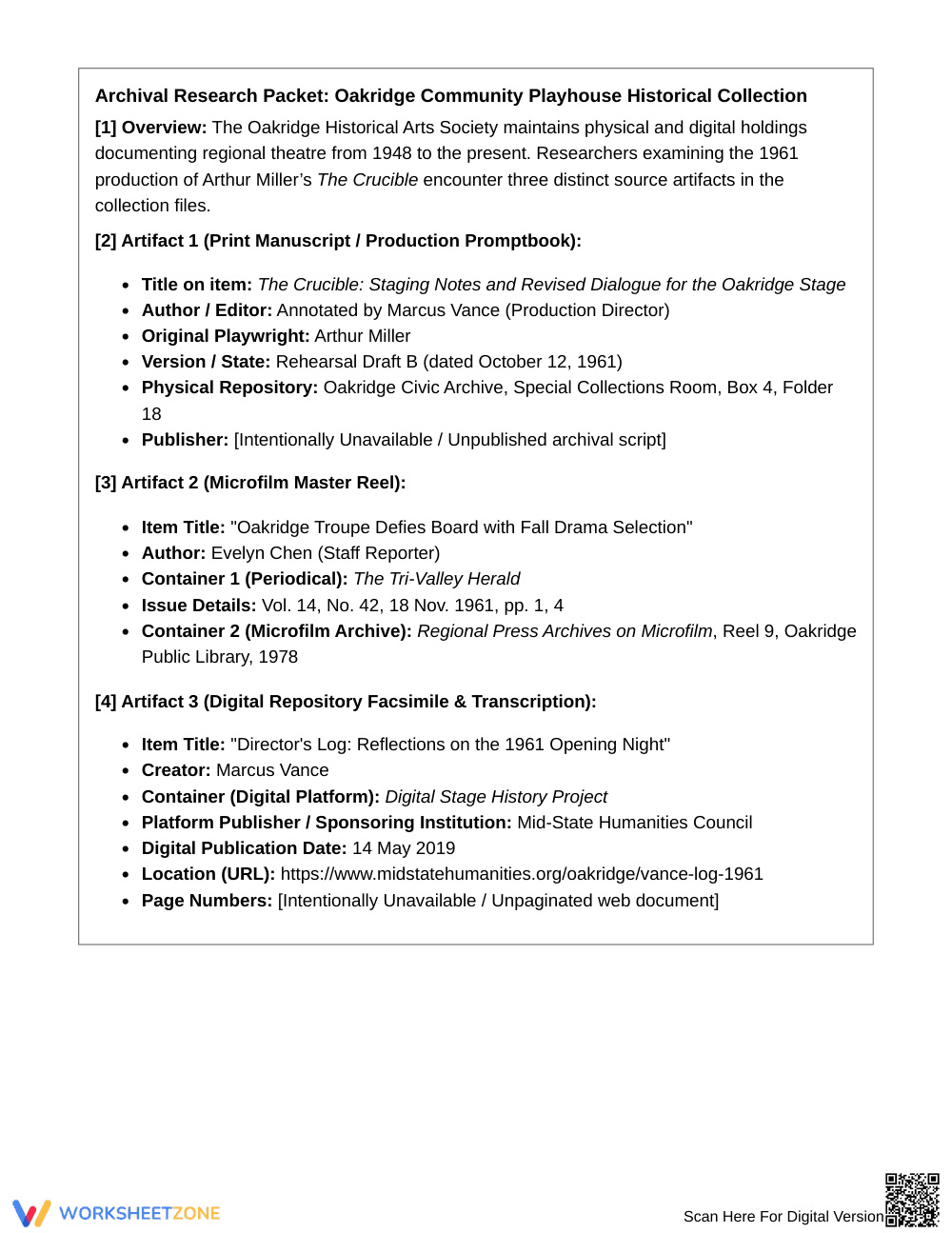
Mastering MLA 9 documentation requires high school researchers to distinguish physical manuscripts, microform, and web repositories. This 6-page English III worksheet gives 11th-grade students 10 structured tasks to analyze archival metadata, evaluate source containers, and build accurate Works Cited entries without inventing missing data.
At a Glance
- Grade: 11 · Subject: English III
- Standard:
W.11-12.8— Gather information from diverse formats and follow standard citation formats- Skill Focus: Compare Versions and Containers of a Source
- Format: 6 pages · 10 problems · Answer key included · PDF
- Best For: High school research citation practice
- Time: 40–50 minutes
What's Inside
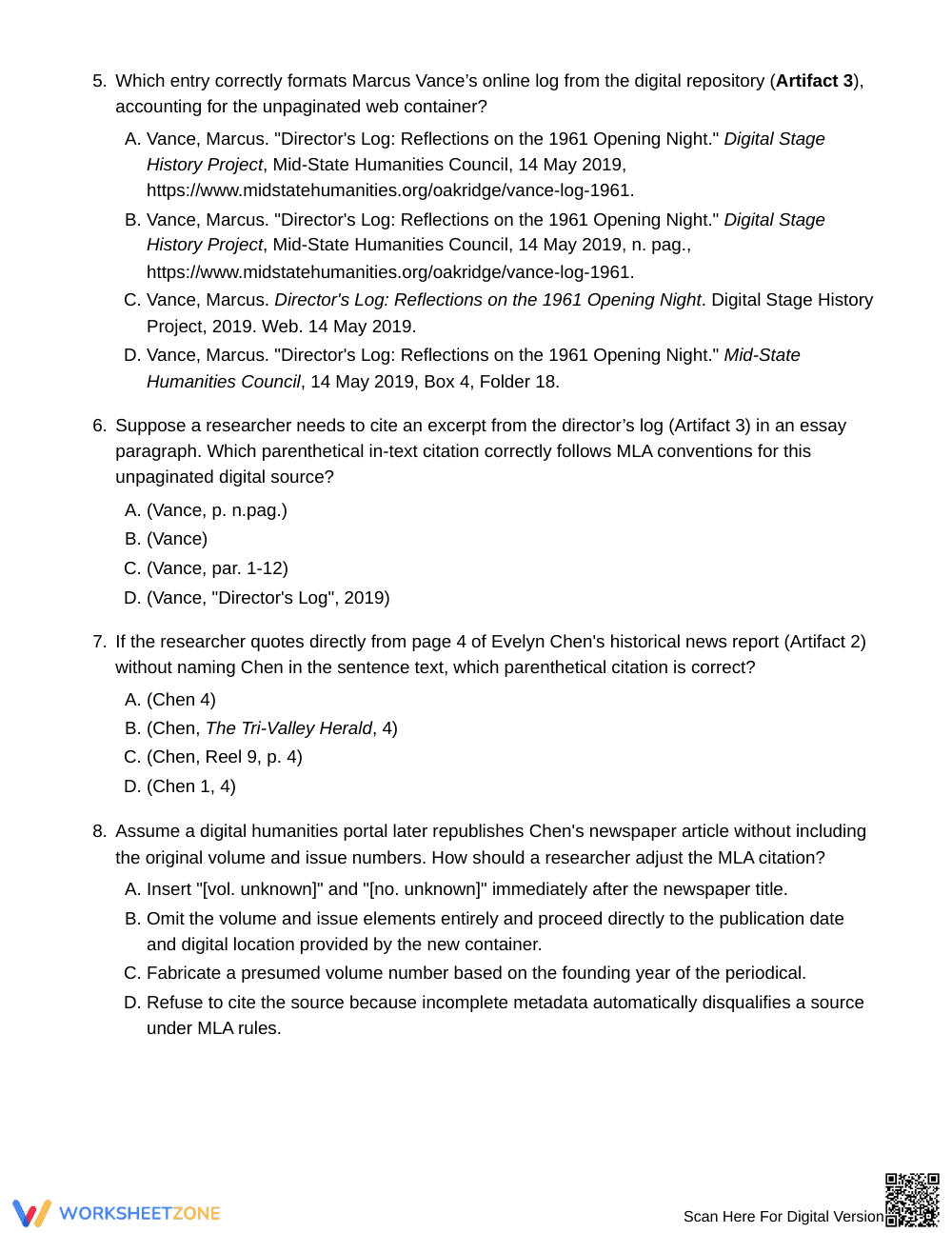
This 6-page resource features a 3-part archival packet covering a 1961 promptbook manuscript, a 1978 microfilm newspaper article, and a 2019 digital log. It includes an MLA 9 rule box, 8 selected-response items on container hierarchies and parenthetical citations, 2 analytical short answers, and a 3-page answer key.
Skill Progression
- Guided practice (Tasks 1–2): Students analyze archival metadata to identify structural distinctions between physical manuscripts, nested microfilm containers, and unpaginated web platforms.
- Supported practice (Tasks 3–8): Learners solve 6 multiple-choice problems, selecting standard MLA 9 Works Cited entries, applying parenthetical rules, and omitting missing publisher data correctly.
- Independent practice (Tasks 9–10): Students write analytical responses explaining nested container logic and critiquing invalid metadata placeholders.
This structured sequence applies the gradual release of responsibility model to build rigorous bibliographic reasoning.
Standards Alignment
Aligned with W.11-12.8, this resource helps students gather authoritative information from diverse formats and follow standard citation guidelines. It also supports RI.11-12.7 by evaluating multi-format source materials. Both standard codes can be copied directly into lesson plans, IEP goals, or district curriculum mapping tools.
How to Use It
Assign this activity after direct instruction on MLA 9 container architecture. For formative assessment, check Tasks 6 and 7 to confirm students omit page numbers for unpaginated web sources rather than inserting outdated abbreviations. Completion takes 40 to 50 minutes.
Who It's For
Built for Grade 11 English III students, this worksheet supports researchers developing citation proficiency. Pair it with primary source analysis units or MLA research paper drafting.
According to research by Fisher & Frey (2014) on disciplinary literacy, high school students require structured, scaffolded practice to transfer complex citation frameworks into authentic academic research writing. Standard W.11-12.8 requires eleventh-grade researchers to evaluate diverse print and digital source formats while adhering to standard bibliographic conventions. This 6-page worksheet reinforces that foundational skill by guiding students through three distinct archival artifacts: an unpublished theater promptbook, a microfilm newspaper reel, and an unpaginated digital repository transcription. Through 10 targeted analytical tasks, learners examine nested container relationships, practice parenthetical documentation, and apply modern MLA 9 omission principles for unavailable metadata elements. By moving from structural identification to independent analytical justification, students develop the procedural knowledge and critical evaluative habits needed to construct defensible, publication-ready Works Cited entries across varied academic media formats.


