





























Complete MLA Containers Worksheet | Grade 11 English III
Paste this activity's link or code into your existing LMS (Google Classroom, Canvas, Teams, Schoology, Moodle, etc.).
Students can open and work on the activity right away, with no student login required.
You'll still be able to track student progress and results from your teacher account.
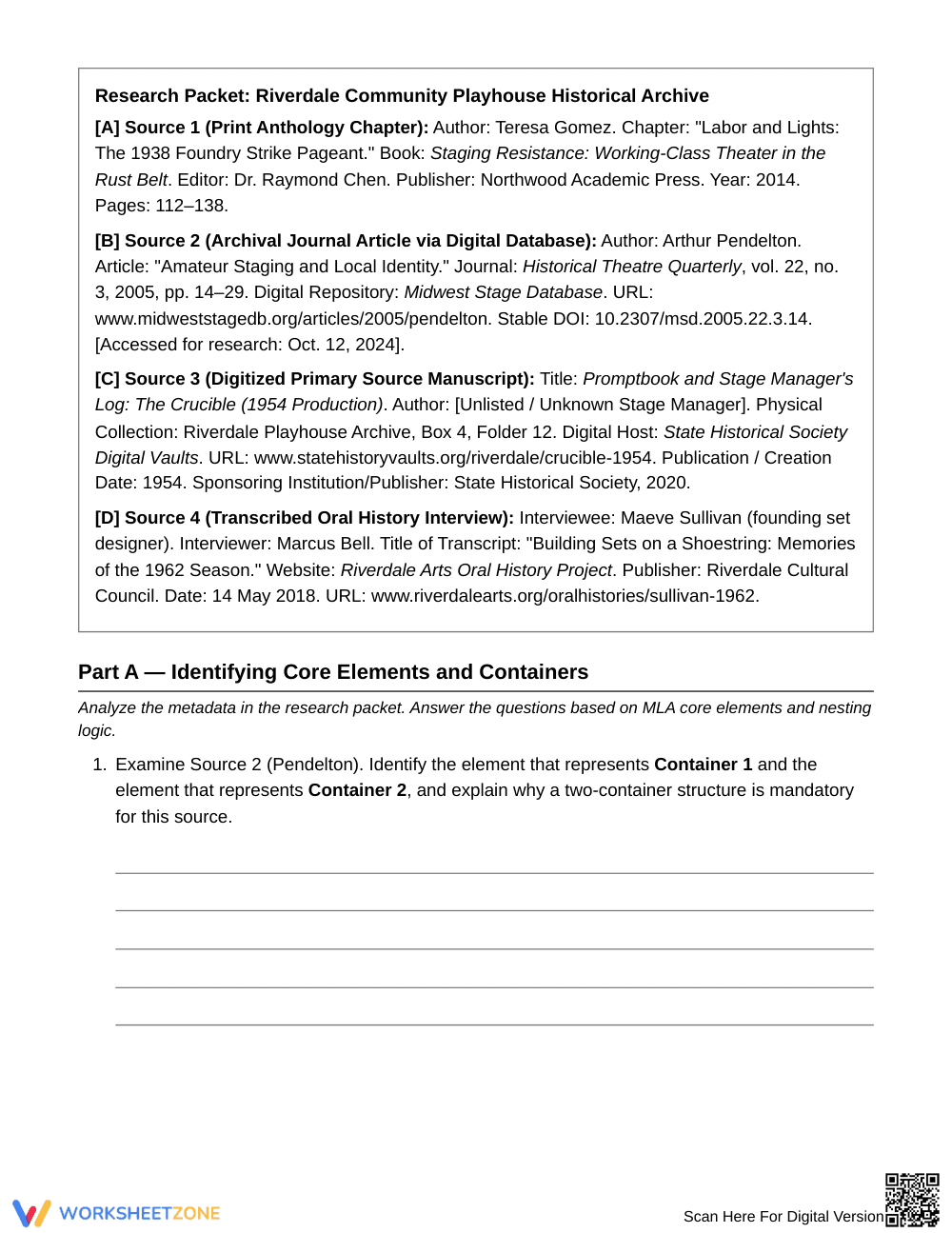
This Grade 11 English III worksheet equips high school researchers to master the MLA 9th edition container framework. Students examine authentic historical metadata, map core citation elements across single and nested containers, construct precise Works Cited entries, and resolve documentation dilemmas with academic integrity.
At a Glance
- Grade: 11 · Subject: English III
- Standard:
W.11-12.8— Gather authoritative information and follow standard citation formats accurately- Skill Focus: Source Containers and Citation Elements
- Format: 6 pages · 12 problems · Answer key included · PDF
- Best For: Advanced MLA research documentation practice
- Time: 45–60 minutes
This 6-page instructional resource includes a modeled two-container exemplar, a four-source research packet from a historical theater archive, and 12 structured analytical tasks. Students practice with print anthologies, database journals, digitized manuscripts, and transcribed oral histories. A complete 3-page answer key provides full bibliographic entries and parenthetical models.
Skill Progression
- Guided Practice (Part A, Tasks 1–3): Students analyze raw metadata to isolate nested containers, identify legitimately missing author elements, and determine contributor descriptor labels.
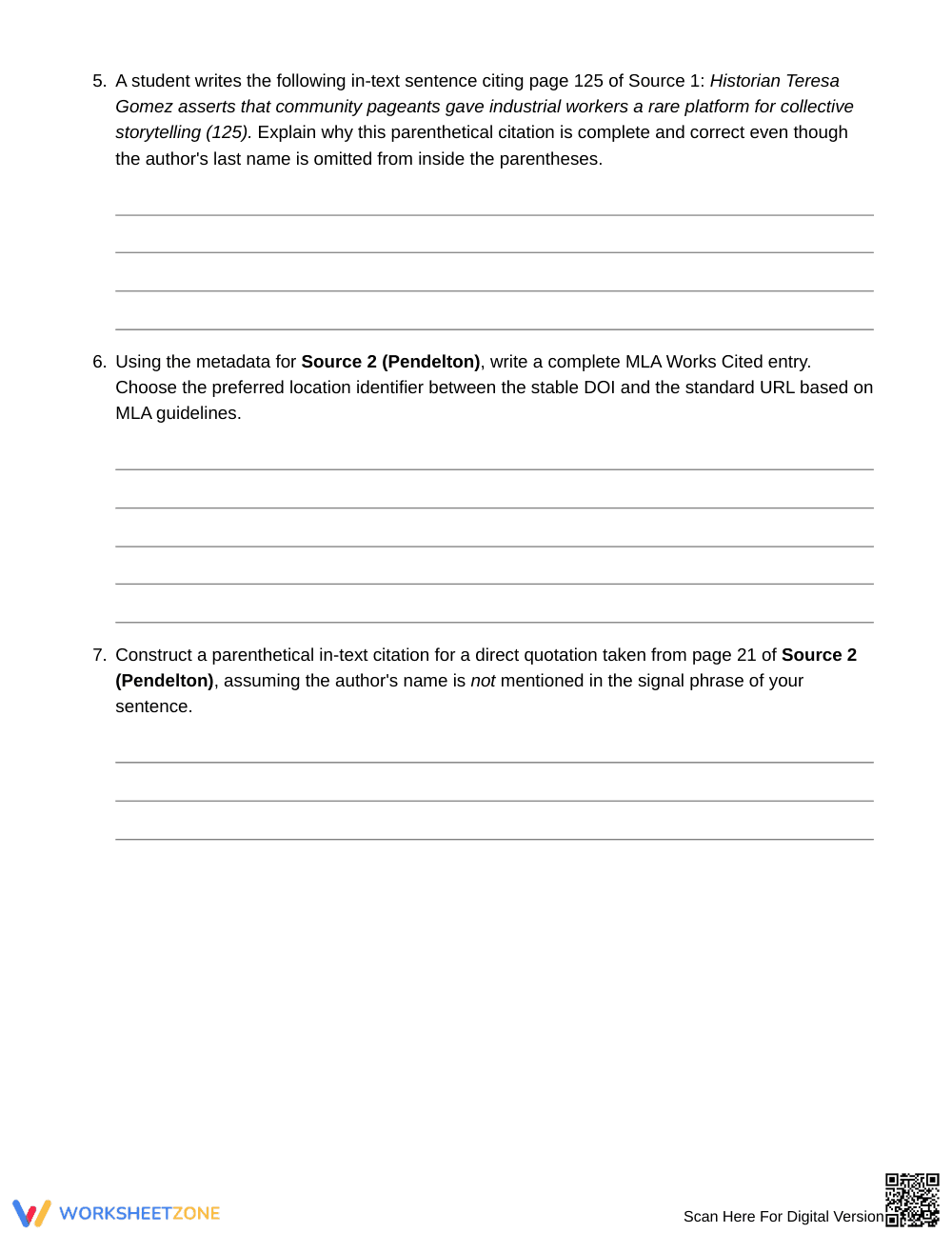
- Supported Practice (Part B, Tasks 4–9): Learners construct full Works Cited entries and parenthetical in-text citations for diverse media types, applying DOI hierarchies and signal phrase mechanics.
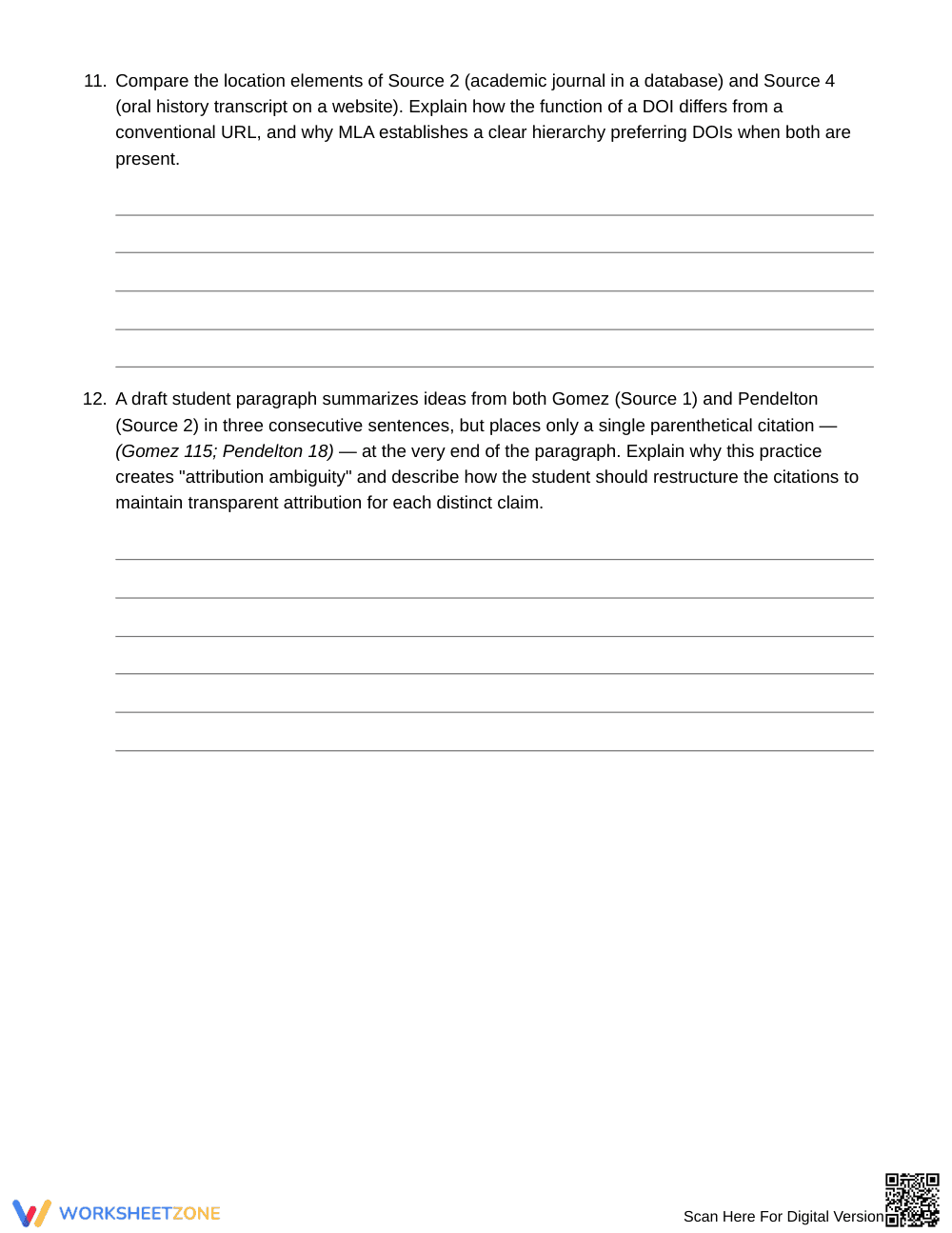
- Independent Practice (Part C, Tasks 10–12): Students independently evaluate research ethics, explain why inventing missing metadata violates integrity, and rectify paragraph-level attribution ambiguity.
This structured sequence utilizes gradual release to move learners from element identification to independent bibliographic synthesis.
Standards Alignment
This resource directly addresses W.11-12.8, requiring students to gather relevant information from authoritative print and digital sources, integrate information selectively, and follow standard citation formats. It also supports RI.11-12.1 by requiring textual attribution for factual claims. Both standard codes can be copied directly into lesson plans, IEP goals, or district curriculum mapping tools.
How to Use It
Deploy this activity during the drafting phase of a research paper or following direct instruction on MLA 9th edition mechanics. When monitoring student progress, check Part A Task 2 to ensure students recognize that missing authors require starting entries directly with the title. Expect a completion time of 45 to 60 minutes.
Who It's For
Designed for Grade 11 English III and pre-college research writers. It offers structured scaffolding through explicit element modeling while challenging advanced students with archival manuscript citation. Pair this worksheet directly with an MLA 9 core elements anchor chart or library database orientation.
Mastering MLA documentation through standard W.11-12.8 enables Grade 11 students to evaluate complex source metadata, correctly nest publication containers, and format academic citations with rigorous precision. According to educational research by Fisher & Frey (2014), structured gradual release instruction—progressing systematically from modeled examples to scaffolded application and independent analytical evaluation—significantly improves student acquisition of complex procedural literacy skills like academic attribution. By navigating nuanced citation scenarios involving digitized archival manuscripts, stable digital object identifiers (DOIs), oral histories, and collaborative anthology editorship, secondary students move far beyond rote memorization to deeply understand the foundational logic of scholarly communication. This comprehensive 12-task exercise directly bridges high school research writing and collegiate expectations, ensuring young researchers cultivate lifelong academic integrity and transparent source tracking across diverse print and digital platforms.


