
































Complete Missing Quantity Rates Worksheet | Grade 6 Math

Paste this activity's link or code into your existing LMS (Google Classroom, Canvas, Teams, Schoology, Moodle, etc.).
Students can open and work on the activity right away, with no student login required.
You'll still be able to track student progress and results from your teacher account.
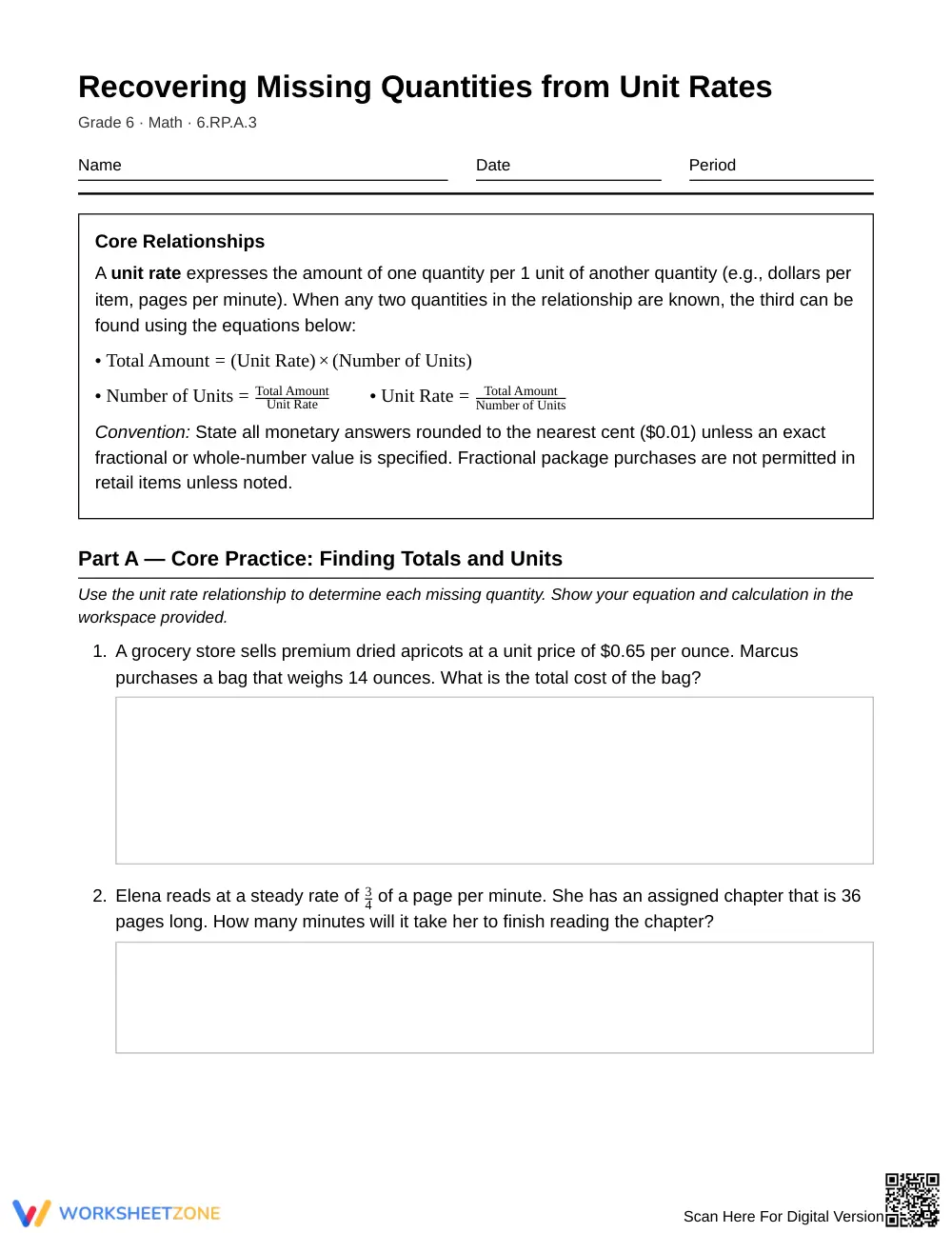
This targeted math worksheet builds sixth-grade mastery in calculating unknown quantities using constant unit rates. Students apply fundamental rate equations across diverse real-world contexts to determine total amounts, unit rates, and unit quantities. The structured problem sets guide learners from direct proportional calculations into multi-step consumer decision problems with realistic budget and packaging constraints.
At a Glance
- Grade: 6 · Subject: Math
- Standard:
6.RP.A.3— Use ratio and rate reasoning to solve real-world and mathematical problems- Skill Focus: Recovering missing quantities from unit rates
- Format: 5 pages · 15 problems · Answer key included · PDF
- Best For: Guided practice, independent classwork, and targeted intervention
- Time: 40–50 minutes
What's Inside
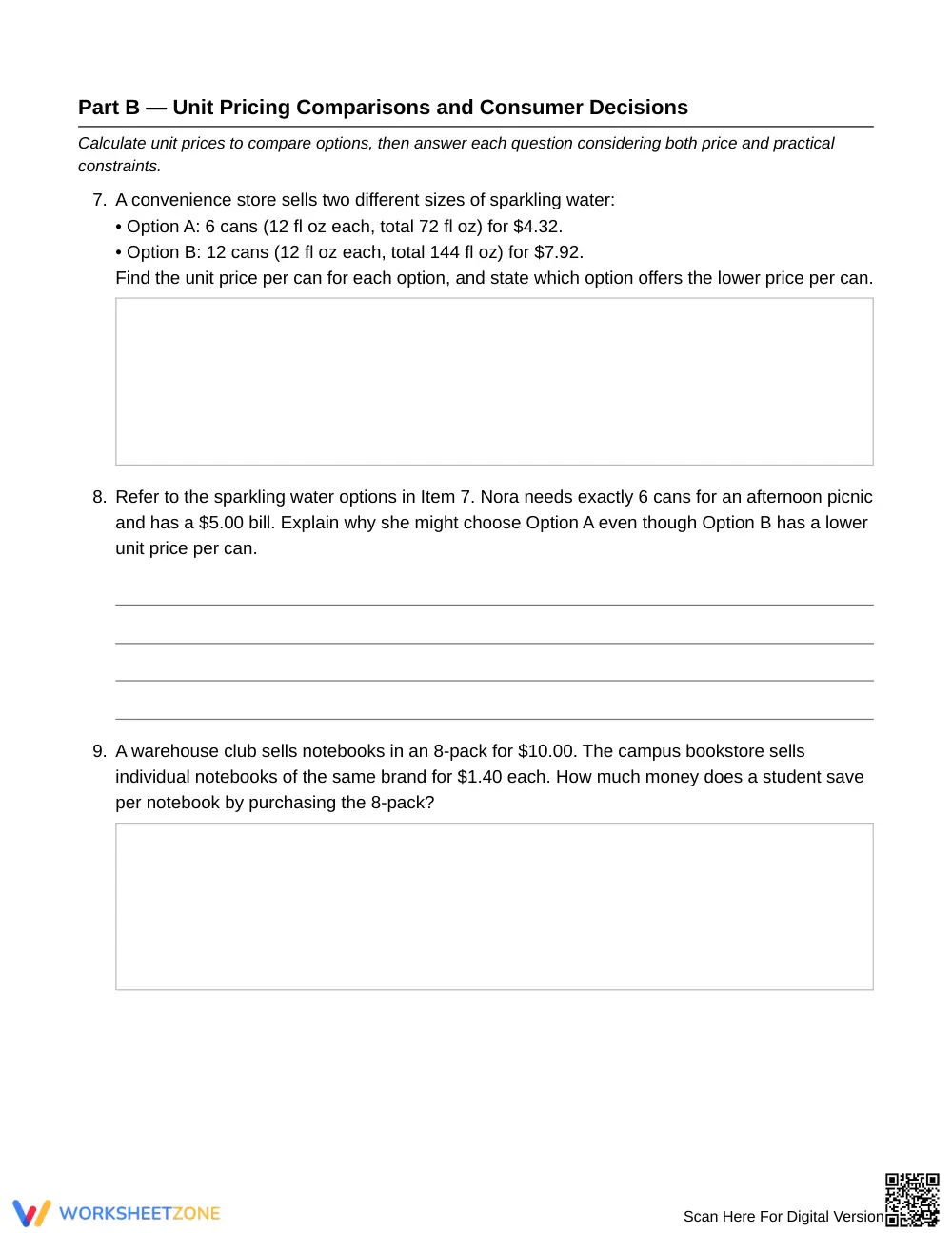
This comprehensive 5-page worksheet includes 15 varied rate problems, reference equations, a structured data table, and a 4-page answer key with step-by-step calculations. Students encounter single-step rate applications, unit price comparisons involving whole packaging limits, and multi-step optimization problems requiring written justifications.
Skill Progression
- Guided practice (Problems 1–6): Core skill building with provided rate formulas and structured data tables where students calculate missing totals, unit counts, and rates.
- Supported practice (Problems 7–11): Comparative unit pricing and step-by-step scaffolded tasks that require evaluating real-world constraints such as purchase packaging and fixed budgets.
- Independent practice (Problems 12–15): Complex multi-step rate applications, cost optimization challenges, and schedule construction requiring full written mathematical justification.
This structured progression reflects the gradual release of responsibility model, ensuring students master foundational rate manipulations before tackling unprompted multi-step word problems.
Standards Alignment
Primary Standard: `6.RP.A.3` — Use ratio and rate reasoning to solve real-world and mathematical problems, e.g., by reasoning about tables of equivalent ratios, tape diagrams, double number line diagrams, or equations. Both standard codes can be copied directly into lesson plans, IEP goals, or district curriculum mapping tools.
How to Use It
Assign Part A immediately following direct instruction on rate equations to verify conceptual understanding. Use Parts B and C during collaborative workshop time or as an independent extension. During work time, monitor whether students round money correctly to the nearest cent and account for whole-carton constraints before calculating final costs. Expect completion within 40 to 50 minutes.
Who It's For
Designed for Grade 6 general mathematics classrooms, Tier 2 math intervention groups, and accelerated Grade 5 students needing rate enrichment. Pair this worksheet directly with visual tape diagram models, double number lines, or a whole-class direct instruction lesson on unit pricing.
According to Fisher & Frey (2014), purposeful scaffolding through the gradual release of responsibility model significantly improves mathematical problem-solving outcomes in middle school learners. This worksheet operationalizes that instructional principle by moving students methodically from explicit three-part rate equations to multi-constraint purchasing scenarios aligned to standard 6.RP.A.3. By systematically requiring students to compute missing totals, compare unit prices, and formulate reasoned scheduling justifications, the 15 tasks bridge algorithmic computation and contextual modeling. The explicit inclusion of practical constraints—such as indivisible package sizes and strict monetary limits—reinforces authentic quantitative reasoning. Teachers can rely on this structured practice to identify student misconceptions in division versus multiplication of rates, ensuring complete mastery of proportional relationships before advancing to Grade 7 constant of proportionality concepts.


