





























Paste this activity's link or code into your existing LMS (Google Classroom, Canvas, Teams, Schoology, Moodle, etc.).
Students can open and work on the activity right away, with no student login required.
You'll still be able to track student progress and results from your teacher account.


Complete Kitchen Chemistry: Physical or Chemical Change?

Paste this activity's link or code into your existing LMS (Google Classroom, Canvas, Teams, Schoology, Moodle, etc.).
Students can open and work on the activity right away, with no student login required.
You'll still be able to track student progress and results from your teacher account.
This Grade 5 science worksheet equips students to classify everyday kitchen changes as physical or chemical by identifying observable scientific evidence. Learners examine familiar cooking scenarios, evaluate indicators such as odor, color, and state changes, and articulate why each transformation forms a new substance or preserves existing matter.
At a Glance
- Grade: 5 · Subject: Science
- Standard: Classify physical and chemical changes using observable evidence of matter
- Skill Focus: Classify cooking changes as physical or chemical and give evidence
- Format: 2 pages · 20 problems · Answer key included · Printable PDF
- Best For: Mid-unit formative check and independent practice
- Time: 25–35 minutes
What's Inside
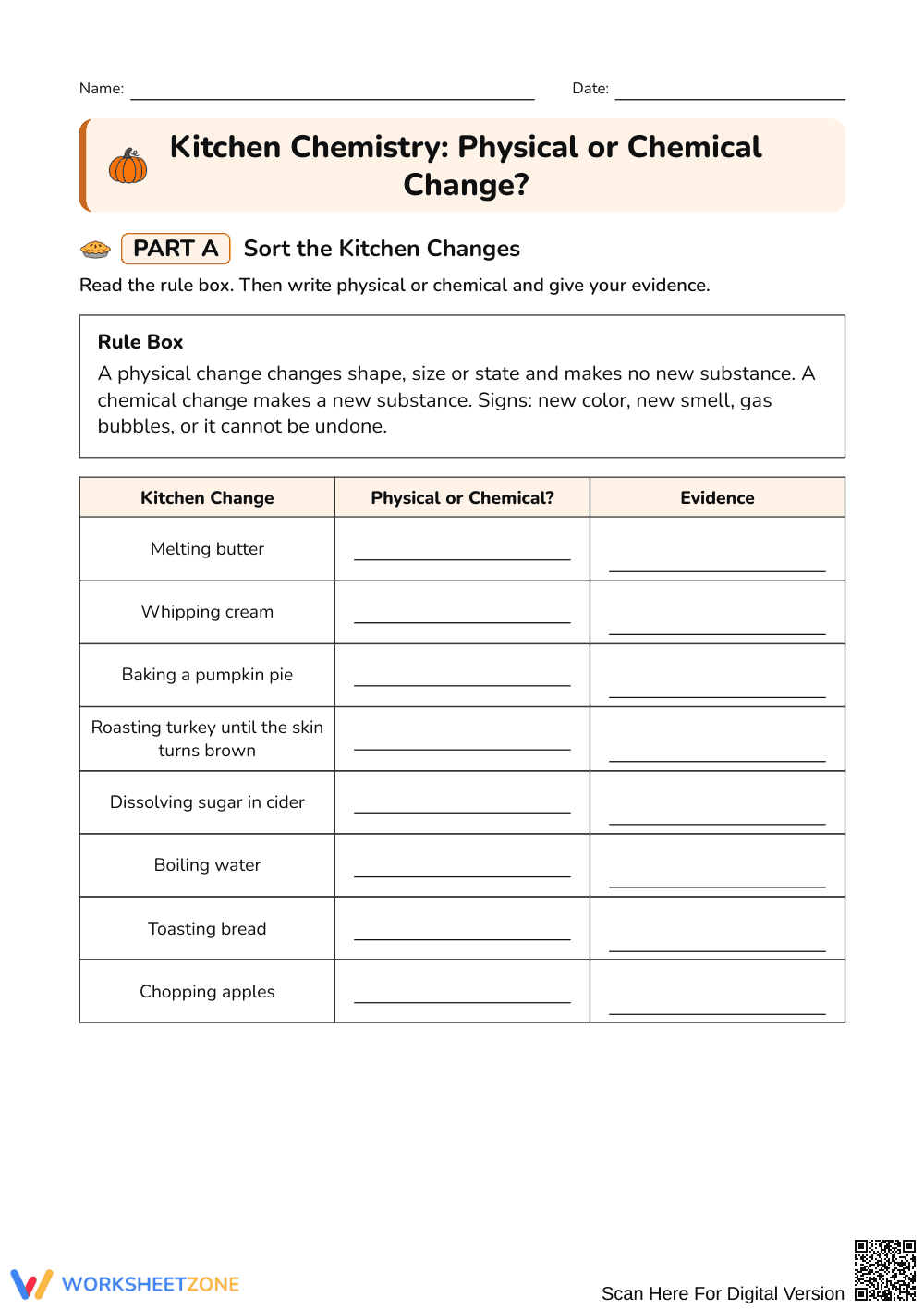
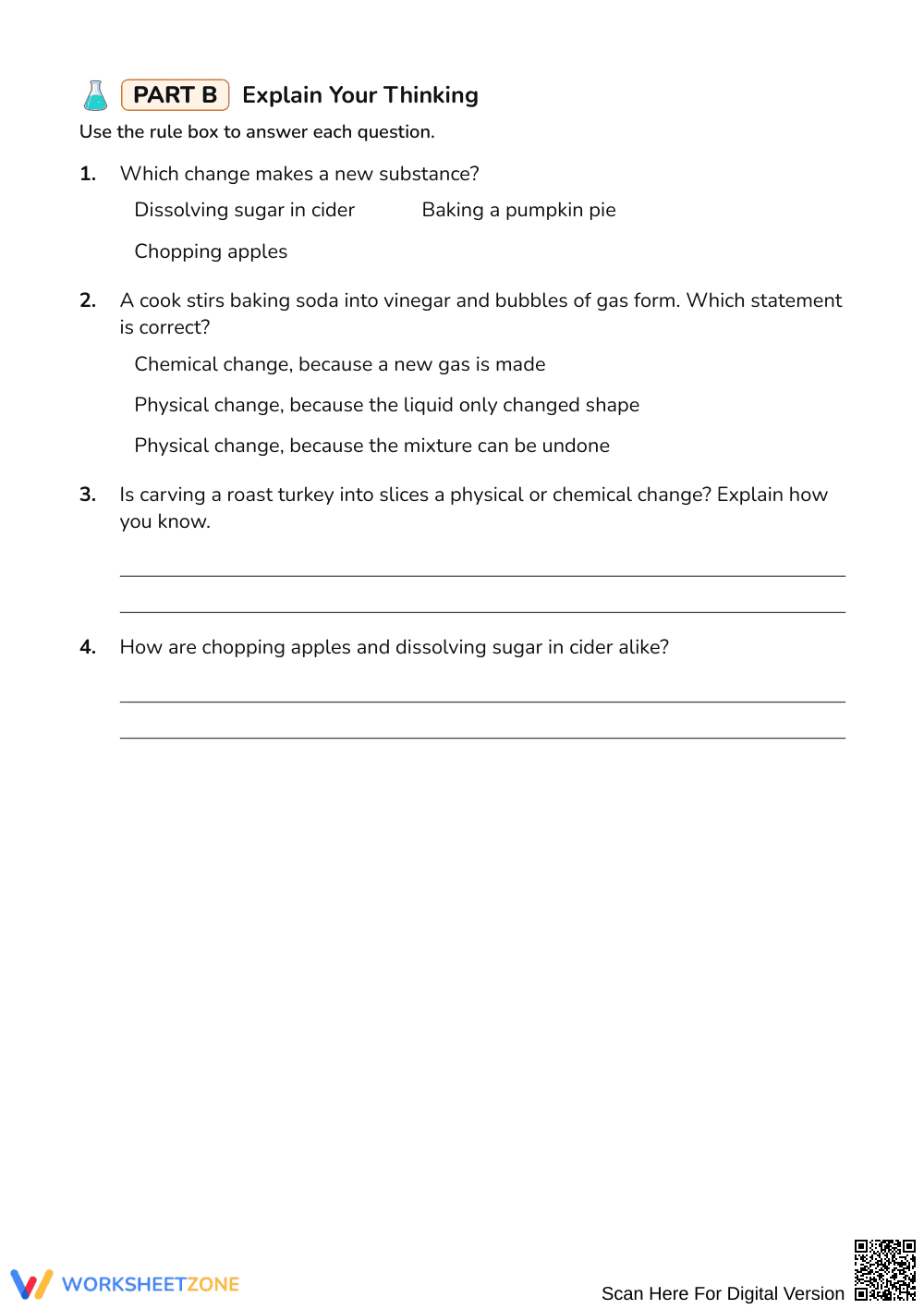
This two-page resource features 20 focused science tasks arranged in two sections. A student-facing rule box defines physical and chemical changes alongside reaction signs. Part A provides a sorting table where students classify eight cooking events and record evidence. Part B deepens comprehension through multiple-choice analysis and written explanation prompts requiring reasoned justifications. A two-page answer key provides model evidence statements.
Skill Progression
The worksheet follows a structured gradual-release architecture to build mastery:
- Guided Practice: The rule box establishes operational criteria, anchoring the first 4 sorting items with clear models of phase and shape shifts.
- Supported Practice: The remaining 4 sorting items and 6 multiple-choice questions challenge students to identify evidence such as odor, bubbles, and irreversibility.
- Independent Practice: The final 6 open-ended tasks require learners to contrast scenarios and defend scientific claims in complete sentences.
This deliberate sequence reinforces the gradual release of responsibility model, guiding students from supported recognition to independent justification.
Standards Alignment
This activity aligns with fifth-grade physical science standards addressing matter and its interactions. Students conduct investigations and analyze evidence to determine whether mixing, heating, or cooling substances results in a new substance or a reversible physical change. Both standard codes can be copied directly into lesson plans, IEP goals, or district curriculum mapping tools.
How to Use It
Deploy this worksheet immediately after direct instruction on physical and chemical properties or during a mid-unit review station. For a formative assessment checkpoint, circulate while students complete Part A and inspect whether they cite specific evidence rather than merely guessing categories. Most fifth-grade students complete the 20 tasks within 25 to 35 minutes.
Who It's For
This resource targets general education fifth-grade science classes, upper elementary intervention groups, and English language learners benefiting from embedded vocabulary supports. Pair this activity directly with a hands-on kitchen chemistry demonstration or an interactive anchor chart illustrating observable indicators of chemical reactions.
Mastering the ability to classify physical and chemical changes using observable evidence provides Grade 5 science students with a vital conceptual foundation for middle school chemistry. Grounded in the gradual release framework articulated by Fisher & Frey (2014), structured practice that pairs concrete rule definitions with systematic evidence citation significantly strengthens conceptual retention and scientific reasoning. By evaluating 20 authentic culinary scenarios—such as melting butter, boiling water, and baking pumpkin pie—students learn to distinguish between reversible alterations in state or shape and irreversible reactions that create entirely new substances. The deliberate progression from guided classification tables to independent explanatory writing scaffolds analytical thinking, ensuring learners justify their conclusions with concrete sensory indicators like bubbling, color shifts, and aroma production. This classroom-tested methodology bridges everyday real-world phenomena with rigorous scientific literacy standards, equipping students for advanced inquiry into matter and molecular transformations across diverse learning environments.


