




























Complete Haploid & Diploid Worksheet | Grade 8-12 Science
Paste this activity's link or code into your existing LMS (Google Classroom, Canvas, Teams, Schoology, Moodle, etc.).
Students can open and work on the activity right away, with no student login required.
You'll still be able to track student progress and results from your teacher account.
This comprehensive biology worksheet builds conceptual understanding and computational fluency with haploid and diploid chromosome sets. Students systematically calculate chromosome values, classify cell types, analyze meiosis models, and explain how chromosome stability is maintained across generations through meiosis and fertilization.
At a Glance
- Grade: Grades 8–12 · Subject: Science / Biology
- Standard: Life Science Core Ideas — Calculate chromosome values and explain the relationship between meiosis, fertilization, and ploidy
- Skill Focus: Calculating haploid and diploid chromosome numbers and sorting cell types
- Format: 4 pages · 46 problems · Answer key included · PDF
- Best For: High school biology chromosome and genetics units
- Time: 45–60 minutes
What's Inside
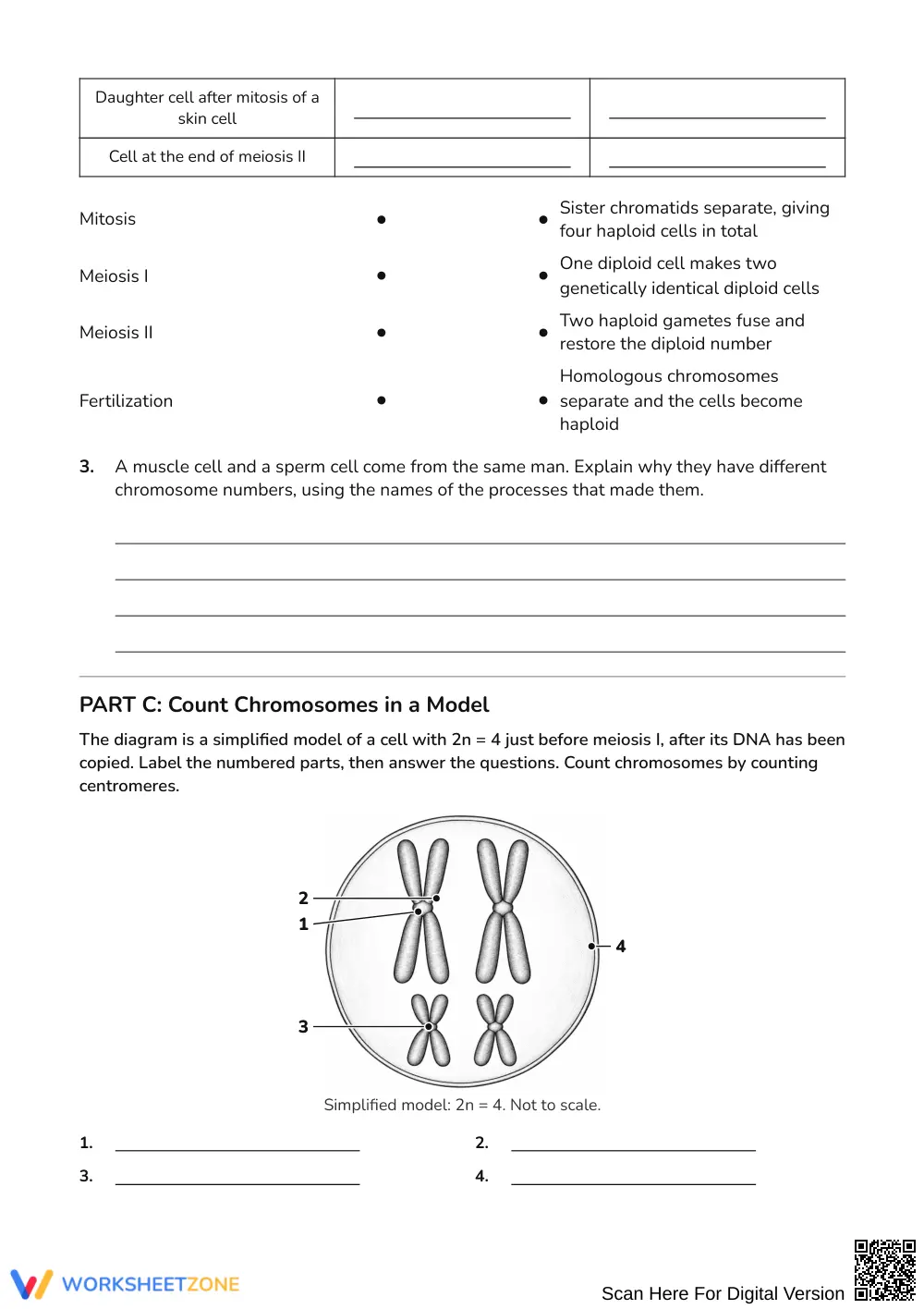
The four-page printable packet contains 46 organized exercises spanning comparative calculation tables, cell-sorting prompts, structural diagram labeling, and short-response relationship questions. A visual model of a replicated cell before meiosis I anchors chromosome and chromatid identification, supported by a 4-page complete teacher answer key containing full explanations.
Skill Progression
- Guided Practice (Part A): Students calculate ploidy values for diverse organisms using the formula n = 2n ÷ 2 and explore why gametic reduction prevents chromosome doubling across generations.
- Supported Practice (Parts B & C): Learners sort human cell types, match meiotic stages to division outcomes, and interpret a cell model to count chromosomes via centromeres rather than chromatid arms.
- Independent Practice (Part D): Students evaluate differences between mitosis and meiosis in a comparison table, correct common misconceptions regarding X-shaped chromosomes, and predict nondisjunction outcomes.
This sequence embodies the gradual release of responsibility model, guiding students from direct mathematical calculation to sophisticated cytological reasoning.
Standards Alignment
This resource aligns with secondary life science curriculum standards addressing cellular division, inheritance, and genetic variation. Students model how meiosis produces haploid gametes with one chromosome set and how fertilization restores diploid numbers in zygotes. Teachers can link these foundational tasks to district curriculum maps, cellular division pacing guides, or IEP learning targets.
How to Use It
Assign Parts A and B immediately after direct instruction on meiosis and mitosis to solidify vocabulary and computation during guided classwork. Use Parts C and D as a formative checkpoint or collaborative partner task on the following day. When reviewing Part C, watch for students who confuse chromatid arms with total chromosome numbers; check whether they count centromeres rather than individual arms. Expected completion time is 45 to 60 minutes.
Who It's For
This resource serves general high school biology students, introductory life science middle schoolers, and AP Biology learners requiring remediation in ploidy arithmetic. It pairs naturally with a hands-on karyotype activity, meiosis pipe-cleaner simulation, or chromosome structure anchor chart.
Calculating haploid and diploid numbers accurately requires students to coordinate algebraic division with concrete cytological models. Research from Fisher & Frey (2014) highlights that structured cognitive progressions—advancing from guided quantitative tables to diagram interpretation and error-analysis prompts—significantly strengthen conceptual retention in secondary science. Without intentional instruction on counting centromeres, secondary learners frequently confuse sister chromatids with distinct chromosomes during meiosis I and II. This 4-page worksheet isolates this specific hurdle by pairing calculation tables with explicit diagram labeling and nondisjunction prediction tasks. The included 46 items ensure students transition from basic formulaic recall to predictive genetic reasoning, equipping educators with actionable formative data to verify whether students truly comprehend how ploidy shifts across mitotic and meiotic life cycles.


