
































Complete Feedback Models Worksheet | Grade 10 Biology

Paste this activity's link or code into your existing LMS (Google Classroom, Canvas, Teams, Schoology, Moodle, etc.).
Students can open and work on the activity right away, with no student login required.
You'll still be able to track student progress and results from your teacher account.
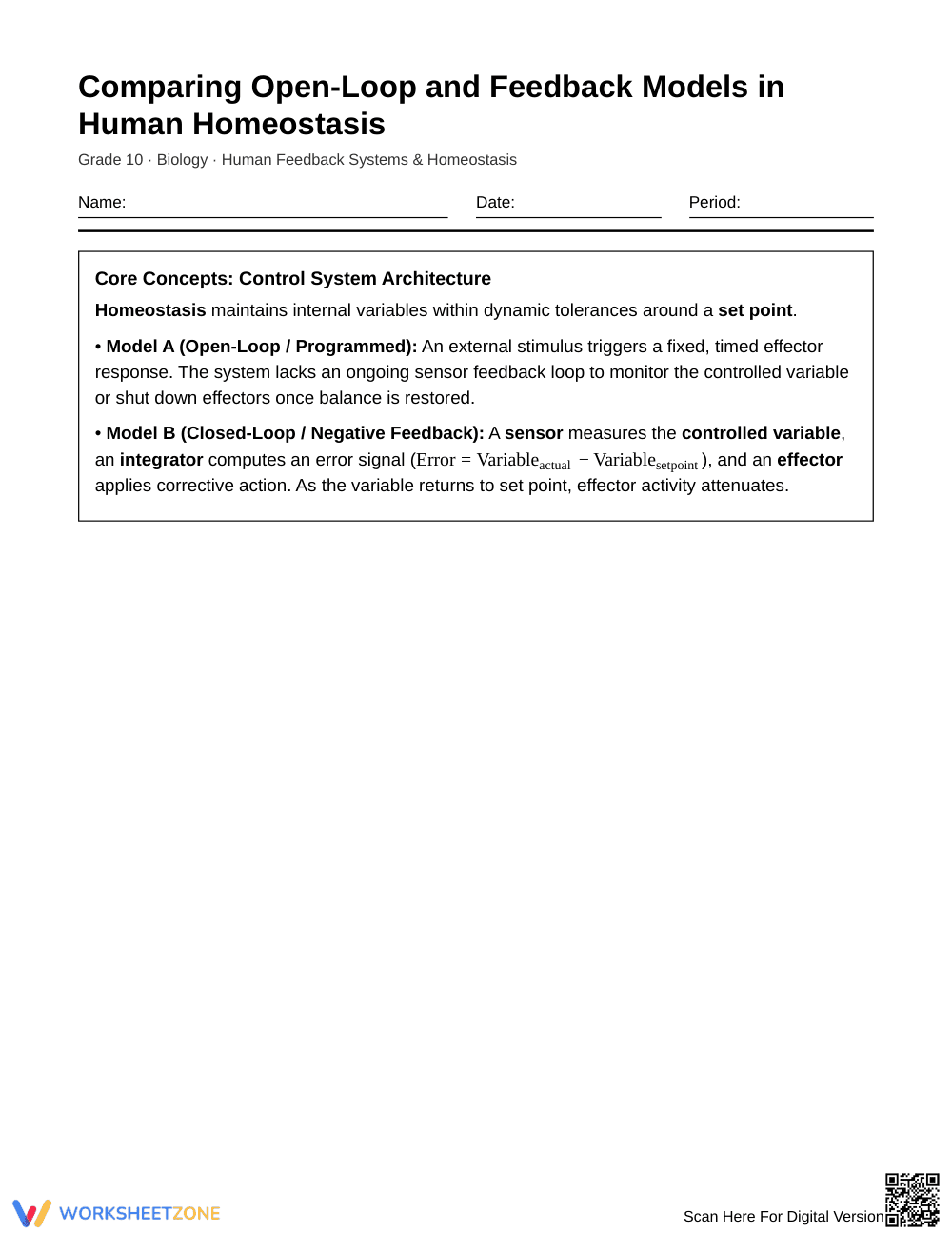
This high school biology worksheet trains students to distinguish closed-loop negative feedback systems from open-loop programmed reflexes in human physiology. Through 10 analytical problems, high school learners evaluate thermoregulation and glucose regulation, predict physiological trajectories under sustained thermal and chemical stress, and analyze empirical laboratory data to establish dynamic equilibrium mechanisms.
At a Glance
- Grade: 10 · Subject: Biology
- Standard: Homeostasis — Analyze biological control systems that maintain dynamic internal equilibrium through feedback mechanisms
- Skill Focus: Compare Open-Loop and Feedback Models
- Format: 5 pages · 10 problems · Answer key included · PDF
- Best For: Advanced physiology and homeostasis unit review
- Time: 45–60 minutes
What's Inside
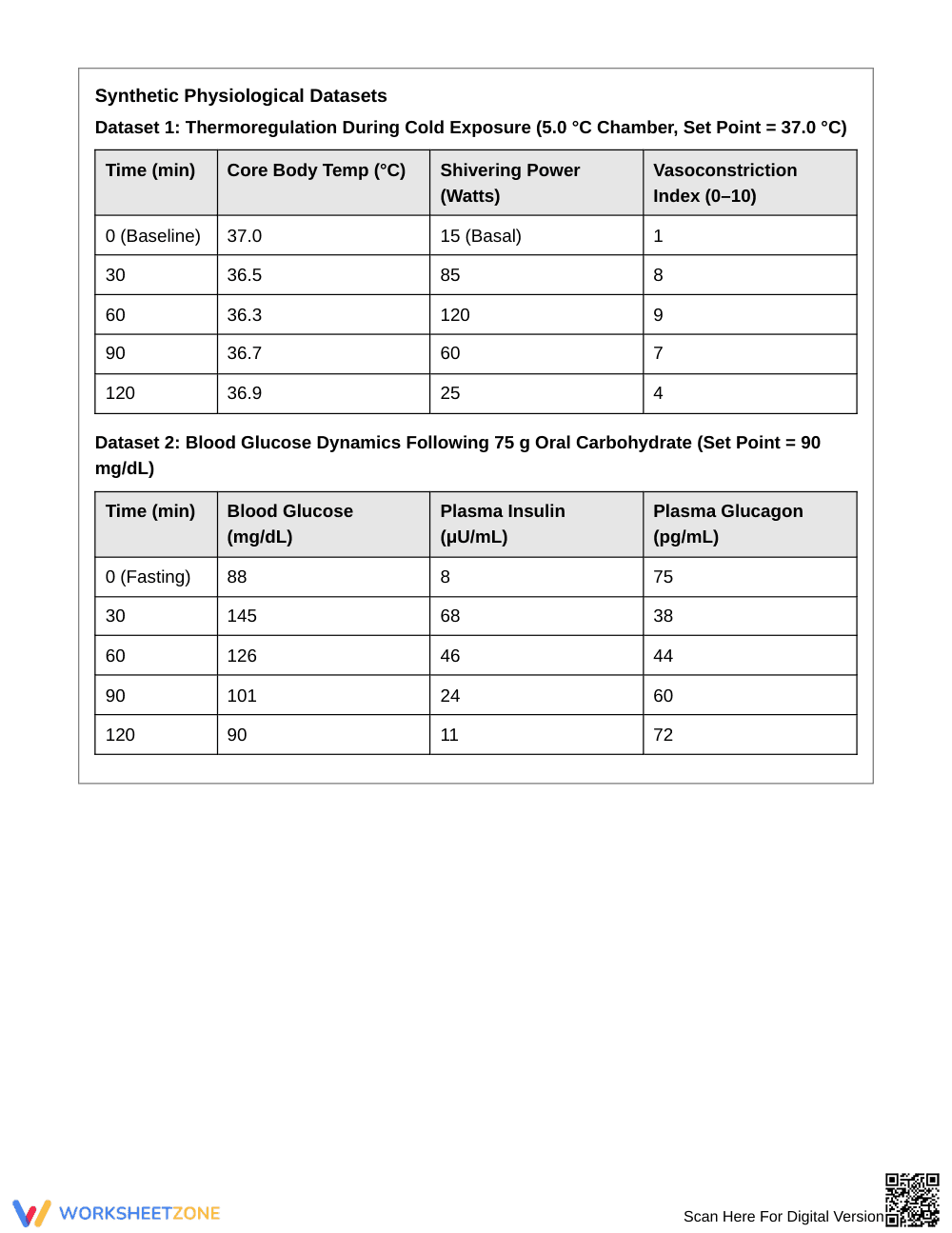
The 5-page worksheet features 10 rigorous tasks across four organized sections, including structural classification items, trajectory prediction scenarios, experimental control evaluations, and empirical data analysis. Students interpret two synthetic data tables covering hypothermic rewarming electromyography and islet perfusion dynamics, backed by a complete 2-page explanatory answer key with explicit physiological reasoning.
Skill Progression
- Guided practice (Tasks 1–4): Foundational architectural comparisons introduce core model definitions, categorizing hypothalamic sensors, effectors, error formulas, and experimental variables under explicit baseline conditions.
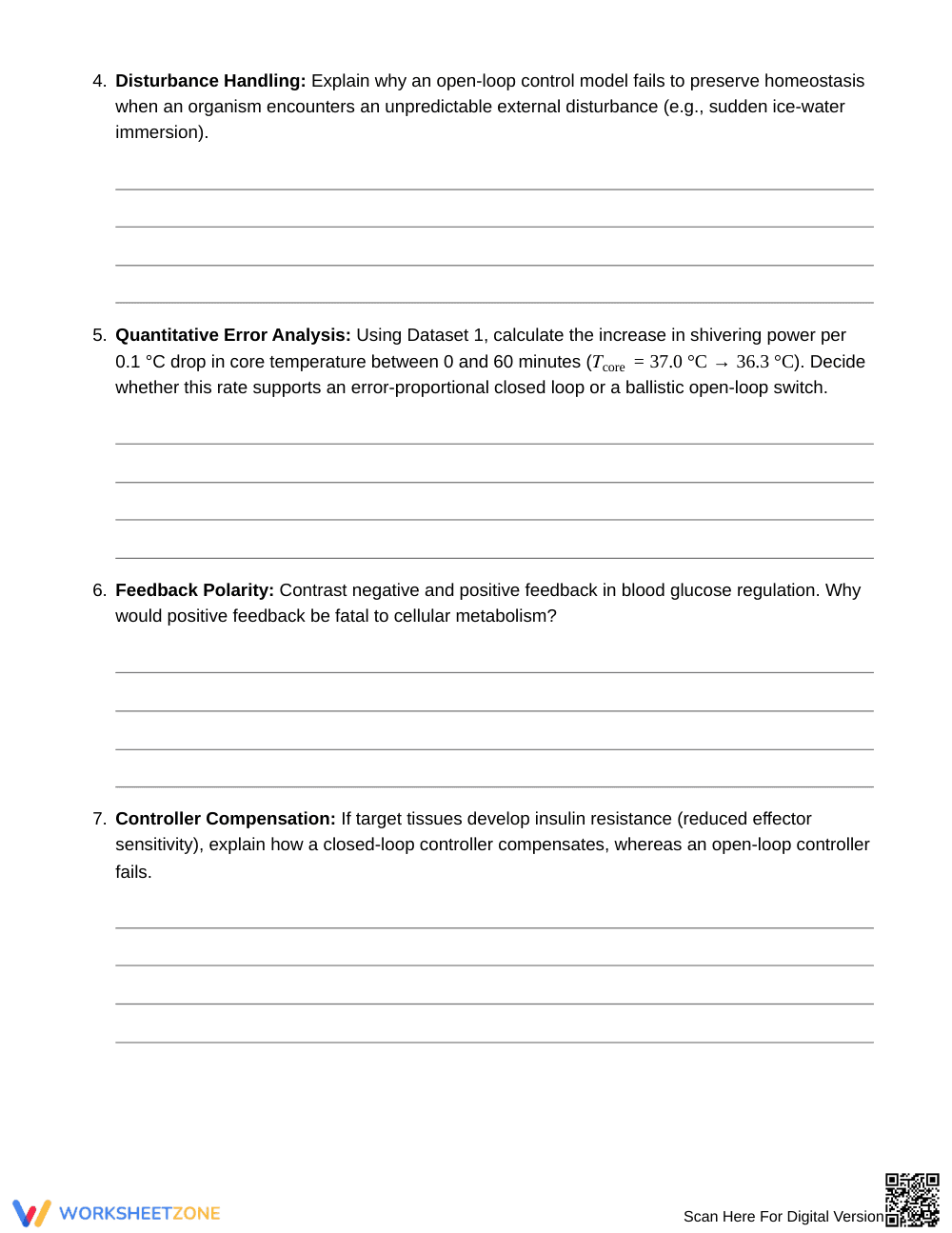
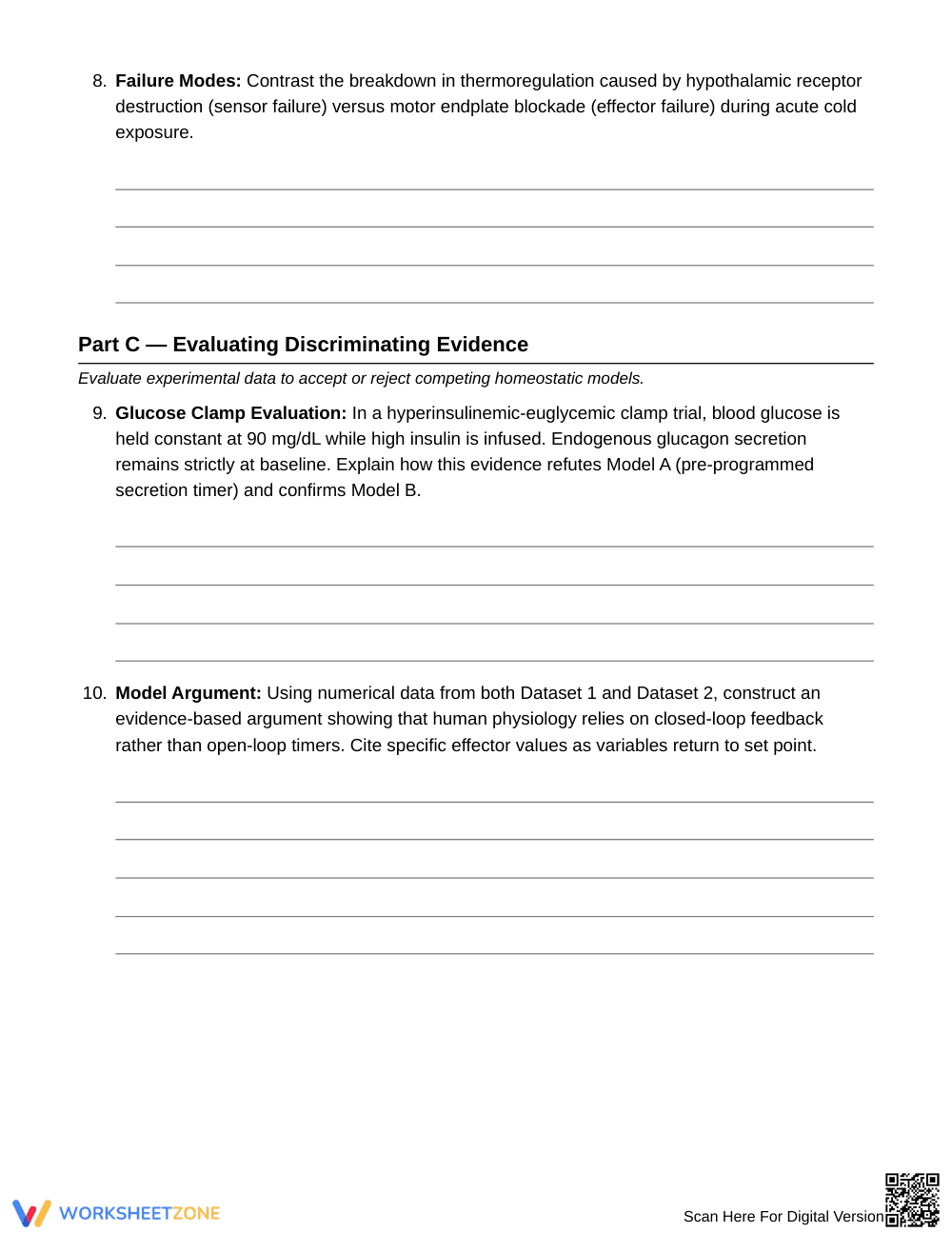
- Supported practice (Tasks 5–8): Intermediate prediction and experimental design items require students to forecast thermal and glucose curves while isolating negative controls during hyperglycemic clamps.
- Independent practice (Tasks 9–10): Unassisted data interpretation challenges learners to critique claims and calculate error signals from synthetic electromyogram and biphasic insulin secretion tables.
This structured progression reflects the gradual-release instructional model, moving learners from conceptual architectural definitions to independent quantitative analysis.
Standards Alignment
This resource aligns with high school life science standards governing feedback mechanisms and homeostasis. Students develop and use models to illustrate how negative feedback restores internal stability following environmental perturbations, while identifying the structural limits of non-regulated reflexes. Both standard codes can be copied directly into lesson plans, IEP goals, or district curriculum mapping tools.
How to Use It
Deploy this worksheet after direct instruction on human thermoregulation and endocrine signaling. During partner problem-solving, conduct a formative check on Task 3 by verifying whether students recognize that effector activity diminishes as the error signal approaches zero in Model A. Allocate 45 to 60 minutes for full completion and collaborative peer review.
Who It's For
This activity serves Grade 10 general biology and honors life science students studying homeostatic regulation. Built-in mathematical formulas and defined baseline parameters support striving learners, while the multi-step synthetic islet perfusion prompt challenges advanced students. Pair this activity with an interactive thermoregulation simulation or an endocrine feedback loop anchor chart.
Instructional research from Fisher & Frey (2014) emphasizes that deep conceptual mastery in secondary science demands guided scaffolding that bridges foundational definitions with complex graphical and quantitative synthesis. This Grade 10 physiology worksheet puts this framework into action as students compare open-loop and feedback physiological models across multiple human organ systems. Rather than treating homeostasis as passive equilibrium, the structured problem progression prompts learners to track error signal variables, forecast response trajectories during sustained environmental cold exposure, and evaluate empirical biphasic insulin curves from isolated murine islets. By contrasting fixed open-loop triggers with dynamic closed-loop error correction, students build durable mental schema regarding internal regulation. The structured sequence of classification, experimental evaluation, and empirical data analysis ensures that secondary learners transition from basic recall to authentic scientific evaluation, demonstrating how physiological effectors maintain human equilibrium under challenging homeostatic conditions.


