

































Complete Fair Rate Comparison Worksheet | Grade 6 Math

Paste this activity's link or code into your existing LMS (Google Classroom, Canvas, Teams, Schoology, Moodle, etc.).
Students can open and work on the activity right away, with no student login required.
You'll still be able to track student progress and results from your teacher account.
This Grade 6 math worksheet guides students to critically evaluate rate claims and justify mathematically sound comparisons. Learners calculate unit rates across eight real-world scenarios, determining whether advertised deals and speed claims represent fair reasoning. By moving beyond simple calculations to explain mathematical validity, students build strong conceptual understanding of rates and unit pricing.
At a Glance
- Grade: 6 · Subject: Math
- Standard:
6.RP.A.3— Use ratio and rate reasoning to solve real-world and mathematical problems- Skill Focus: Justify a Fair Rate Comparison
- Format: 5 pages · 8 multi-step problems · Full 5-page answer key included · Printable PDF
- Best For: Proportional reasoning, claim testing, and rate justification practice
- Time: 40–50 minutes
What's Inside
This 5-page worksheet delivers eight multi-step rate justification tasks paired with a comprehensive 5-page answer key. Students reference core definitions for rate, unit rate, and fair comparison before analyzing rates presented in data tables. Tasks require computing unit prices, critiquing flawed comparison methods, and generating mathematical counterexamples.
Skill Progression
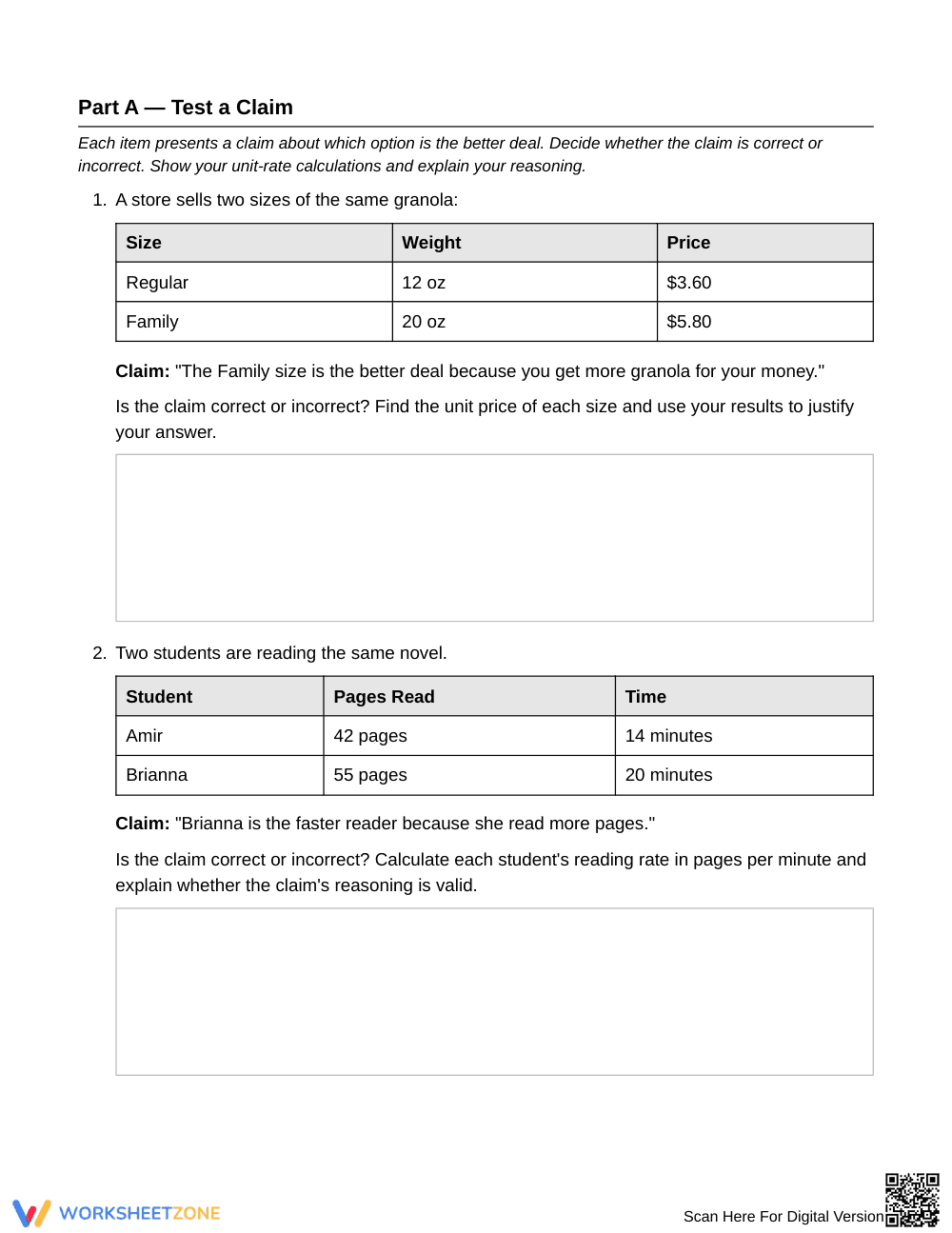
- Guided practice (Part A, Problems 1–2): Students test claims about granola costs and reading speeds using structured data tables and definitions.
- Supported practice (Part B, Problems 3–6): Learners evaluate whether subtraction, reciprocal rates, or unit pricing yield valid comparisons across four varied contexts.
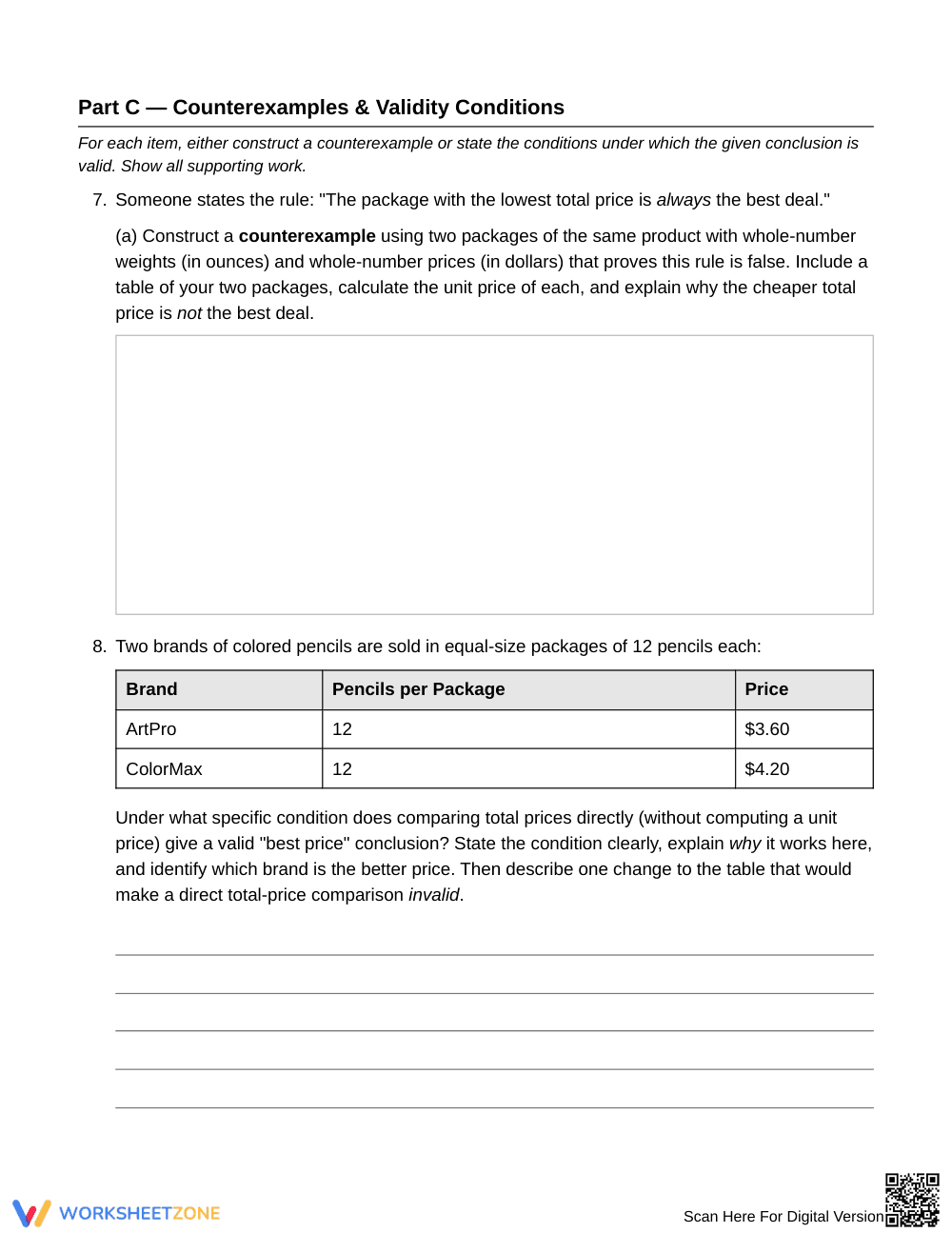
- Independent practice (Part C, Problems 7–8): Students independently construct a counterexample and formulate validity conditions for comparing total package prices.
This sequence follows the gradual-release framework, guiding students from supported claim evaluations to autonomous mathematical argumentation.
Standards Alignment
This resource aligns with `6.RP.A.3` by prompting students to solve real-world problems using unit rate reasoning. It also supports `6.RP.A.2` as students compute unit rates and apply rate language to evaluate comparisons. Both standard codes can be copied directly into lesson plans, IEP goals, or district curriculum mapping tools.
How to Use It
Assign this worksheet after direct instruction on unit rates. For partner work, have students discuss Part B to analyze why subtraction fails as a comparison method, observing whether learners confuse total costs with rate values. For independent practice, assign Part C as an extension task. Completion takes 40 to 50 minutes.
Who It's For
This worksheet is ideal for Grade 6 math classrooms building proportional reasoning, as well as Grade 7 intervention groups. The structured tables and definition box assist striving learners, while the counterexample tasks challenge advanced students. Pair this activity with an anchor chart comparing unit rates to reinforce visual representations.
Mastering standard 6.RP.A.3 requires students to apply ratio and rate reasoning to solve real-world problems while developing critical mathematical discourse. This five-page educational worksheet provides eight structured tasks that prompt learners to justify fair rate comparisons through claim analysis, method evaluation, and numerical counterexamples. Grounded in the gradual-release instructional model documented by Fisher & Frey (2014), the resource scaffolds student autonomy from basic claim verification to independent formulation of mathematical validity conditions. Rather than relying on rote computation, middle school learners examine underlying quantitative relationships, identify common misconceptions like improper subtraction, and articulate why equal unit measurements are necessary for equitable decision-making. By pairing concrete grocery and speed data with rigorous written explanations, this resource equips educators with high-leverage practice that bridges procedural fluency and conceptual justification. The complete five-page answer key provides clear exemplar explanations, supporting standards-based grading, targeted intervention, and IEP progress monitoring.


