




























Complete Fact Elaboration Worksheet | Grade 7 ELA
Paste this activity's link or code into your existing LMS (Google Classroom, Canvas, Teams, Schoology, Moodle, etc.).
Students can open and work on the activity right away, with no student login required.
You'll still be able to track student progress and results from your teacher account.
This Grade 7 informative writing worksheet guides students to develop broad facts using concrete details, technical evidence, and explanatory transitions. Centered on school podcast production, the resource helps middle school writers move from analyzing professional models to drafting and revising fully elaborated informational paragraphs.
At a Glance
- Grade: 7 · Subject: ELA
- Standard:
W.7.2.b— Develop informative topics with relevant facts, concrete details, quotations, and examples- Skill Focus: Develop a Fact with a Relevant Example
- Format: 5 pages · 8 problems · Answer key included · PDF
- Best For: Informational elaboration practice and paragraph drafting
- Time: 45–60 minutes
What's Inside
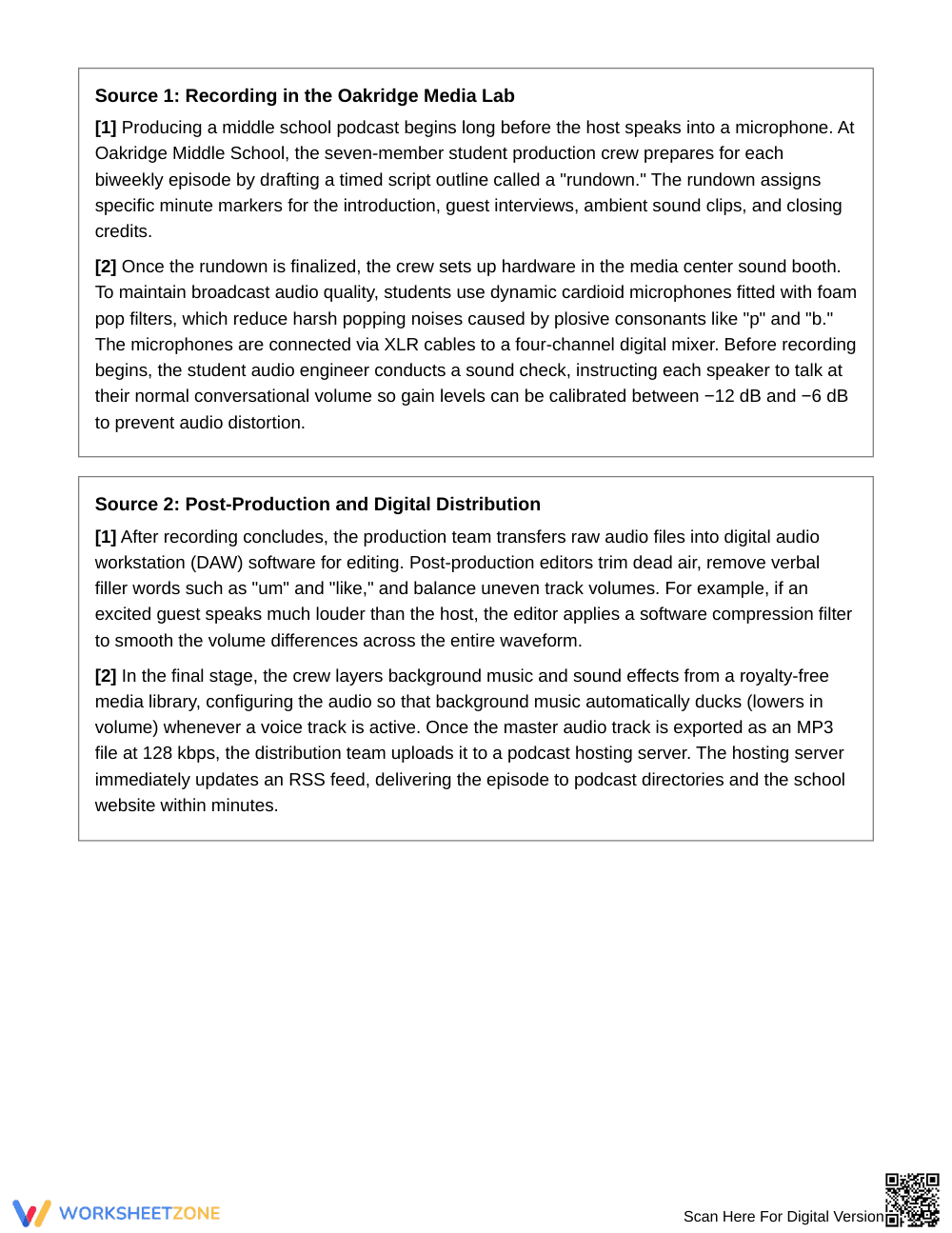
This 5-page printable packet features two informational texts detailing audio recording and digital editing. Students examine an explicit strategy anchor defining base facts, concrete examples, and explanatory bridges. The 8 tasks include model analysis, evidence-matching graphic organizers, guided sentence composition, an extended briefing draft, and targeted revision, supported by a 4-page answer key.
Skill Progression
- Guided practice (Items 1–2): Students analyze exemplar text excerpts to identify base facts and evaluate how concrete details clarify abstract concepts.
- Supported practice (Items 3–6): Writers pair equipment specifications into an organizer and write bridge sentences using targeted transitions like specifically.
- Independent practice (Items 7–8): Students draft an original two-paragraph informative briefing synthesizing both passages and complete a focused self-revision.
This sequence implements gradual release, moving writers from identifying elaboration to independently integrating functional evidence.
Standards Alignment
This worksheet aligns directly to W.7.2.b: "Develop the topic with relevant facts, definitions, concrete details, quotations, or other information and examples." It also reinforces RI.7.1 by requiring text-grounded evidence. Both standard codes can be copied directly into lesson plans, IEP goals, or district curriculum mapping tools.
How to Use It
Introduce the model move during direct instruction before students complete Parts A and B in pairs. For formative assessment, check Item 4 to ensure students explain functional connections rather than merely copying measurements. Assign Part C as an independent post-lesson assessment. The full sequence takes 45 to 60 minutes across one or two class periods.
Who It's For
This resource supports seventh-grade ELA students refining informative writing, including writers who struggle to expand short claims. Built-in graphic scaffolds benefit multilingual learners. Pair this activity with an informative transition anchor chart or an evidence-integration mini-lesson.
Grounded in the gradual release of responsibility framework synthesized by Fisher & Frey (2014), this Grade 7 informative writing resource builds student mastery of standard W.7.2.b by systematically teaching writers to develop a fact with a relevant example. Middle school writers frequently struggle to bridge technical data with explanatory prose, often listing isolated facts without showing how tools or processes operate. By coupling authentic audio production source texts with explicit sentence frames, matching charts, and guided drafting tasks, this 5-page worksheet scaffolds the transition from cognitive noticing to independent composition. Fisher & Frey (2014) demonstrate that structured scaffolding combining teacher modeling, collaborative practice, and independent application significantly accelerates writing fluency and analytical precision in secondary English language arts classrooms. Students acquire repeatable strategies for turning raw facts into cohesive, highly developed informational paragraphs across diverse academic content areas.


