





























Complete Explain a Process Clearly Worksheet | Grade 6 ELA
Paste this activity's link or code into your existing LMS (Google Classroom, Canvas, Teams, Schoology, Moodle, etc.).
Students can open and work on the activity right away, with no student login required.
You'll still be able to track student progress and results from your teacher account.
This Grade 6 explanatory writing worksheet guides students to explain a multi-step process clearly and logically. Using an informational text on library procedures, learners filter essential steps from background details, sequence actions with varied transitions, and draft a 160-word procedural explanation that novice readers can follow effortlessly.
At a Glance
- Grade: 6 · Subject: ELA
- Standard:
W.6.2.c— Use appropriate transitions to clarify the relationships among steps in a process- Skill Focus: Explain a Process Clearly
- Format: 5 student pages · 8 structured problems · Complete teacher answer key included · PDF document
- Best For: Direct instruction, guided explanatory writing, and transition practice
- Time: 40–50 minutes
What's Inside
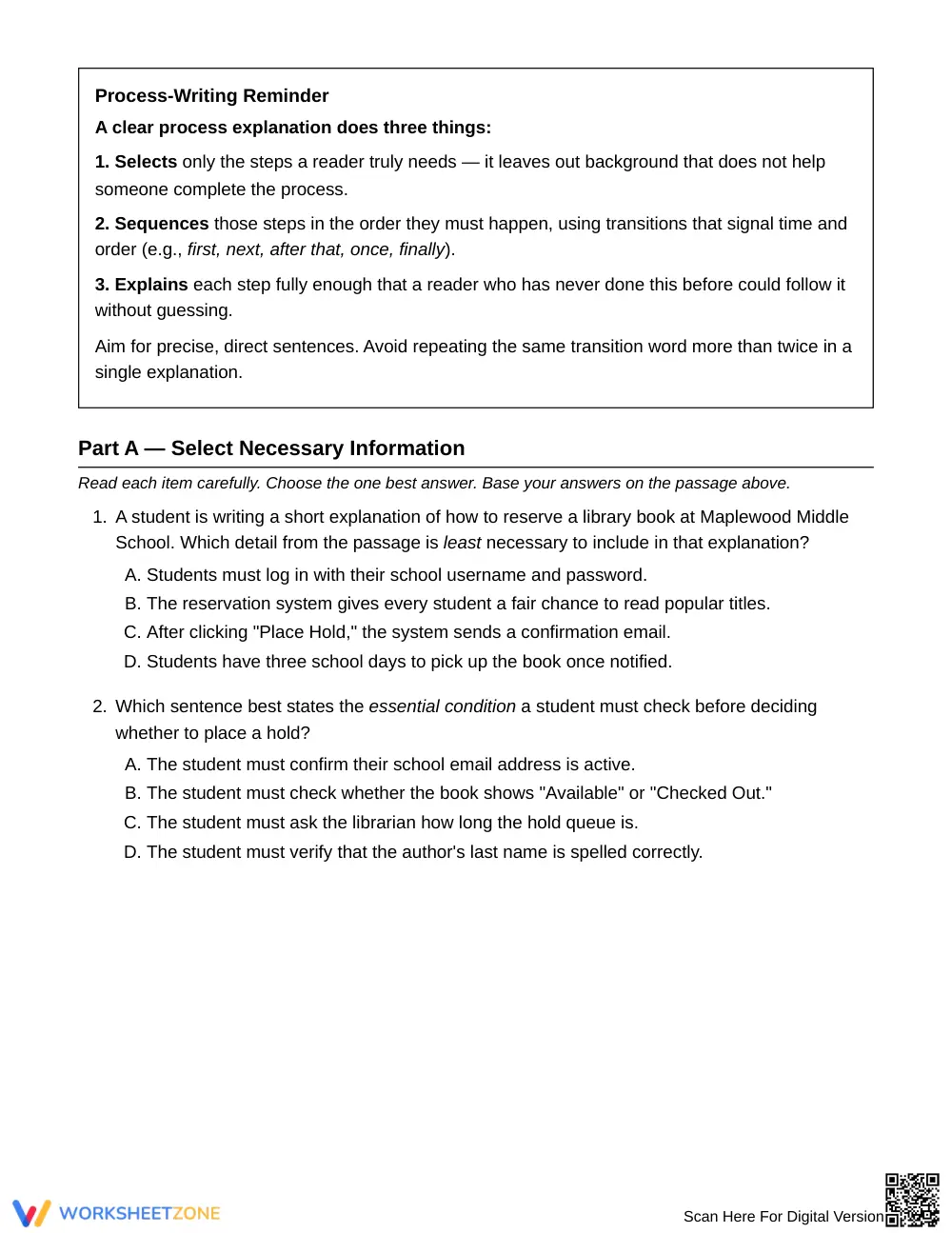
This 5-page resource includes an informational anchor text on middle school library book holds alongside a "Process-Writing Reminder" scaffold defining step selection, logical order, and transition variety. Across 8 problems, students evaluate detail relevance, sequence events, rewrite repetitive transitions, and draft a 160-word procedural passage. A 6-page answer key provides complete model responses.
Skill Progression
- Guided practice (Tasks 1–2): Students examine the anchor text to identify essential procedural steps and eliminate nonessential background.
- Supported practice (Tasks 3–6): Learners sequence four action stages, rewrite repetitive transitional phrases, justify information exclusion, and correct order errors.
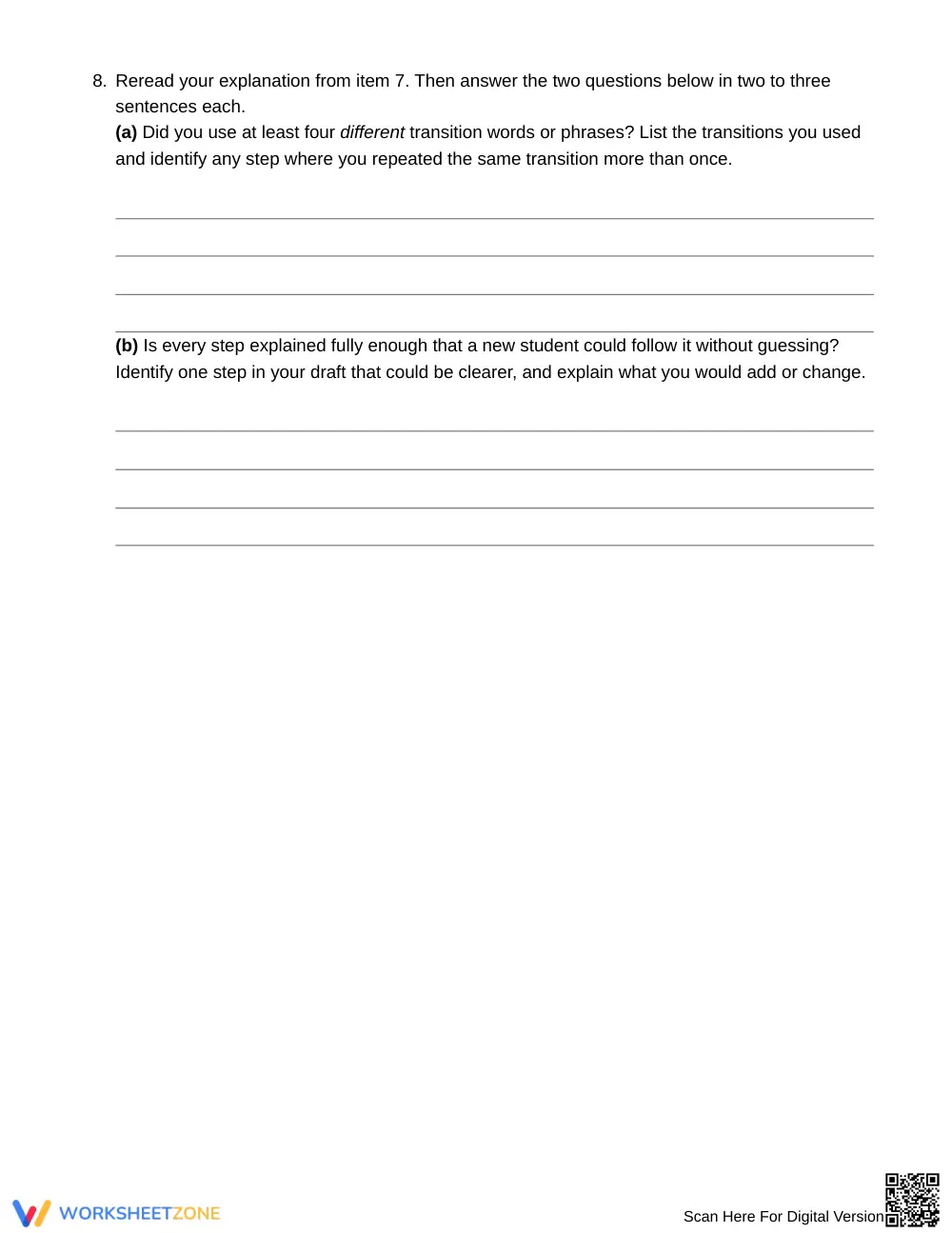
- Independent practice (Tasks 7–8): Students write an original 160-word procedural text using varied transitions, then complete a self-audit on clarity.
This sequence applies the gradual-release framework (I Do, We Do, You Do) to build procedural coherence.
Standards Alignment
This worksheet aligns with primary standard `W.6.2.c`: "Use appropriate transitions to clarify the relationships among ideas and concepts." Students use varied transitions to connect sequential stages logically. It also supports `W.6.2.b` through relevant concrete details. Both standard codes can be copied directly into lesson plans, IEP goals, or district curriculum mapping tools.
How to Use It
Use this worksheet during direct instruction on explanatory transitions or as follow-up practice. In a guided setting, complete Parts A and B together to address repetitive transitions before students write independently in Part C. For formative assessment, inspect Task 4 rewrites to confirm transition variety before drafting begins. Completion takes 40 to 50 minutes.
Who It's For
This resource is designed for Grade 6 ELA students, developing writers needing structured scaffolds, and English language learners benefiting from the reminder box. Pair this practice with a transition word anchor chart or an informative mentor text lesson.
Developing competence in standard W.6.2.c requires middle school writers to move beyond simple chronological listing toward purposeful signaling of relationships between ideas. When students explain a process clearly, they must coordinate domain-specific vocabulary, filter nonessential details, and employ diverse transitions to guide unfamiliar readers through multi-step tasks. According to Fisher & Frey (2014), explicit instruction in structural scaffolds combined with gradual release shifts cognitive responsibility from teacher modeling to independent execution, significantly boosting student writing stamina and coherence. By isolating stages in an authentic informational passage and requiring students to revise redundant temporal markers, this five-page instructional sequence directly operationalizes evidence-based literacy practices. Students who routinely practice identifying procedural prerequisites and evaluating their own transition variety demonstrate stronger organization and syntactic maturity on statewide informative writing assessments. This resource equips Grade 6 educators with an effective, standards-aligned framework that reinforces sequential logic and student self-regulation during drafting.


