




























Complete Energy Transfer Worksheet | Grades 6–12 Science
Paste this activity's link or code into your existing LMS (Google Classroom, Canvas, Teams, Schoology, Moodle, etc.).
Students can open and work on the activity right away, with no student login required.
You'll still be able to track student progress and results from your teacher account.
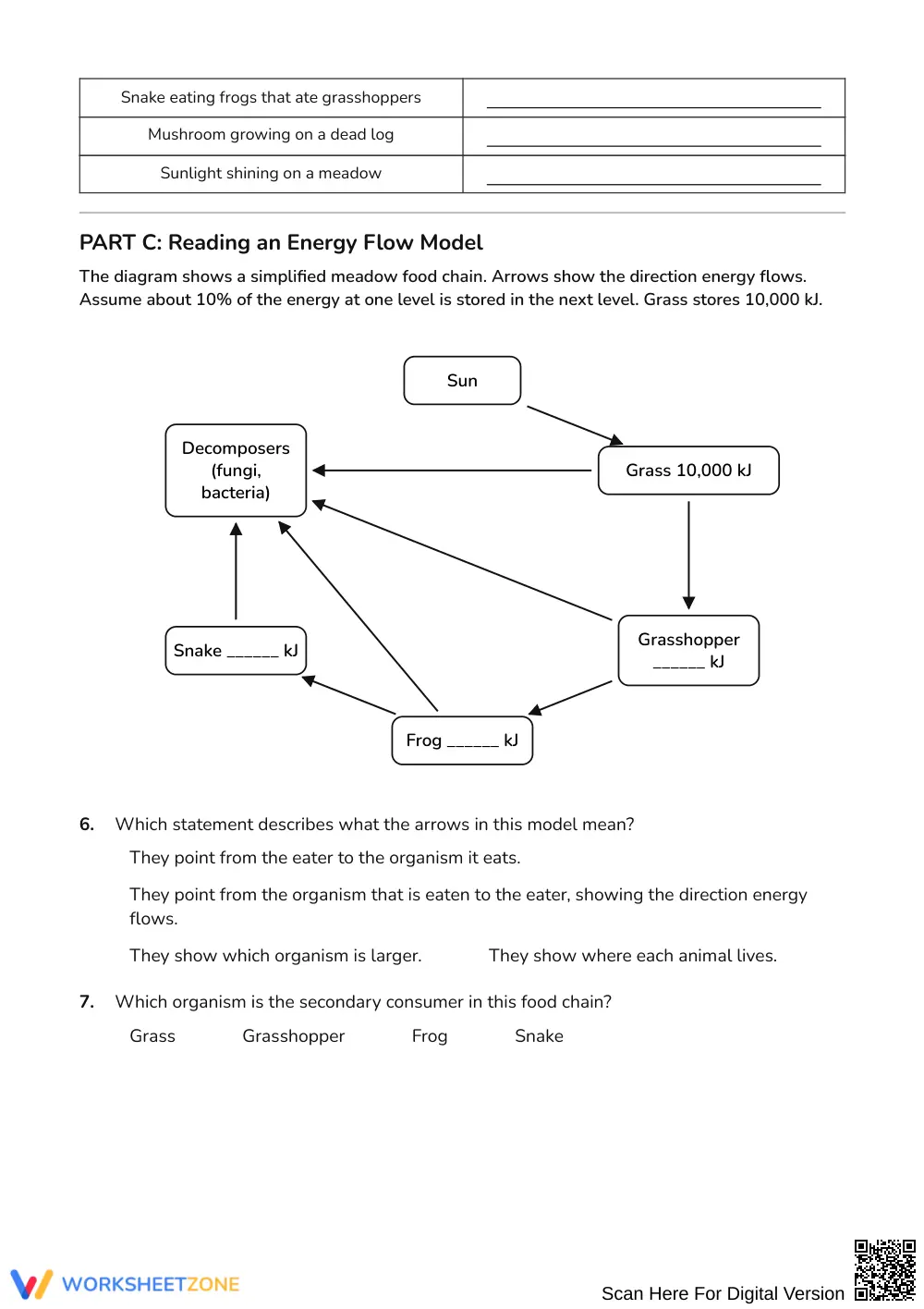
This comprehensive energy transfer worksheet equips secondary students to master foundational ecology concepts, from identifying trophic levels to calculating energy loss using the 10% rule. Through focused practice, learners define critical biological terms, analyze a structured food chain model, and dismantle persistent misconceptions about energy conservation versus matter cycling in living ecosystems.
At a Glance
- Grade: Grades 6–12 · Subject: Science
- Standard: Focus — Trace the flow of energy and cycling of matter through trophic levels
- Skill Focus: Energy transfer vocabulary, trophic levels, and 10% rule
- Format: 4 pages · 33 problems · Answer key included · PDF
- Best For: Ecology unit introduction or review
- Time: 45–60 minutes
What's Inside
This 4-page printable resource features 33 organized tasks spanning five sequential sections: vocabulary matching with fill-in-the-blank sentences, an example and non-example classification table, model analysis of meadow food chains, quantitative data interpretation using the 10% rule, and an evidence-based misconception evaluation. A complete 4-page answer key provides full explanations and sample written responses.
Skill Progression
- Guided Practice (Part A): Students match definitions and complete cloze sentences for 6 core vocabulary terms using a targeted word bank, establishing foundational literacy.
- Supported Practice (Parts B & C): Learners categorize 6 ecological examples and analyze a meadow food chain model across 3 structured analysis questions, tracing energy flow from primary producers to decomposers.
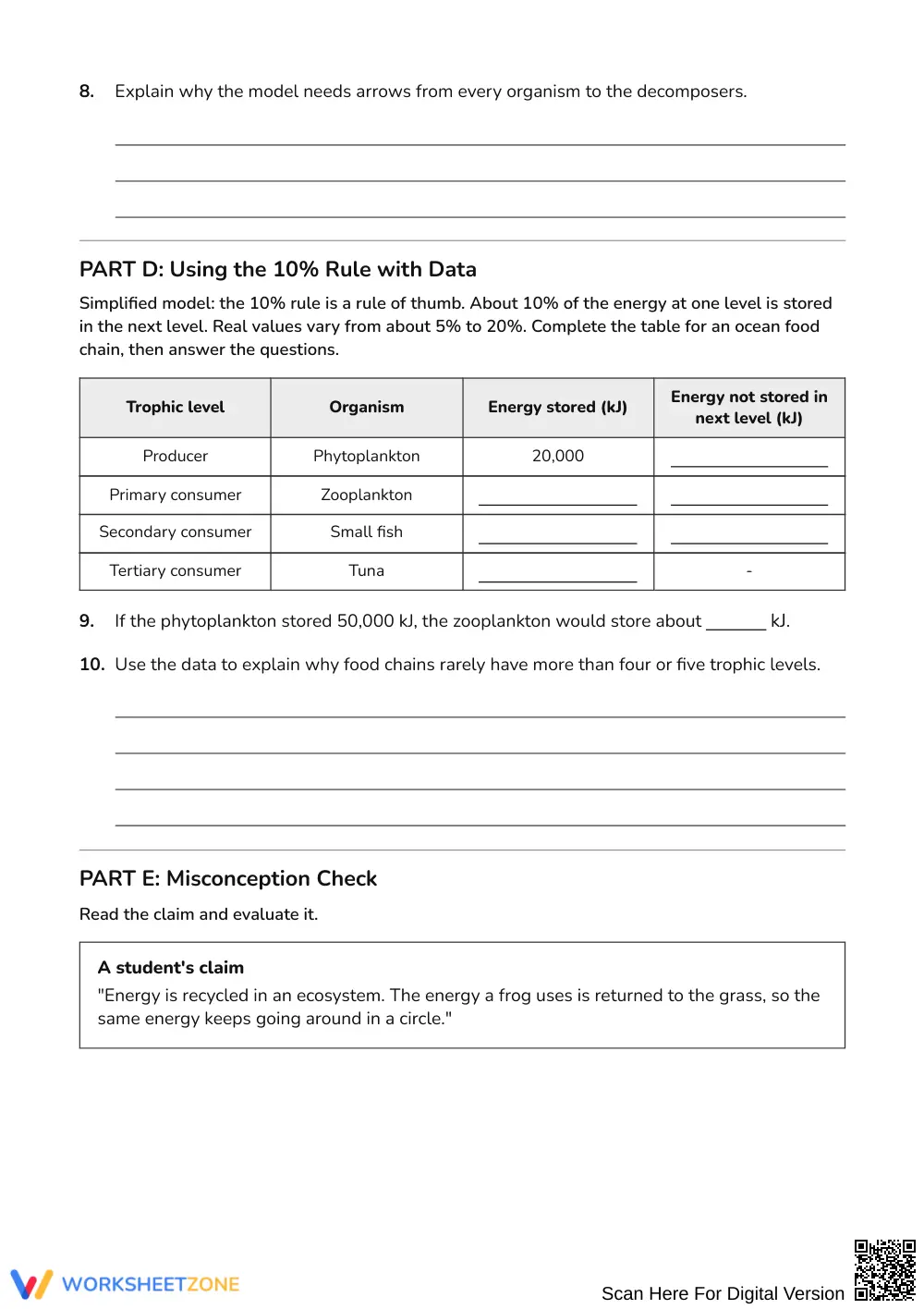
- Independent Practice (Parts D & E): Students calculate energy values across 4 trophic levels in an ocean data table and evaluate a written student claim regarding energy recycling with written evidence.
This structured progression follows an explicit gradual-release model, shifting students smoothly from direct recall to rigorous conceptual analysis.
Standards Alignment
This resource aligns with middle and high school life science standards that require students to develop models showing the flow of energy among living components of an ecosystem. The activities reinforce the directional transfer of light energy into chemical energy and thermal loss, distinguishing it from nutrient cycles. This alignment can be copied directly into lesson plans, IEP goals, or district curriculum mapping tools.
How to Use It
Deploy this worksheet after direct instruction on ecosystem dynamics to reinforce key distinctions between producers, consumers, and decomposers. Alternatively, assign Part A and Part B as an introductory check of prior knowledge before presenting the 10% ecological rule. While students analyze the quantitative table in Part D, check their work for students who multiply rather than divide by 10% when moving up trophic levels. Most students will complete the full set in 45 to 60 minutes.
Who It's For
Designed for general science, life science, and introductory biology classes across grades 6 through 12, this resource includes clear scaffolding for English learners and students receiving intervention services. Pair this worksheet directly with a food web diagram or interactive ecosystem simulation to deepen conceptual connections.
Ecology curricula require students to trace chemical energy flows and analyze thermodynamic constraints within ecosystems. According to Fisher & Frey (2014), systematic vocabulary acquisition paired with scaffolded model analysis significantly improves student retention of complex scientific concepts. This 4-page worksheet guides learners through 33 targeted tasks that build foundational mastery of trophic interactions, biomass, and caloric efficiency across food chains. By comparing mathematical calculations with open-ended diagnostic prompts, the resource addresses the prevalent misconception that energy cycles indefinitely like matter. Instead, students examine concrete data demonstrating that roughly 90% of available energy radiates into the environment as metabolic heat at every feeding level. Complete with a 4-page answer key, this resource provides an adaptable, classroom-ready solution for rigorous secondary life science instruction.


