



























Complete Energy Transfer Worksheet | Grade 6-12 Science
Paste this activity's link or code into your existing LMS (Google Classroom, Canvas, Teams, Schoology, Moodle, etc.).
Students can open and work on the activity right away, with no student login required.
You'll still be able to track student progress and results from your teacher account.
This comprehensive science worksheet guides students through 26 targeted tasks to classify ecosystem roles and evaluate the thermodynamics of energy transfer. Learners identify producers, consumers, and decomposers across trophic levels, calculate 10% energy losses using real data, and articulate how energy constraints govern community population structures across aquatic and terrestrial habitats.
At a Glance
- Grade: Grades 6–12 · Subject: Science
- Standard: Ecosystem Energy Flow — Trace matter and energy flow across trophic levels in ecosystems
- Skill Focus: Sort, classify, and explain energy transfer processes and trophic relationships
- Format: 4 pages · 26 problems · Answer key included · PDF
- Best For: Biology review, classwork, or assessment practice
- Time: 40–55 minutes
What's Inside: This 4-page student activity contains 26 structured questions organized into three distinct investigation parts. Students complete matching and classification tables for grassland food chains, execute multistep energy calculations using the 10% ecological efficiency rule, and analyze quantitative lake ecosystem data. A complete 4-page teacher answer key provides full calculation solutions and exemplary short-answer scientific explanations.
Skill Progression
- Guided practice (Part A — 10 tasks): Students classify organism roles from an informational passage into structured reference tables with explicit process definitions.
- Supported practice (Part B — 8 tasks): Learners apply the 10% energy efficiency rule across trophic levels using guided mathematical prompts and diagrams.
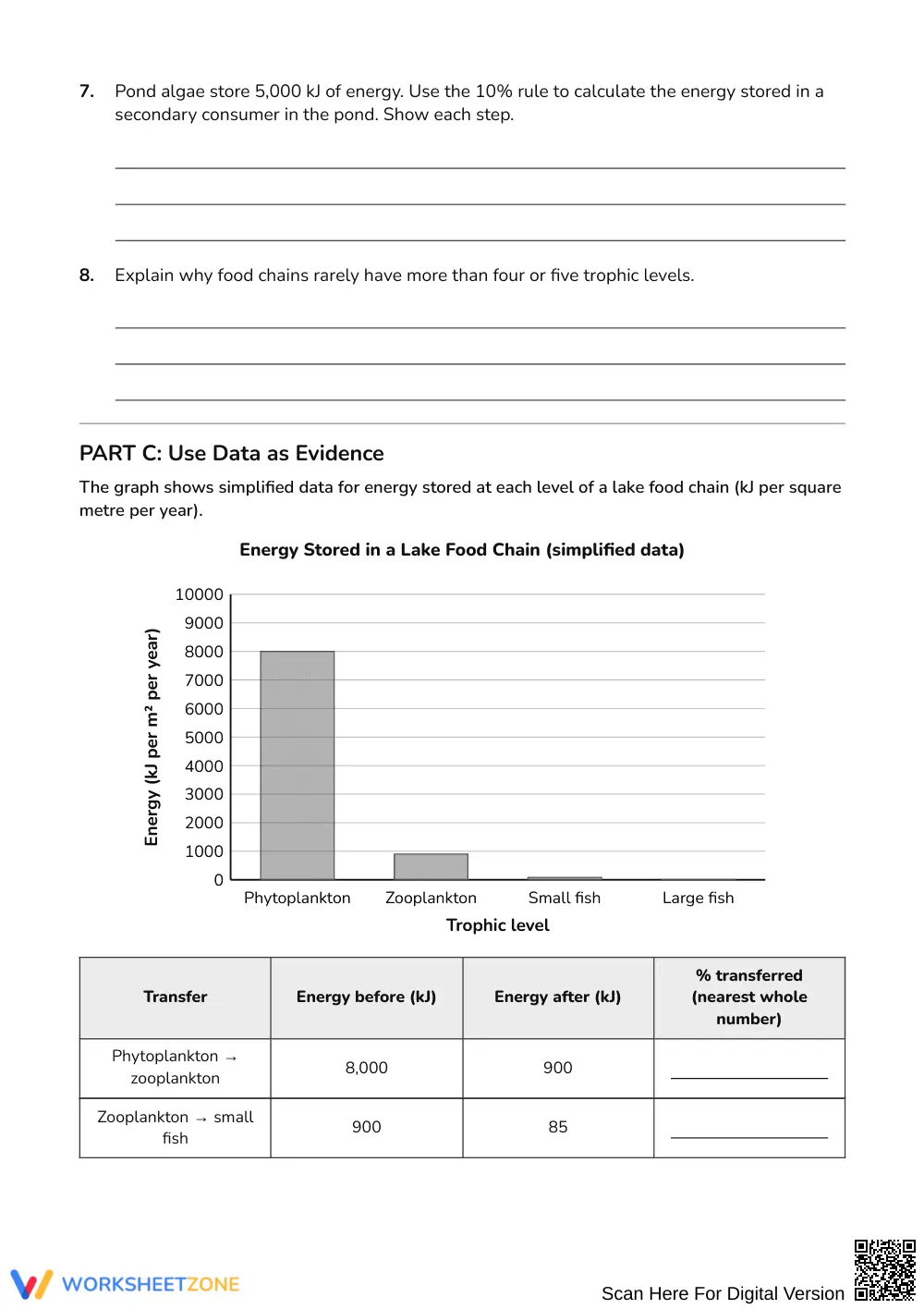
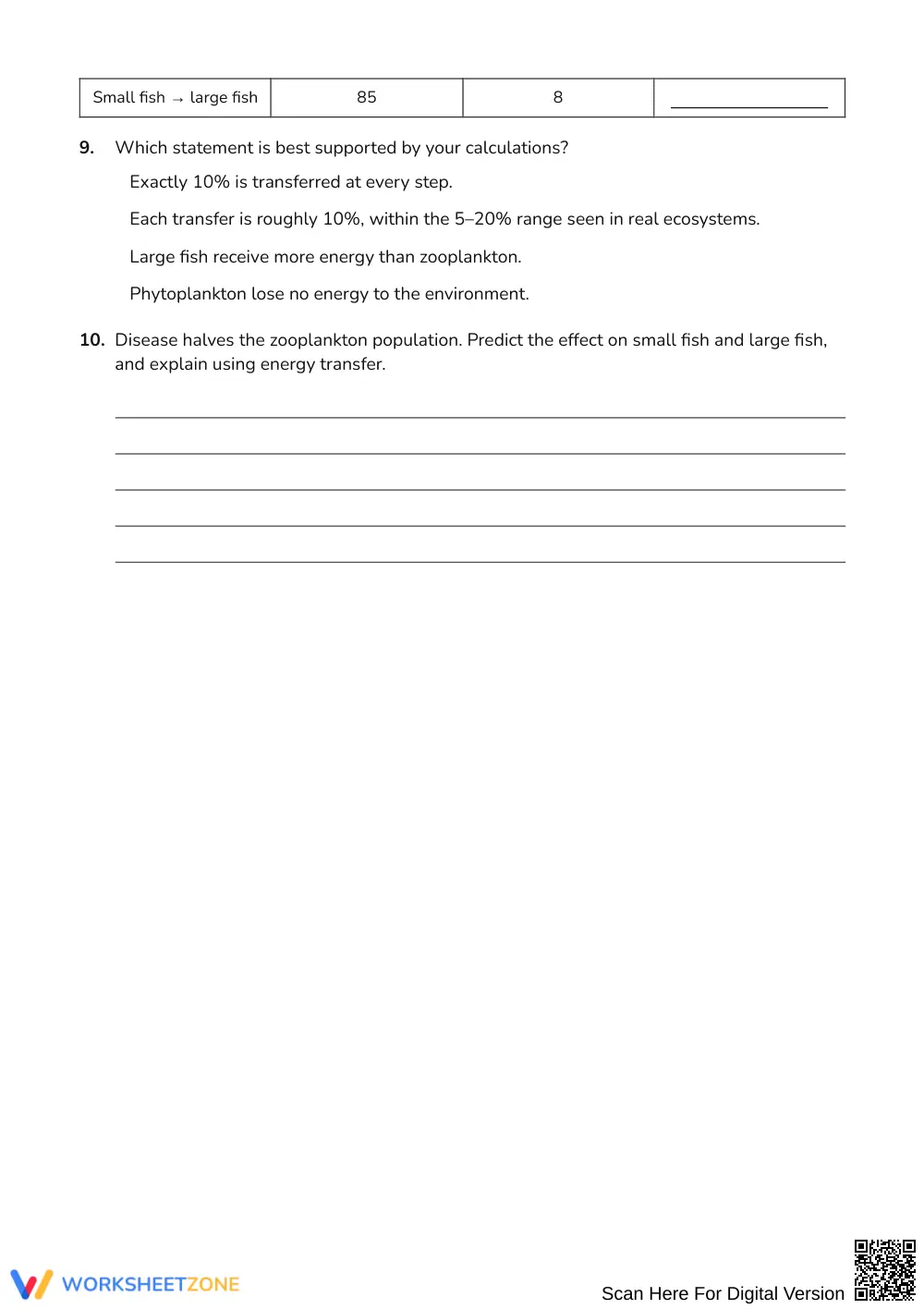
- Independent practice (Part C — 8 tasks): Students evaluate empirical lake ecosystem data sets independently, calculate transfer percentages, and predict ecological disruption impacts.
This sequence embodies gradual-release instruction (I Do, We Do, You Do), establishing foundational scientific vocabulary before asking students to solve quantitative problems and justify ecosystem claims.
Standards Alignment
This worksheet addresses secondary life science expectations for matter and energy transfer in ecosystems, where students construct explanations for how energy cascades through food webs. The supporting expectations reinforce quantitative reasoning in data evaluation and predicting organism population shifts. Both standard codes can be copied directly into lesson plans, IEP goals, or district curriculum mapping tools.
How to Use It
Deploy this worksheet after direct instruction on food chains and ecological efficiency. For formative assessment, examine student responses to Part B's open-ended prompt regarding 90% energy loss to identify whether learners correctly attribute dissipating energy to cellular respiration and thermal release rather than disappearance. The complete 4-page activity takes approximately 40 to 55 minutes to finish.
Who It's For
Designed for middle and high school general science, biology, and environmental science students. English learners and developing readers benefit from the explicit process definitions in Part A, while advanced learners engage deeply with Part C's proportional calculations. Pair this resource with an introductory anchor chart illustrating ecological energy pyramids.
Ecological literacy requires middle and secondary students to conceptualize energy flow not as a static diagram but as a dynamic thermodynamic process. According to Fisher & Frey (2014), structured skill progression that moves from concrete organism classification to quantitative data analysis provides the precise instructional scaffolding adolescents need to master complex biological systems. When students classify producers, consumers, and decomposers before calculating the 10% rule in food chains, they build conceptual pathways connecting cellular biology to ecosystem-level population dynamics. Analyzing quantitative energy transfer data enables learners to understand why thermodynamic inefficiency limits trophic pyramid height to four or five tiers. Grounded in systematic instructional design, this 4-page worksheet equips students with the empirical reasoning skills required to predict community population shifts following ecological disruption while reinforcing core scientific principles through structured analytical practice.


