































Complete Energy Scenarios Worksheet | Grade 12 Science

Paste this activity's link or code into your existing LMS (Google Classroom, Canvas, Teams, Schoology, Moodle, etc.).
Students can open and work on the activity right away, with no student login required.
You'll still be able to track student progress and results from your teacher account.
This Grade 12 science worksheet guides students through complex energy lifecycle assessments and resource modeling under dynamic real-world conditions. Seniors analyze synthetic generation data, calculate cost penalties, and compare trade-offs across four generation systems to predict environmental outcomes under changing policy and climactic constraints.
At a Glance
- Grade: 12 · Subject: Environmental & Earth/Space Science
- Standard: Scientific Modeling — Compare energy lifecycle scenarios and system impacts under altered operational assumptions
- Skill Focus: Compare Scenarios Under Changed Assumptions
- Format: 5 pages · 10 problems · Answer key included · PDF
- Best For: Advanced energy resource modeling and assessment
- Time: 45–60 minutes
What's Inside
This 5-page resource provides a theoretical framework defining Lifecycle Assessment (LCA) and Levelized Cost of Electricity (LCOE), supported by a 30-year synthetic dataset for four generation systems. Students complete 10 analytical problems covering cost shifts, variable control, capacity factor math, and hypothesis testing. A full 2-page answer key provides complete calculations and model rationales.
Skill Progression
- Guided practice (Part A, 2 problems): Students calculate carbon fees, land tariffs, and dry-cooling costs using explicit formulas.
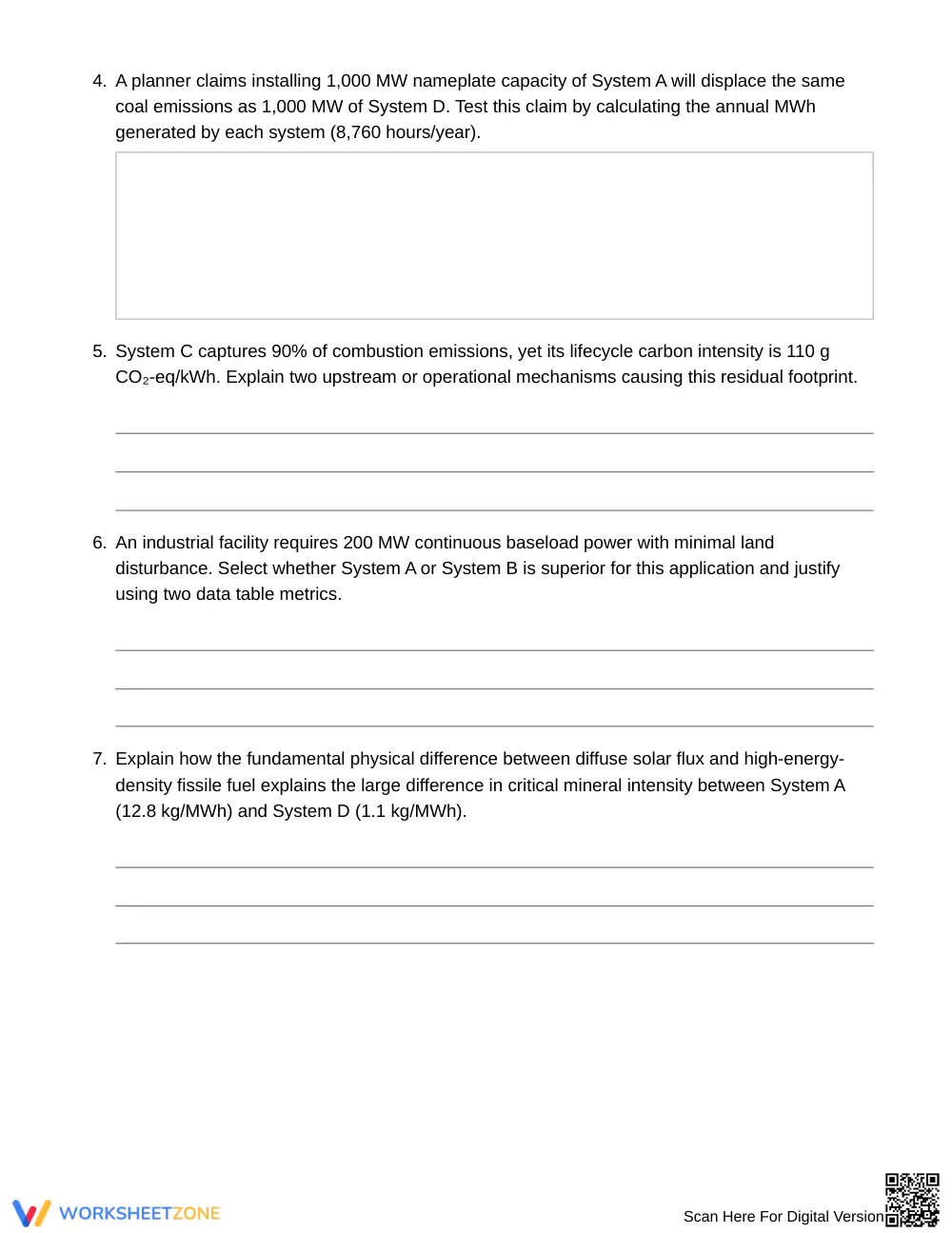
- Supported practice (Part B, 6 problems): Learners evaluate variable standardization, compute annual generation with capacity factors, and contrast mineral intensity against energy density.
- Independent practice (Part C, 2 problems): Students analyze multi-variable empirical data and design an experiment to falsify competing technological models.
This deliberate sequence applies gradual release, transitioning students from guided computation to autonomous systems modeling.
Standards Alignment
This worksheet aligns with high school Earth and Space Science practices requiring students to evaluate competing design solutions for developing and managing energy resources. Students quantify system trade-offs, account for resource constraints, and simulate outcomes when economic and environmental parameters change. Both standard codes can be copied directly into lesson plans, IEP goals, or district curriculum mapping tools.
How to Use It
Use this worksheet after direct instruction on electrical grids and lifecycle emissions. Have students complete Part A in pairs before tackling Parts B and C individually. Formatively assess whether learners calculate annual generation using capacity factors rather than raw nameplate capacity. The full activity requires approximately 45 to 60 minutes.
Who It's For
This resource serves Grade 12 Environmental Science and Earth and Space Science students mastering systems analysis. Scaffolding supports learners transitioning from basic cost formulas to experimental design. Pair this worksheet with a lesson on critical mineral supply chains or grid decarbonization.
According to research by Fisher & Frey (2014) on purposeful instructional design, structured scenario modeling bridges conceptual comprehension and autonomous scientific reasoning by providing explicit analytical frameworks before asking students to evaluate open-ended systemic shifts. This 10-task worksheet operationalizes that finding within secondary science education, specifically targeting the core practice of comparing energy lifecycle scenarios under changed assumptions. By examining synthetic records for solar photovoltaics, geothermal energy, natural gas with carbon capture, and small modular nuclear reactors, Grade 12 students engage in rigorous quantitative modeling. Students systematically determine how parameter modifications—ranging from drought-induced cooling requirements to mineral depletion bottlenecks—alter relative technological feasibility and environmental metrics. The multi-tiered progression reinforces evidence-based decision-making, ensuring that high school seniors master data interpretation, capacity factor conversions, and model falsification protocols while building the critical evaluative capabilities essential for post-secondary environmental science and engineering coursework.


