































Complete Energy Flow Worksheet | Grade 6-12 Science

Paste this activity's link or code into your existing LMS (Google Classroom, Canvas, Teams, Schoology, Moodle, etc.).
Students can open and work on the activity right away, with no student login required.
You'll still be able to track student progress and results from your teacher account.
This cumulative energy flow assessment evaluates student understanding of trophic levels, energy transfer efficiency, and matter recycling. Across 15 structured tasks, middle and high school students interpret food chain models, calculate energy loss, and write scientific explanations about ecosystem energetics. Students demonstrate mastery of trophic pyramids and thermal energy dissipation.
At a Glance
- Grade: Grades 6–12 · Subject: Science
- Standard: Life Science Standards — Model trophic energy flow and matter cycling in ecosystems
- Skill Focus: Energy Flow cumulative assessment
- Format: 4 pages · 15 problems · Answer key included · PDF
- Best For: Summative assessment and review
- Time: 45–60 minutes
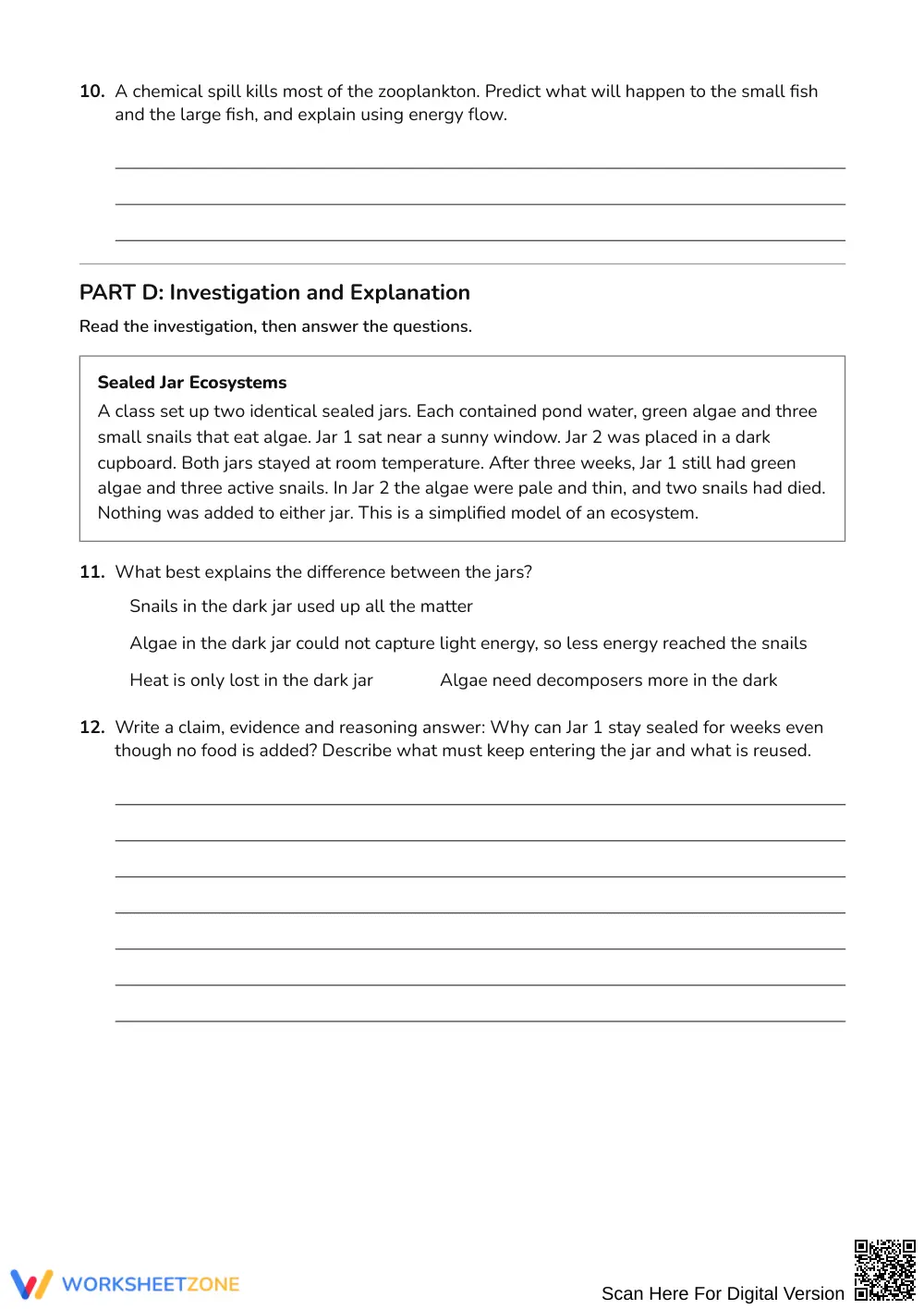
The four-page printable assessment includes multiple-choice questions, data calculation tables, and claim-evidence-reasoning prompts. Students analyze grassland food chains, calculate energy transfers in kilojoules, predict aquatic population shifts, and evaluate closed jar ecosystems. A full four-page answer key provides complete model solutions.
Skill Progression
- Guided practice (Part A, Problems 1–3): Students interpret a food chain diagram to identify consumers and describe heat loss.
- Supported practice (Parts B & C, Problems 4–13): Learners calculate energy budgets and apply the 10 percent rule to aquatic webs.
- Independent practice (Part D, Problems 14–15): Students evaluate controlled jar experiments using claim, evidence, and reasoning.
This gradual-release structure moves learners from visual analysis to independent scientific writing.
Standards Alignment
This resource aligns with middle and high school life science standards requiring students to model how energy flows and matter cycles across trophic levels. Objectives can be copied directly into lesson plans, IEP goals, or district curriculum mapping tools.
How to Use It
Use this assessment as a summative unit exam or assign sections across consecutive days as review stations. Watch for students confusing heat loss with matter destruction during data analysis. Expected completion time is 45 to 60 minutes.
Who It's For
Designed for Grades 6–12 life science and biology classrooms. Sentence starters can support emerging writers on the final explanation. Pair with a trophic pyramid anchor chart for pre-assessment review.
According to Fisher & Frey (2014), structured formative and summative assessments that mirror gradual-release instructional architectures significantly improve adolescent students' retention of complex science concepts. This comprehensive energy flow assessment reinforces standards-aligned life science principles by requiring students to analyze trophic dynamics, quantify energy transfer efficiency across trophic levels, and distinguish between open energy loss and closed matter cycles. Grounded in evidence-based pedagogical frameworks, the four-part progression guides students from scaffolded diagram analysis to autonomous claim, evidence, and reasoning writing. Research on disciplinary literacy confirms that synthesizing empirical data with written scientific explanations cements conceptual understanding far more effectively than isolated multiple-choice recall. By evaluating quantitative kilojoule balances and real-world aquatic ecosystem disruptions, students demonstrate authentic mastery of ecological energetics. The complete four-page package equips educators with valid diagnostic data to monitor student mastery and guide targeted curricular interventions.


