


























Views
Downloads



Complete Disrupted Regulation Worksheet | Grade 10 Biology
Paste this activity's link or code into your existing LMS (Google Classroom, Canvas, Teams, Schoology, Moodle, etc.).
Students can open and work on the activity right away, with no student login required.
You'll still be able to track student progress and results from your teacher account.
This Grade 10 biology worksheet guides students through the mechanisms of physiological homeostasis. Learners examine feedback mechanisms, analyze synthetic physiological datasets, and evaluate failure points when regulatory loops are disrupted by pharmacological agents or genetic variations to build deep mechanistic reasoning in cellular biology.
At a Glance
- Grade: 10 · Subject: Biology
- Standard: Investigate feedback mechanisms maintaining homeostasis and evaluate physiological failure points
- Skill Focus: Analyzing Disrupted Regulation Scenarios
- Format: 5 pages · 10 problems · Answer key included · PDF
- Best For: Homeostasis unit synthesis
- Time: 45–60 minutes
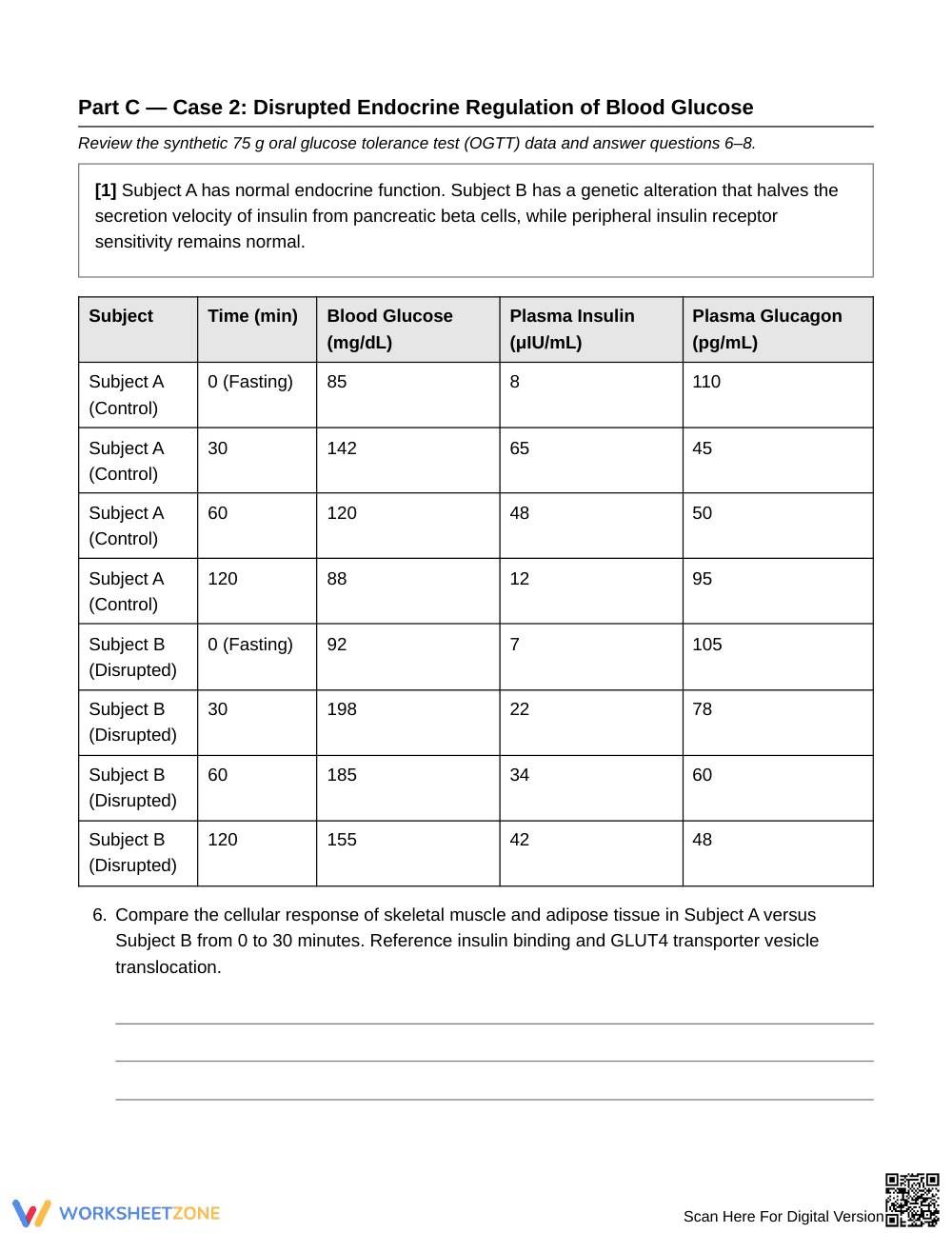
The 5-page worksheet includes 10 analytical tasks organized into four sections. Students analyze two clinical case studies with multi-variable data tables for thermoregulation and glucose regulation. The resource features a feedback reference diagram and a detailed 3-page explanatory answer key.
Skill Progression
- Guided Practice (Part A, Problems 1–2): Students identify physical heat-transfer constraints and explain dynamic equilibrium versus static set points.
- Supported Practice (Parts B & C, Problems 3–8): Students analyze quantitative case data on thermoregulation and endocrine glucose regulation, tracing receptor-effector uncoupling and transporter translocation.
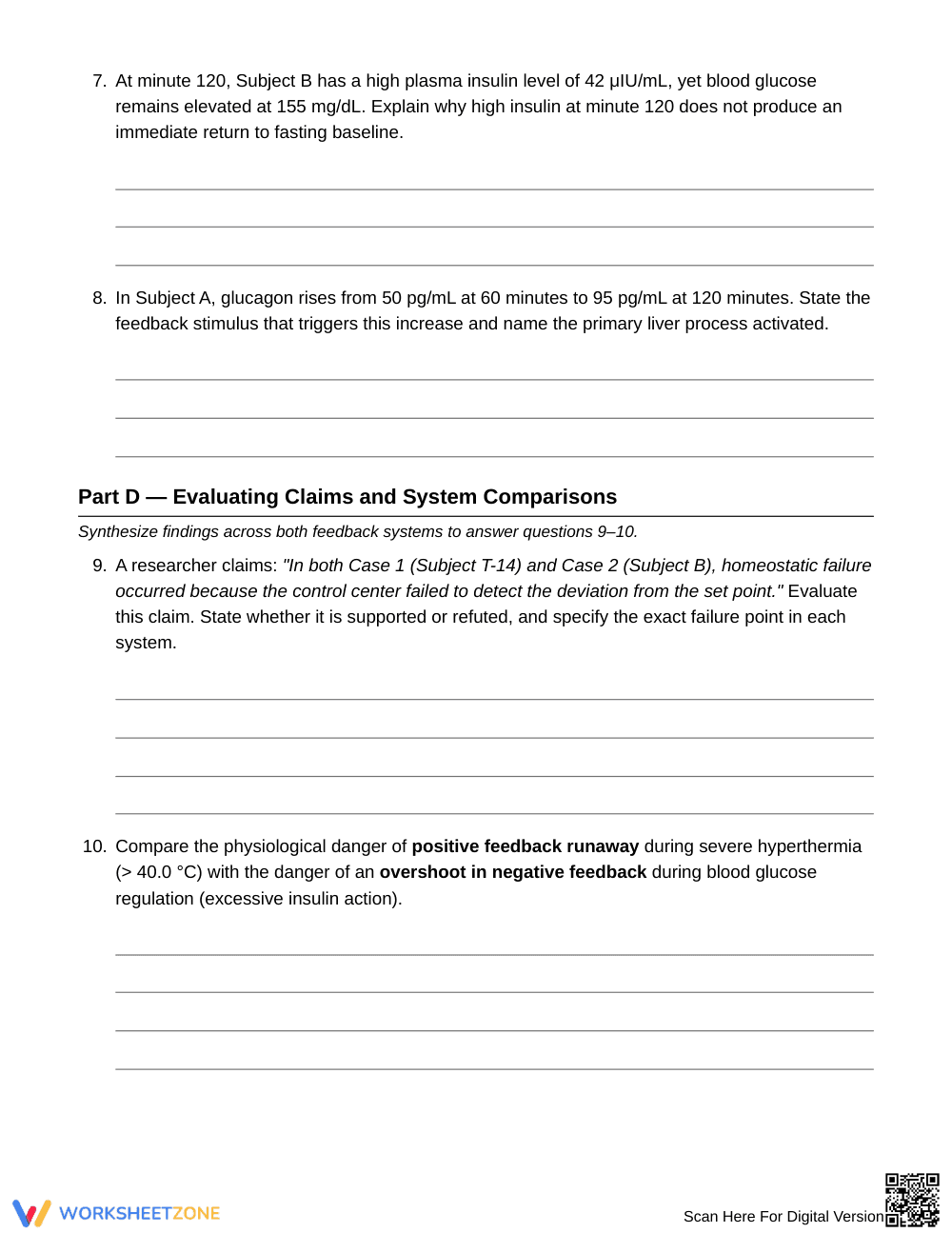
- Independent Practice (Part D, Problems 9–10): Students evaluate scientific claims about control-center detection and contrast hyperthermic positive feedback with negative feedback overshoot.
This scaffolded sequence follows the gradual release of responsibility model.
Standards Alignment
This worksheet aligns with high school life science standards requiring students to explain how feedback mechanisms maintain homeostasis. Students investigate how positive and negative loops mediate physiological responses to external changes, supporting lesson plans and district curriculum mapping tools.
How to Use It
Deploy this worksheet after direct instruction on human feedback loops to practice quantitative analysis, or use it during collaborative stations. As a formative check, review student responses to Problem 4 to ensure they understand heat dissipation constraints. Expected completion time is 45 to 60 minutes.
Who It's For
Designed for Grade 10 biology students developing data-analysis skills, this resource includes reference scaffolds for emerging learners and challenging items for advanced thinkers. Pair it with an interactive homeostasis simulation or an endocrine system anchor chart for comprehensive instruction.
Homeostatic regulation requires secondary biology students to integrate multi-variable inputs, receptor signaling, and effector pathways across human organ systems. According to Fisher & Frey (2014), instructional frameworks that move students from foundational system constraints to multi-step quantitative scenario analysis substantially improve conceptual retention in science education. This Grade 10 worksheet develops the core skill of analyzing disrupted regulatory scenarios through 10 sequenced analytical tasks across 5 student and answer key pages. By contrasting normal physiological baselines against synthetic pharmacological and genetic disruption models, learners evaluate real-time feedback failure points rather than memorizing static definitions. Biology educators can reliably incorporate this resource to assess student mastery of negative feedback mechanisms, dynamic equilibrium, and cellular endocrine responses during regular classroom instruction or targeted intervention blocks.


