






























Complete Development Choices Worksheet | Grade 7 ELA
Paste this activity's link or code into your existing LMS (Google Classroom, Canvas, Teams, Schoology, Moodle, etc.).
Students can open and work on the activity right away, with no student login required.
You'll still be able to track student progress and results from your teacher account.
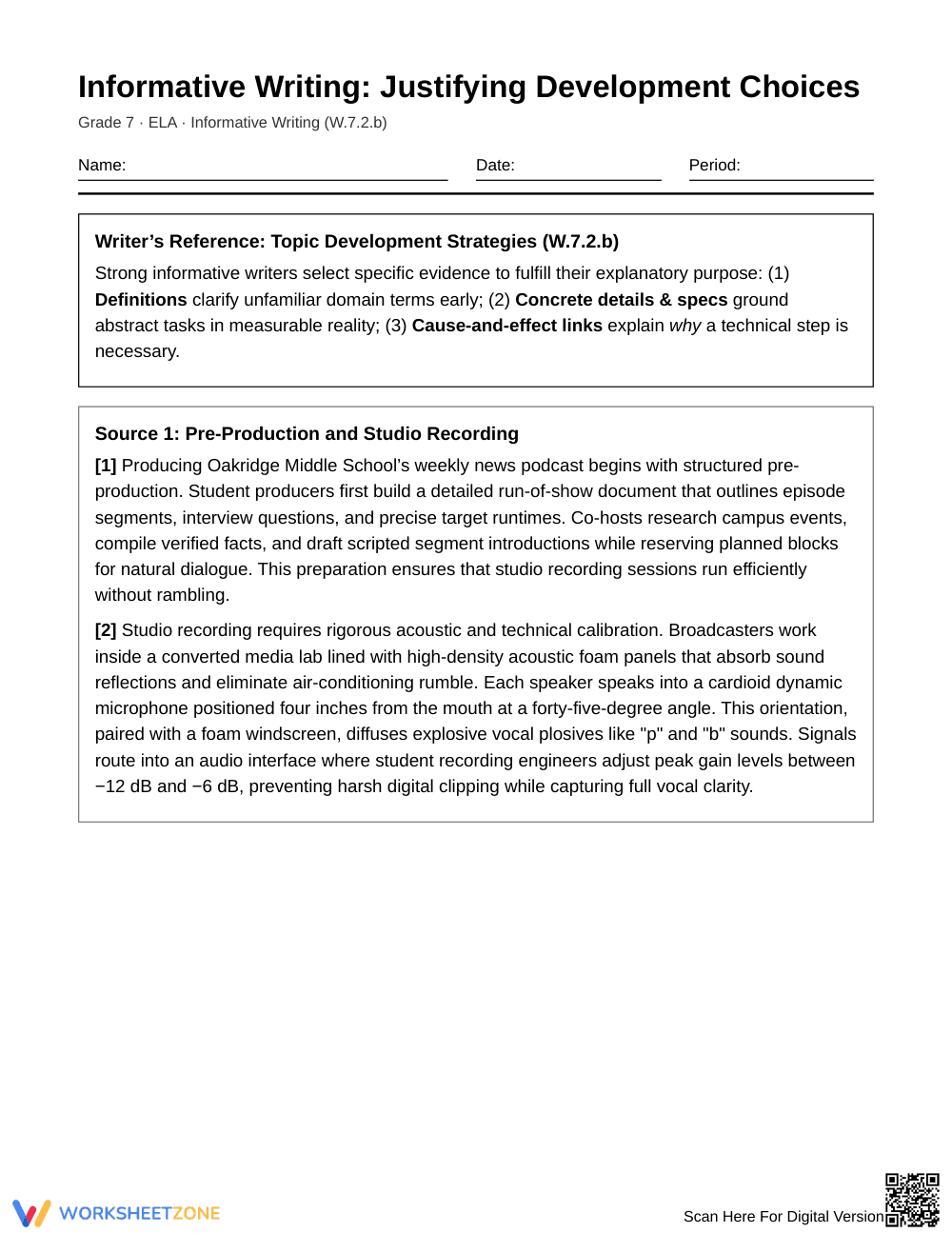
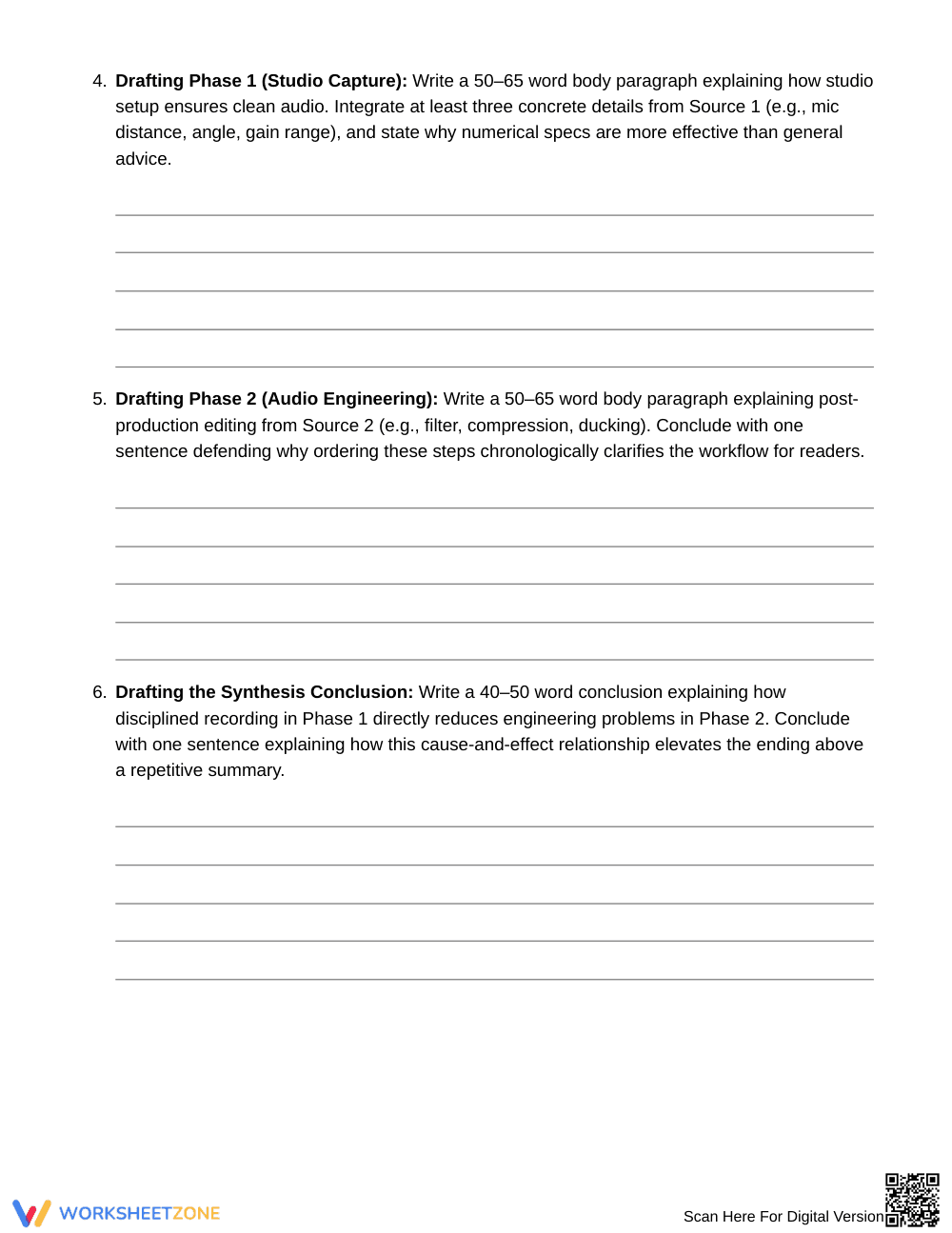
This Grade 7 informative writing worksheet teaches students to select, draft, and defend precise explanatory details. Students analyze technical source texts on audio production, evaluate organizational strategies, compose structured paragraphs, and write explicit rationales for their authorial choices, mastering objective topic development with measurable accuracy.
At a Glance
- Grade: 7 · Subject: ELA
- Standard:
W.7.2.b— Develop a topic with relevant facts, definitions, concrete details, and examples- Skill Focus: Justify a Development Choice
- Format: 5 pages · 8 problems · Answer key included · PDF
- Best For: Informational drafting and revision practice
- Time: 40–50 minutes
What's Inside
This 5-page printable instructional resource contains 8 rigorous tasks grounded in authentic technical source texts on digital podcast engineering. The worksheet includes an introductory Writer's Reference guide, multiple-choice strategy justifications, guided four-part drafting prompts with explicit rationale checkpoints, and a detailed 3-page answer key featuring exemplar student paragraphs and analysis criteria.
Skill Progression
- Guided practice (Part A, 2 tasks): Students evaluate two authorial scenarios, selecting the most effective explanatory strategy (definitions vs. concrete specs) and defending their choice.
- Supported practice (Part B, 4 tasks): Students draft a four-stage briefing on audio production, integrating specific numerical details, domain vocabulary, and chronological transitions while providing embedded rationales.
- Independent practice (Part C, 2 tasks): Students revise vague writing into technical prose and articulate a comprehensive defense of their overall development strategy.
This sequence follows a gradual-release instructional model that transitions learners from conceptual strategy selection to rigorous, self-monitored writing production.
Standards Alignment
This resource directly targets Common Core standard W.7.2.b: "Develop the topic with relevant facts, definitions, concrete details, quotations, or other information and examples." Students satisfy this benchmark by integrating technical parameters and explaining why specific evidence types clarify complex mechanisms. Both standard codes can be copied directly into lesson plans, IEP goals, or district curriculum mapping tools.
How to Use It
Implement this worksheet during a direct instruction unit on expository text structures or as an intensive drafting clinic before summative research writing. To formatively assess learning, monitor Part B responses to confirm students explain why a detail was selected rather than merely copying facts. The complete 8-task progression requires approximately 40 to 50 minutes of instructional time.
Who It's For
Designed for Grade 7 English Language Arts classrooms, this resource supports general education writers, accelerated Grade 6 students, and Grade 8 students needing targeted remediation in topic elaboration. It pairs naturally with informational anchor charts on domain-specific vocabulary and mentor texts detailing technical STEM workflows.
Instructional frameworks established by Fisher & Frey (2014) highlight that secondary writers achieve greater informational mastery when explicit metacognitive reflection accompanies text composition. This Grade 7 expository writing resource aligns with Common Core standard W.7.2.b, which tasks students with developing informative topics using relevant facts, domain definitions, concrete details, and structural examples. By completing 8 multi-tiered tasks centered on audio engineering source texts, learners move beyond passive fact-gathering to actively justify why specific evidence types clarify complex technical processes for an unfamiliar audience. The integrated scaffold requires students to articulate rationales for every drafting choice, directly reinforcing the cognitive link between authorial purpose and audience comprehension. Educational practitioners can utilize the included 3-page exemplar key to evaluate student analytical depth, support differentiated intervention, and verify standards-aligned developmental proficiency across middle school writing curricula.


