




























Views
Downloads



Complete Defending Allusions Worksheet | Grade 8 ELA

Paste this activity's link or code into your existing LMS (Google Classroom, Canvas, Teams, Schoology, Moodle, etc.).
Students can open and work on the activity right away, with no student login required.
You'll still be able to track student progress and results from your teacher account.
This Grade 8 ELA worksheet guides students to defend an author's use of allusion by analyzing how historical references shape tone, character, and theme. Students read an original fiction passage, cite evidence linking community archives to the ancient Library of Alexandria, and evaluate competing interpretations.
At a Glance
- Grade: 8 · Subject: ELA
- Standard:
RL.8.4— Analyze how literary allusions and specific word choices impact meaning and tone- Skill Focus: Defend an Allusion’s Contribution to Meaning
- Format: 5 pages · 8 problems · Full answer key included · PDF
- Best For: Close reading and analytical writing practice
- Time: 40–50 instructional minutes
What's Inside
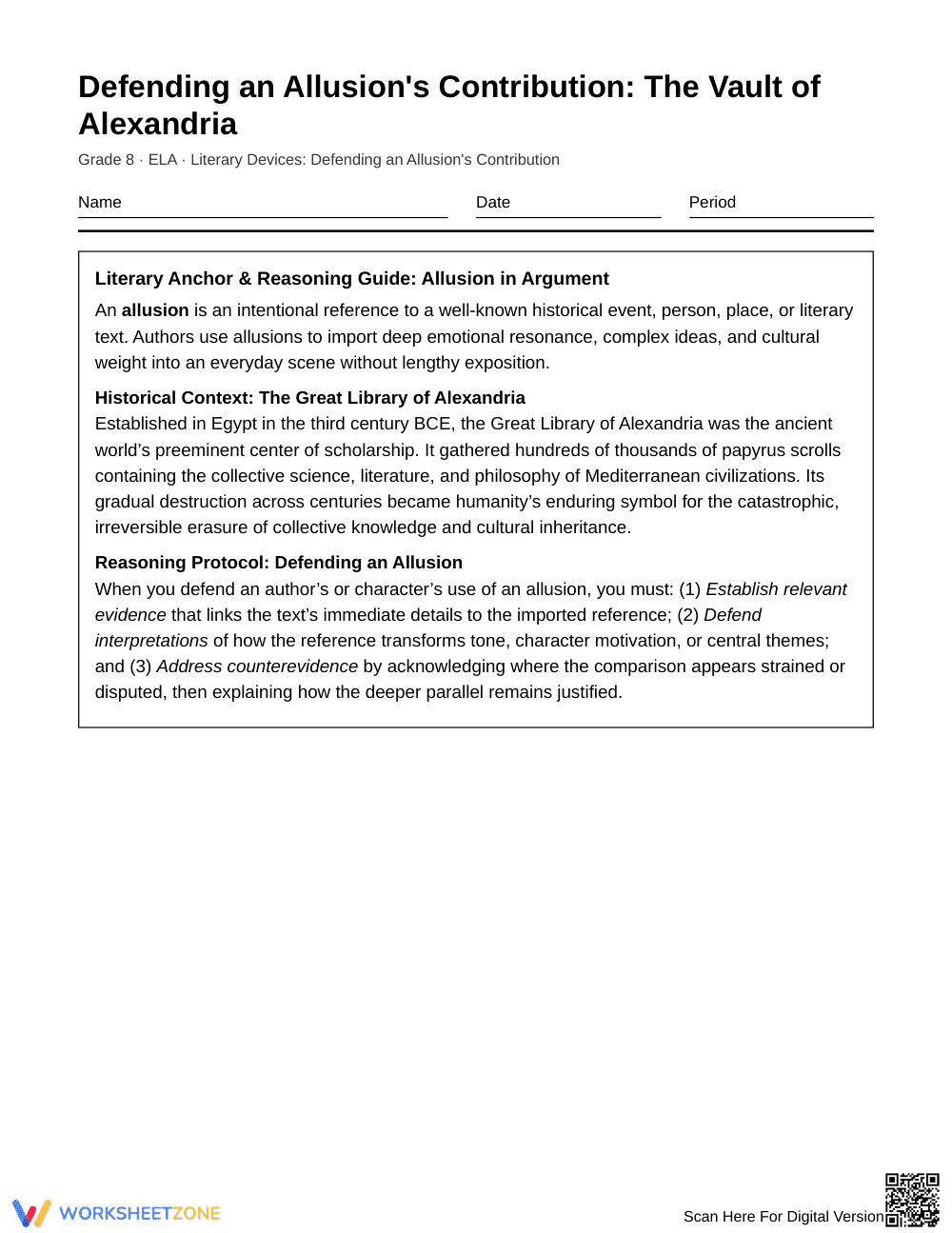
This 5-page printable resource includes the narrative passage 'The Vault of Alexandria' paired with an instructional Literary Anchor and Reasoning Guide. Students complete 8 text-dependent tasks featuring multiple-choice evidence analysis and open-ended written defense prompts. An embedded historical context guide illuminates the Library of Alexandria, supported by a complete 3-page answer key with exemplary student responses.
Skill Progression
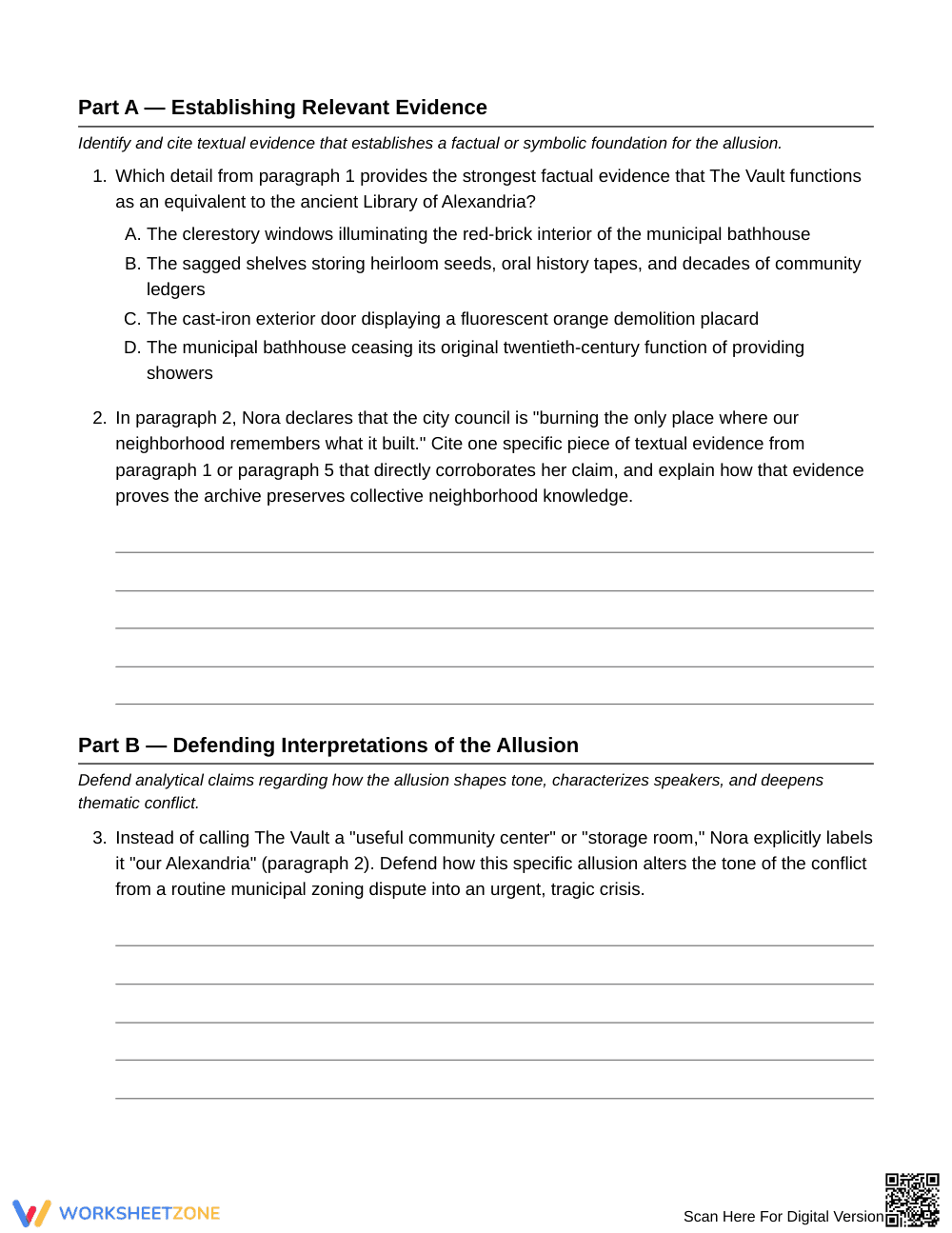
- Guided practice (Tasks 1–2): Students identify direct textual evidence connecting a neighborhood archive to Alexandria using historical notes.
- Supported practice (Tasks 3–6): Learners construct written arguments defending how the allusion shifts tone and dignifies working-class labor.
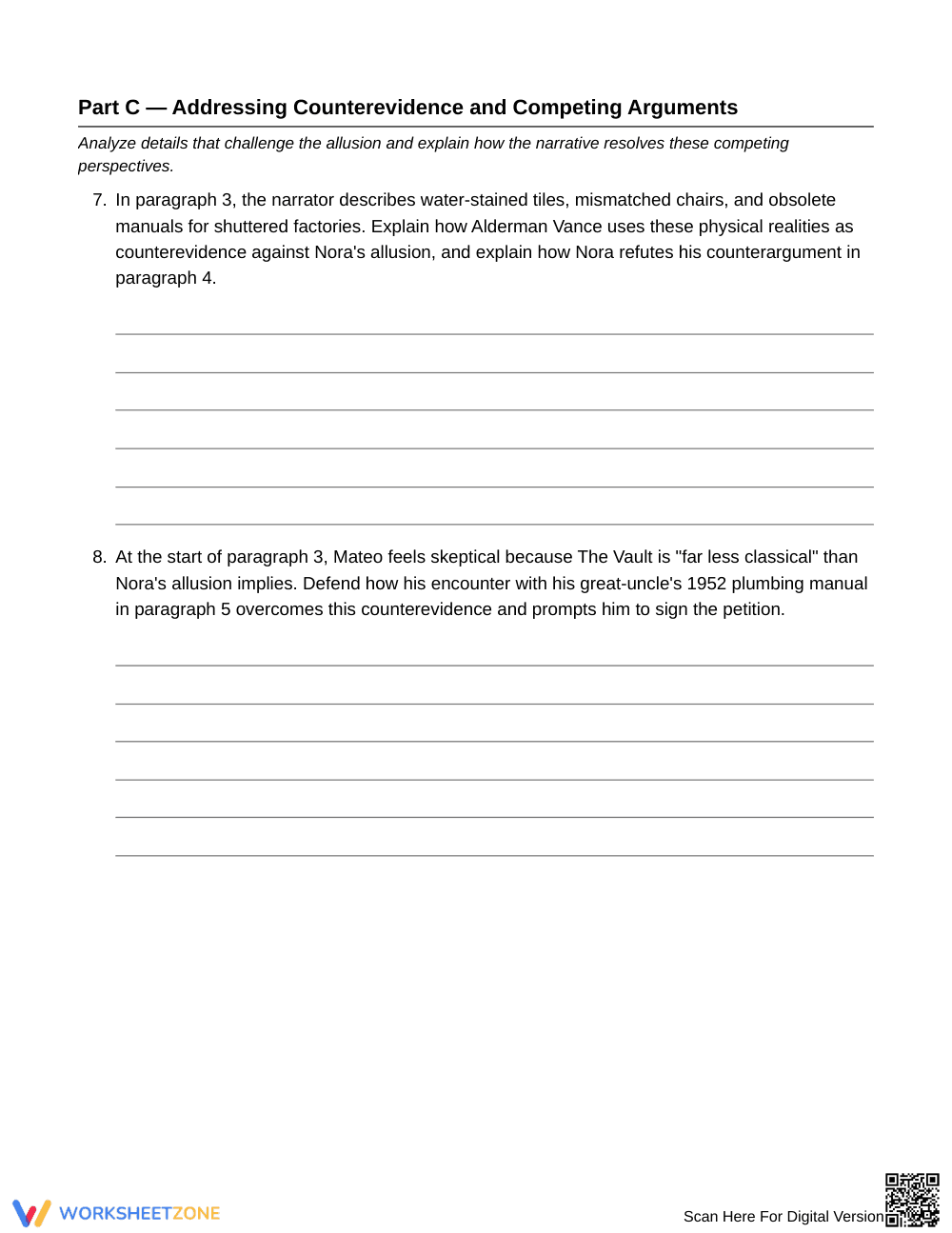
- Independent practice (Tasks 7–8): Students independently analyze counterevidence and explain how characters reconcile decay with classical grandeur.
This sequence mirrors the gradual-release model, transitioning students from foundational evidence retrieval to sophisticated rhetorical defense.
Standards Alignment
This resource directly targets primary standard `RL.8.4`: Determine the meaning of words and phrases as they are used in a text, including figurative and connotative meanings; analyze the impact of specific word choices on meaning and tone, including analogies or allusions to other texts. It additionally supports `RL.8.1` through textual evidence citation. Both standard codes can be copied directly into lesson plans, IEP goals, or district curriculum mapping tools.
How to Use It
Implement this worksheet following direct instruction on figurative language. In whole-group instruction, review the reasoning protocol together before having pairs complete Parts A and B. For independent practice, assign the full worksheet during a literary devices unit. As a formative assessment observation tip, check student responses on Task 4 to verify they understand how Nora reframes Alexandria around community labor rather than elite scholarship. Expect completion in 40 to 50 minutes.
Who It's For
This resource serves Grade 8 ELA students advancing their text analysis and argumentative writing skills. The historical context guide supports striving readers and English learners, while Part C offers rigorous extension for advanced students. Pair this activity with an anchor chart on classical allusions or a lesson on civic debate speeches.
Mastering standard `RL.8.4` requires middle school students to defend how figurative language and literary allusions directly govern narrative tone, characterization, and thematic development. According to research on structured literacy instruction by Fisher & Frey (2014), purposeful scaffolding through a gradual-release framework enables adolescent learners to transition successfully from basic textual retrieval to complex, evidence-based literary argumentation. By supplying an anchor text that contains an explicit reasoning guide alongside multi-tiered analytical tasks, this Grade 8 ELA worksheet equips students to evaluate metaphorical comparisons, rebut counterarguments, and justify an author's rhetorical choices. Learners do not merely define an allusion in isolation; they actively demonstrate how classical historical references transform mundane civic conflicts into urgent moral imperatives. The accompanying five-page format and thorough three-page answer key ensure instructors have verifiable indicators of student mastery across all eight text-dependent analytical tasks.


