




























Complete Deep-Space Word Search | Grades 7–8 Science
Paste this activity's link or code into your existing LMS (Google Classroom, Canvas, Teams, Schoology, Moodle, etc.).
Students can open and work on the activity right away, with no student login required.
You'll still be able to track student progress and results from your teacher account.
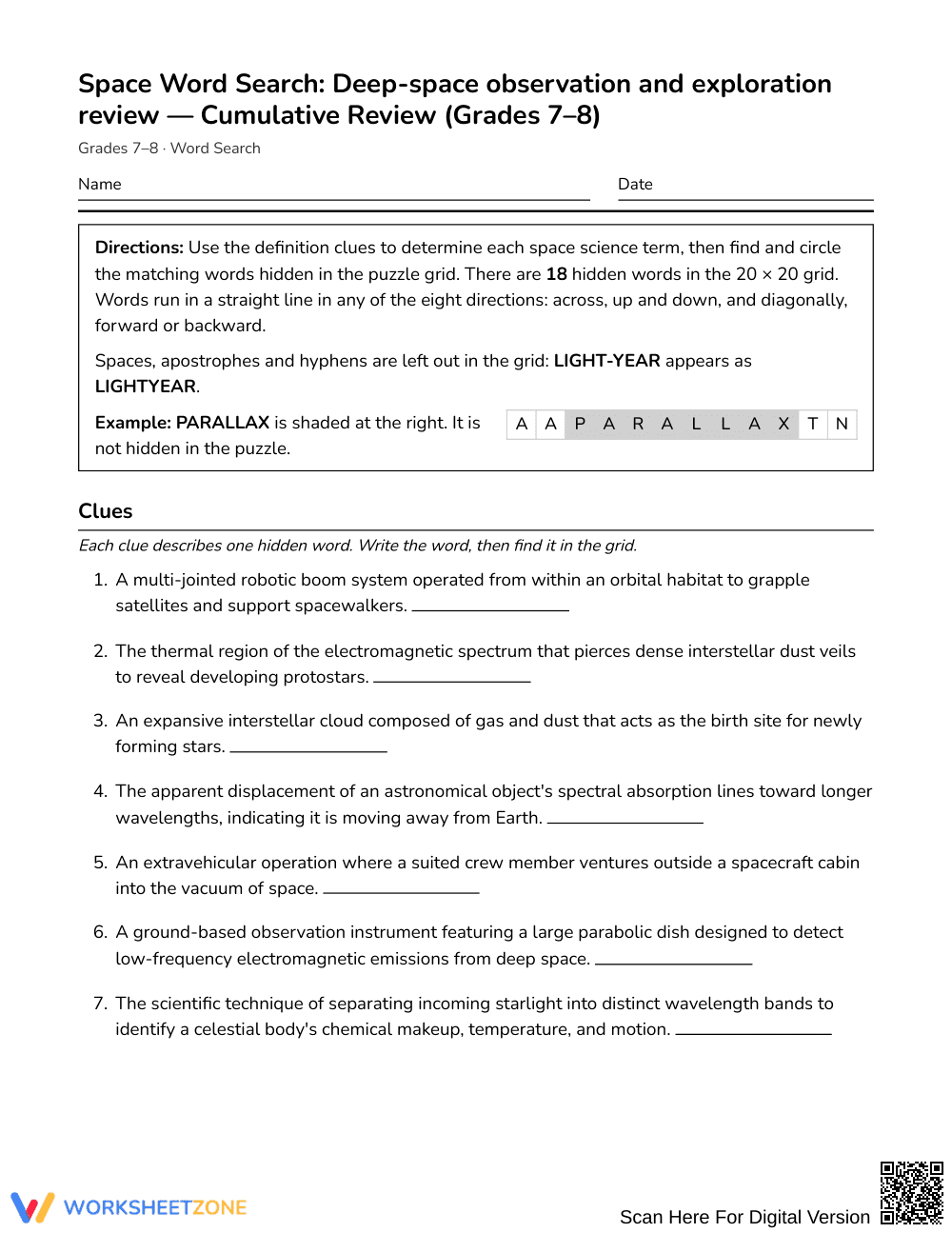
This deep-space observation and exploration review word search reinforces essential astronomy vocabulary for middle school science students. Learners identify key terms by reading detailed scientific definition clues and locating each matching concept within the puzzle. This activity consolidates student understanding of astronomical tools, cosmological structures, and spaceflight technology following direct instruction.
At a Glance
- Grade: Grades 7–8 · Subject: Science
- Standard: Not standards-assessed — vocabulary enrichment
- Skill Focus: Deep-space observation and exploration review
- Format: 3 pages · 18 words · Answer key included · PDF
- Best For: Cumulative astronomy unit review and vocabulary reinforcement
- Time: 25–35 minutes
What's Inside
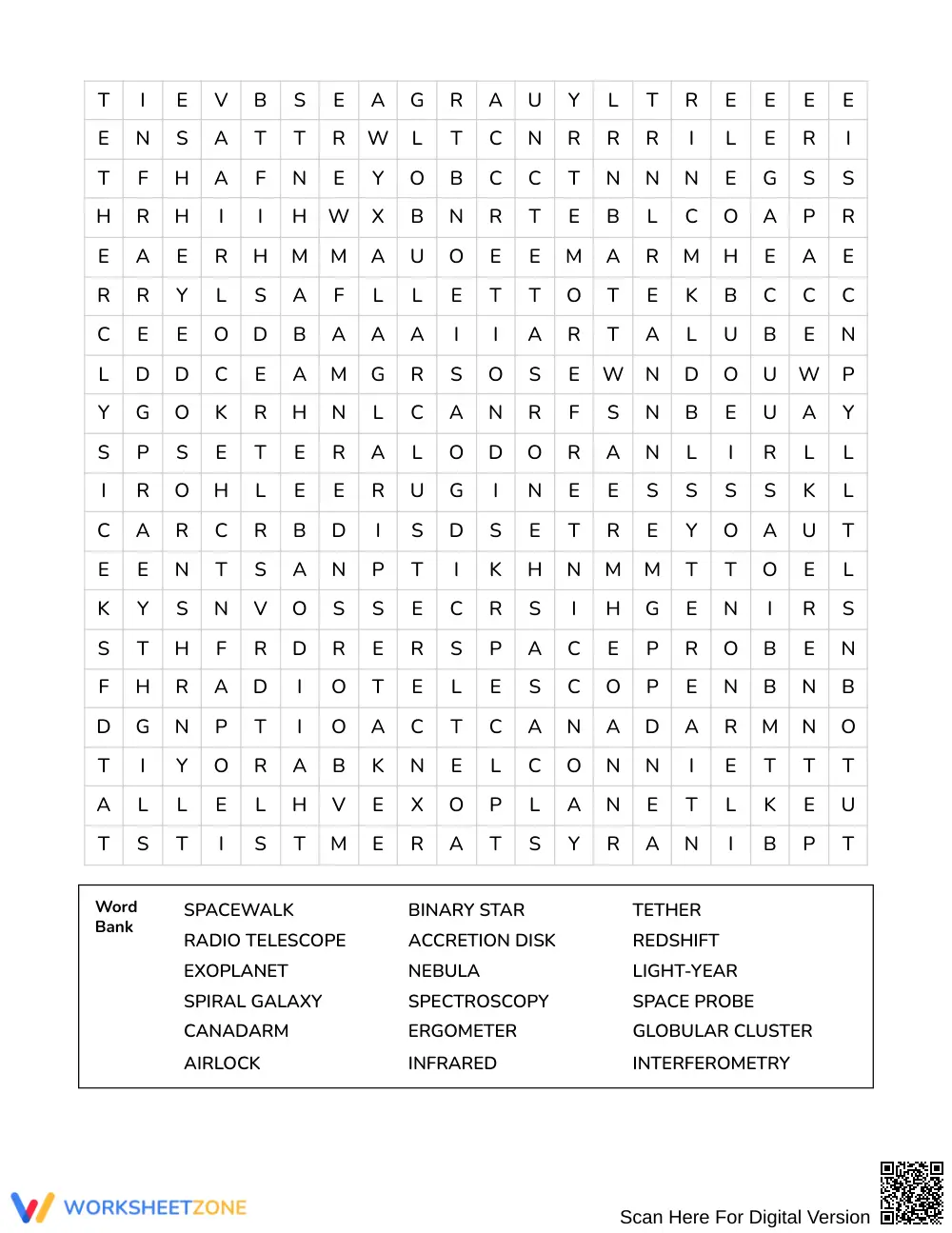
This 3-page science resource features a dense 20-by-20 letter grid containing 18 hidden astronomy terms. Rather than a simple word list, the activity provides rigorous, content-aligned definition clues that require students to recall domain-specific concepts before searching. A shuffled word bank provides reference support, and a complete 4-page answer key provides fast, visual verification of all word placements.
Puzzle Mechanics and Structure
The puzzle uses a 20-by-20 grid designed to challenge middle school search strategies. Words run in all 8 compass directions: north, northeast, east, southeast, south, southwest, west, and northwest, including backward and diagonal placements. Students read definition clues to identify target vocabulary such as spectroscopy, redshift, and interferometry, using the shuffled word bank to verify spelling before locating terms across intersecting letter paths.
Standards Alignment
This resource serves as targeted vocabulary enrichment and is not aligned to a specific state or national science standard. It supports general middle school earth and space science curricula by reinforcing specialized terminology related to telescopes, stellar systems, and orbital spaceflight operations during cumulative review units.
How to Use It
Deploy this activity after direct instruction on astronomical exploration or as an engaging station during cumulative exam preparation. For formative assessment, circulate as students analyze the clues; note whether learners can name concepts like accretion disks or exoplanets independently or if they rely heavily on the shuffled bank. Typical student completion takes between 25 and 35 minutes.
Who It's For
This puzzle is designed for Grades 7–8 science students reviewing astronomy and aerospace engineering concepts. For emerging bilingual learners or students needing additional support, teachers can highlight starting letters or pair students for collaborative clue-solving. It pairs naturally with telescope diagrams, electromagnetic spectrum anchor charts, and space exploration reading passages.
Academic vocabulary mastery is a critical foundation for scientific literacy in the intermediate grades. According to Fisher & Frey (2014), intentional exposure to disciplinary terminology through varied retrieval tasks strengthens conceptual understanding and improves reading comprehension across complex informational texts. This Grades 7–8 astronomy resource supports deep-space observation and exploration review by requiring students to match technical definitions with specialized terms like interferometry, spectroscopy, and radio telescopes. Because learners must decipher clues rather than passively copying spelling patterns, they engage in deliberate semantic processing. Research highlighted by Fisher & Frey (2014) confirms that combining contextual definition retrieval with active recognition exercises anchors abstract scientific concepts in long-term memory. This 18-word search delivers targeted vocabulary reinforcement, ensuring middle school science students retain core terminology regarding celestial structures, observational instrumentation, and human spaceflight missions throughout cumulative astronomy units.


