
































Complete Deep Space Word Search | Grades 7–8 Science

Paste this activity's link or code into your existing LMS (Google Classroom, Canvas, Teams, Schoology, Moodle, etc.).
Students can open and work on the activity right away, with no student login required.
You'll still be able to track student progress and results from your teacher account.
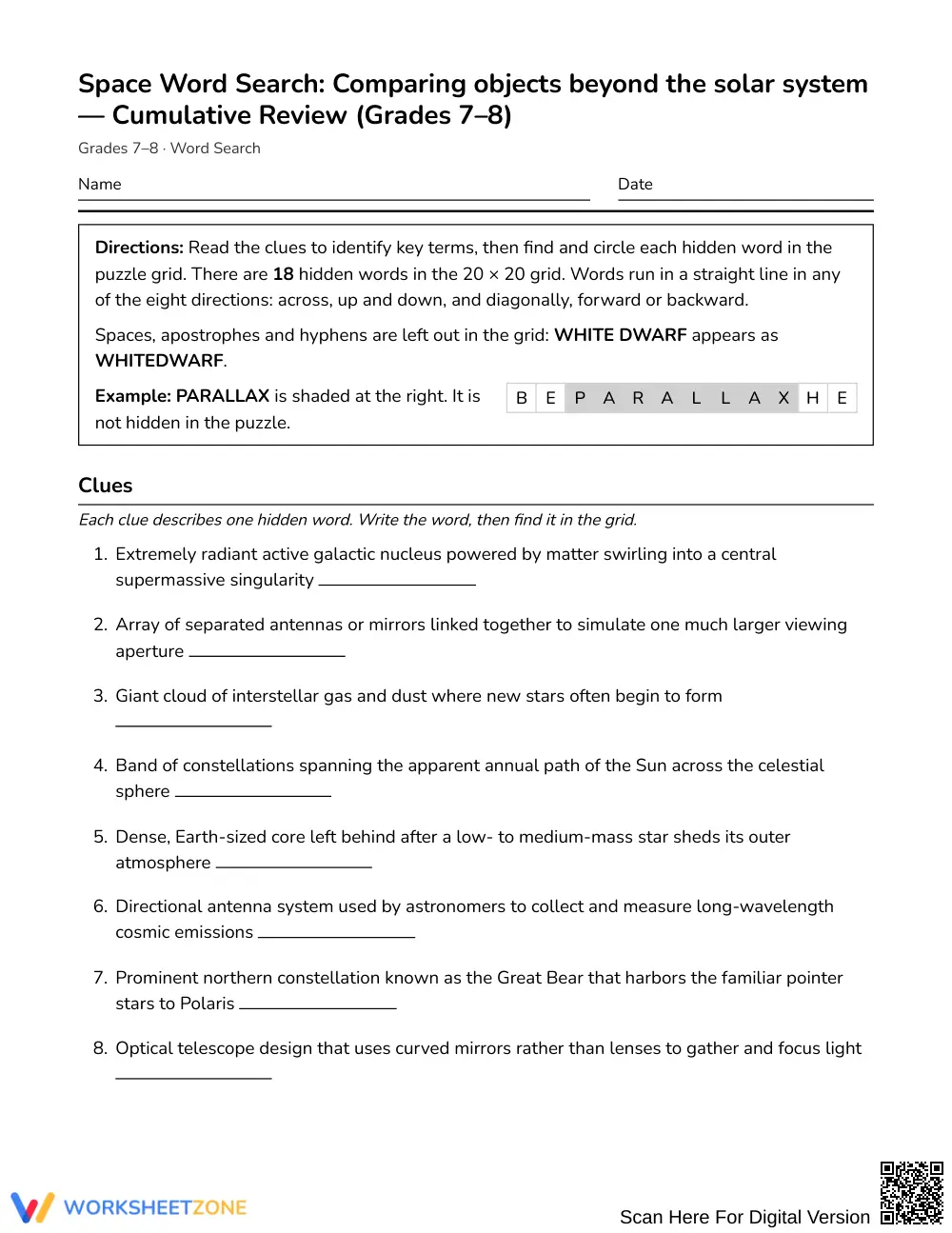
This astronomy word search helps middle school students master vocabulary related to objects beyond our solar system. Learners read definitions to identify 18 target astronomical terms and locate them within the letter grid. The activity reinforces scientific literacy and conceptual understanding of deep space structures and observational instruments through engaging context clues.
At a Glance
- Grade: Grades 7–8 · Subject: Science
- Standard: Not standards-assessed — vocabulary enrichment
- Skill Focus: Comparing objects beyond the solar system
- Format: 3 pages · 18 words · Answer key included · PDF
- Best For: Vocabulary review and fast finisher tasks
- Time: 25–35 minutes
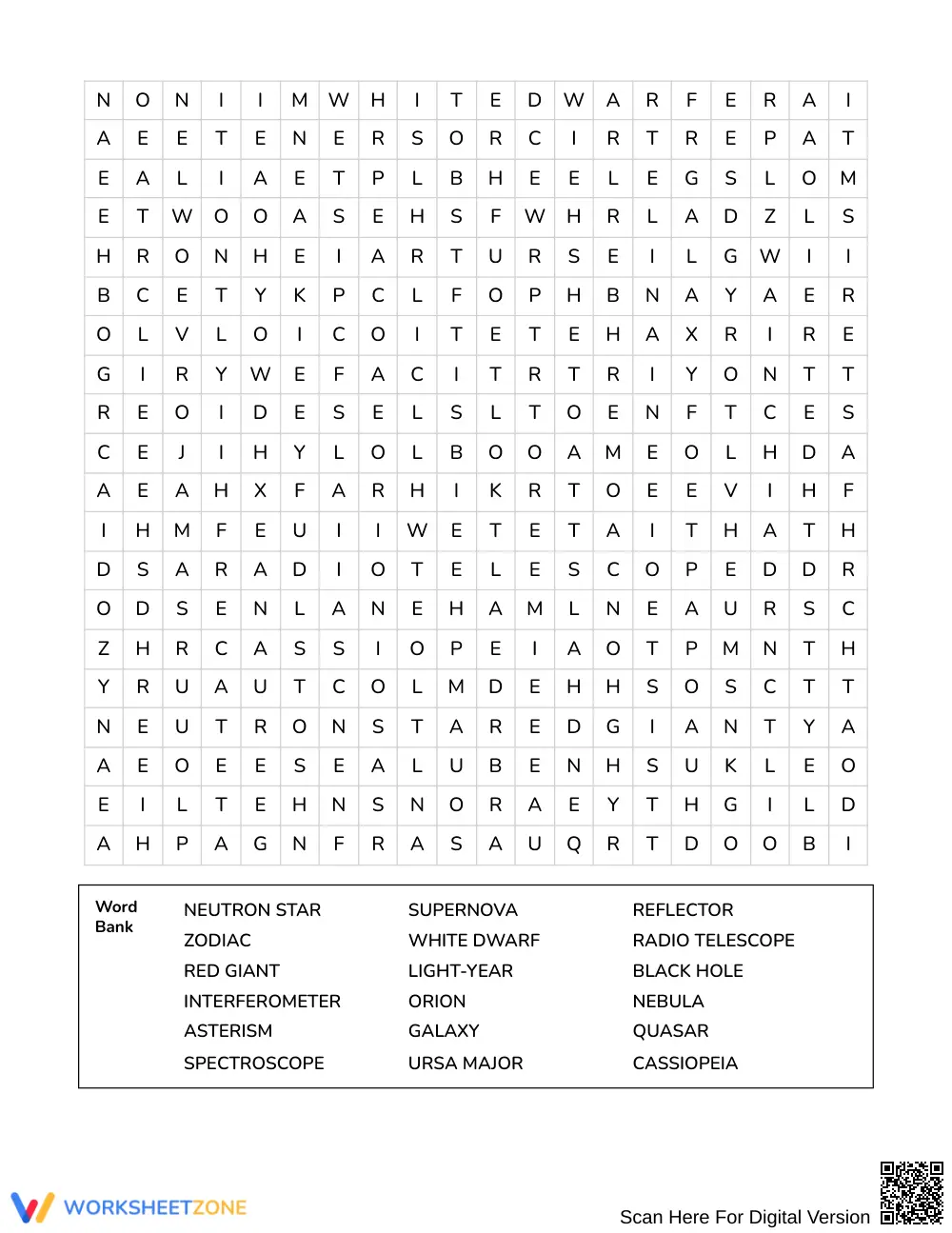
The printable set includes a three-page student activity featuring 18 hidden vocabulary terms paired with descriptive science clues. Rather than searching from a simple word list, students read clue sentences detailing nebulae, stellar life cycles, galaxies, and observational tools to deduce each term before finding it. A full four-page answer key clearly highlights word placements for rapid checking.
The puzzle features a challenging 20 by 20 grid designed for comprehensive vocabulary reinforcement. Words are placed in eight possible directions: north, northeast, east, southeast, south, southwest, west, and northwest. A shuffled word bank provides reference support while 18 detailed clues prompt students to connect definitions to scientific terminology, ensuring active recall rather than passive letter matching.
This resource serves as targeted vocabulary enrichment and is not aligned to a formal state standard. It provides supplementary domain-specific language practice to support astronomy units exploring stellar evolution, deep space phenomena, and astronomical instrumentation without standard-specific assessment constraints.
Introduce this activity during an astronomy unit after direct instruction on stellar lifecycles and deep space structures, or deploy it as a cumulative review before a unit exam. For formative assessment, observe whether students identify terms directly from the descriptive clues or rely primarily on the word bank, noting which astrophysical concepts require reteaching. Expect completion to take between 25 and 35 minutes.
Designed for middle school learners in Grades 7–8, this activity supports general education science classes, advanced elementary enrichment, and introductory high school earth science. Pair this word search naturally with an anchor chart illustrating stellar life cycles or an introductory informational text on astronomical tools to reinforce conceptual connections.
Integrating targeted domain-specific vocabulary practice strengthens reading comprehension in secondary science education. According to research synthesized by Fisher & Frey (2014), intentional exposure to technical terminology through contextual clues and structured review tasks significantly bolsters student schema retention and scientific literacy. This Grades 7–8 science word search engages learners in identifying 18 key astronomical concepts—including nebulae, supernovae, black holes, and optical telescopes—by connecting rigorous definitions to term recognition. While classified as non-standards-assessed vocabulary enrichment, the resource supports foundational knowledge necessary for comparing objects beyond the solar system. By requiring students to analyze informational clues across an expansive 20 by 20 grid, the activity transforms traditional puzzle mechanics into an effective retrieval exercise. Independent review tasks that combine definitional analysis with orthographic search strategies facilitate long-term vocabulary acquisition, providing educators with a practical, low-stakes tool to consolidate astronomical terminology across diverse classroom learning environments.


