
































Complete Comparing Rates Worksheet | Grade 6 Math

Paste this activity's link or code into your existing LMS (Google Classroom, Canvas, Teams, Schoology, Moodle, etc.).
Students can open and work on the activity right away, with no student login required.
You'll still be able to track student progress and results from your teacher account.
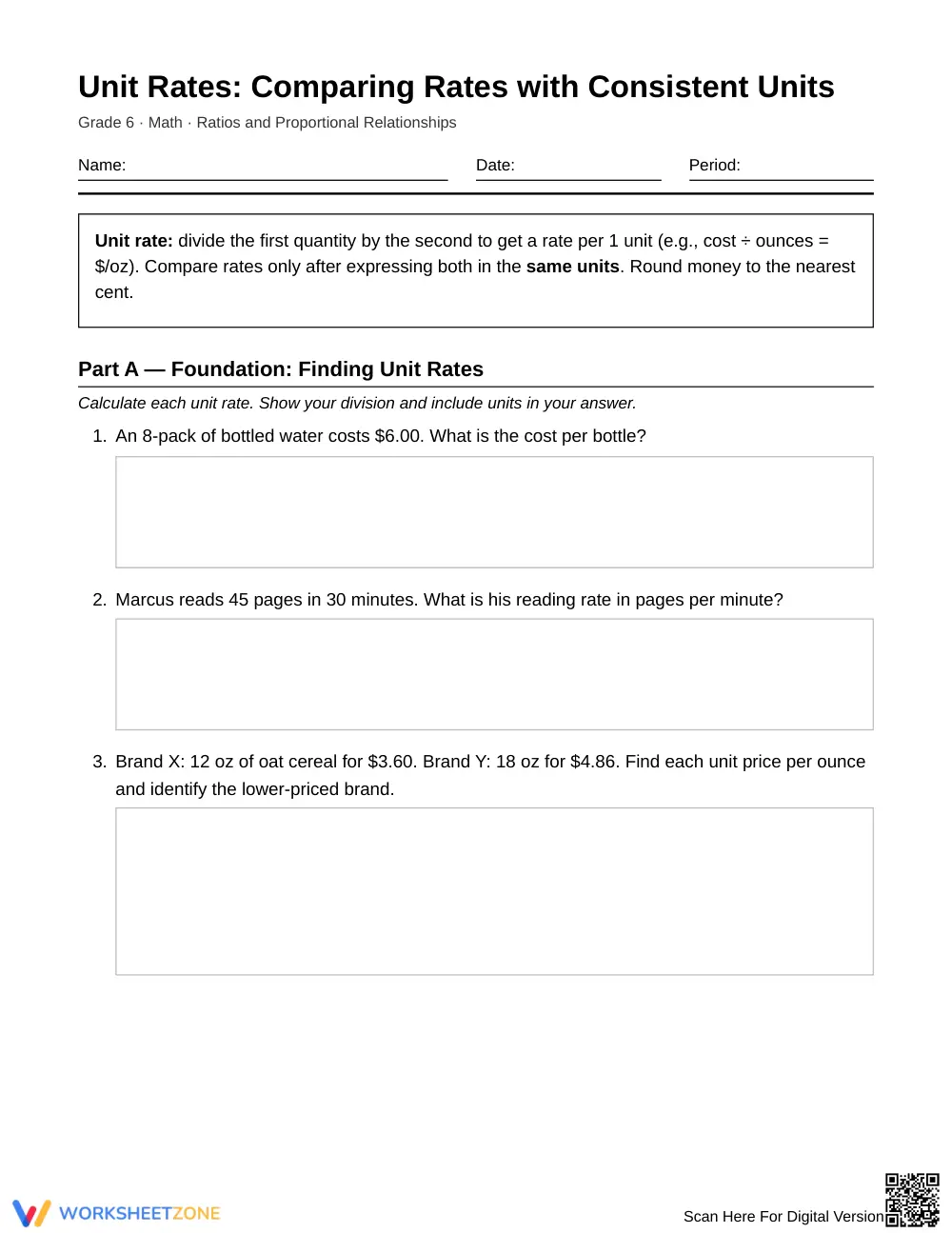
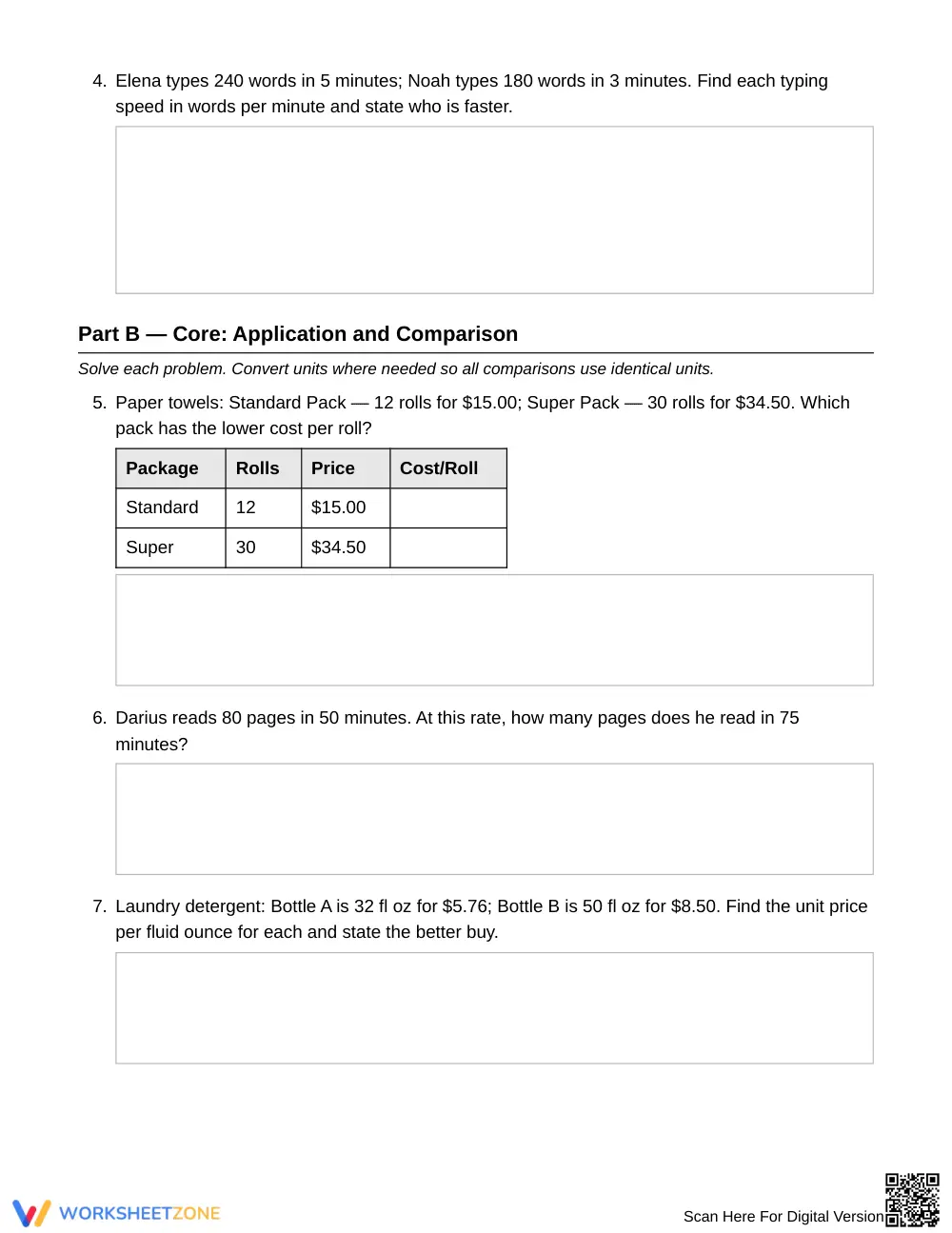
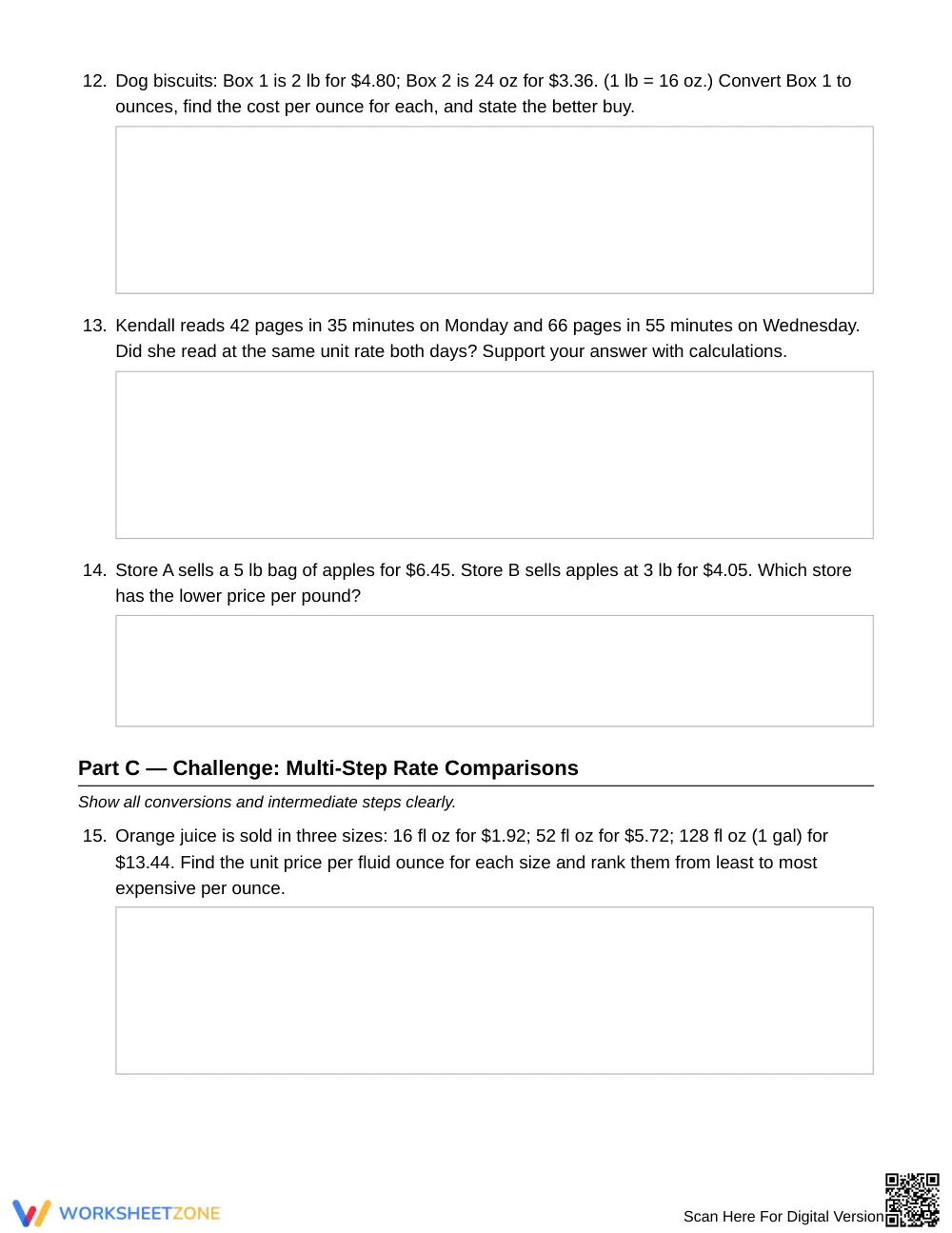
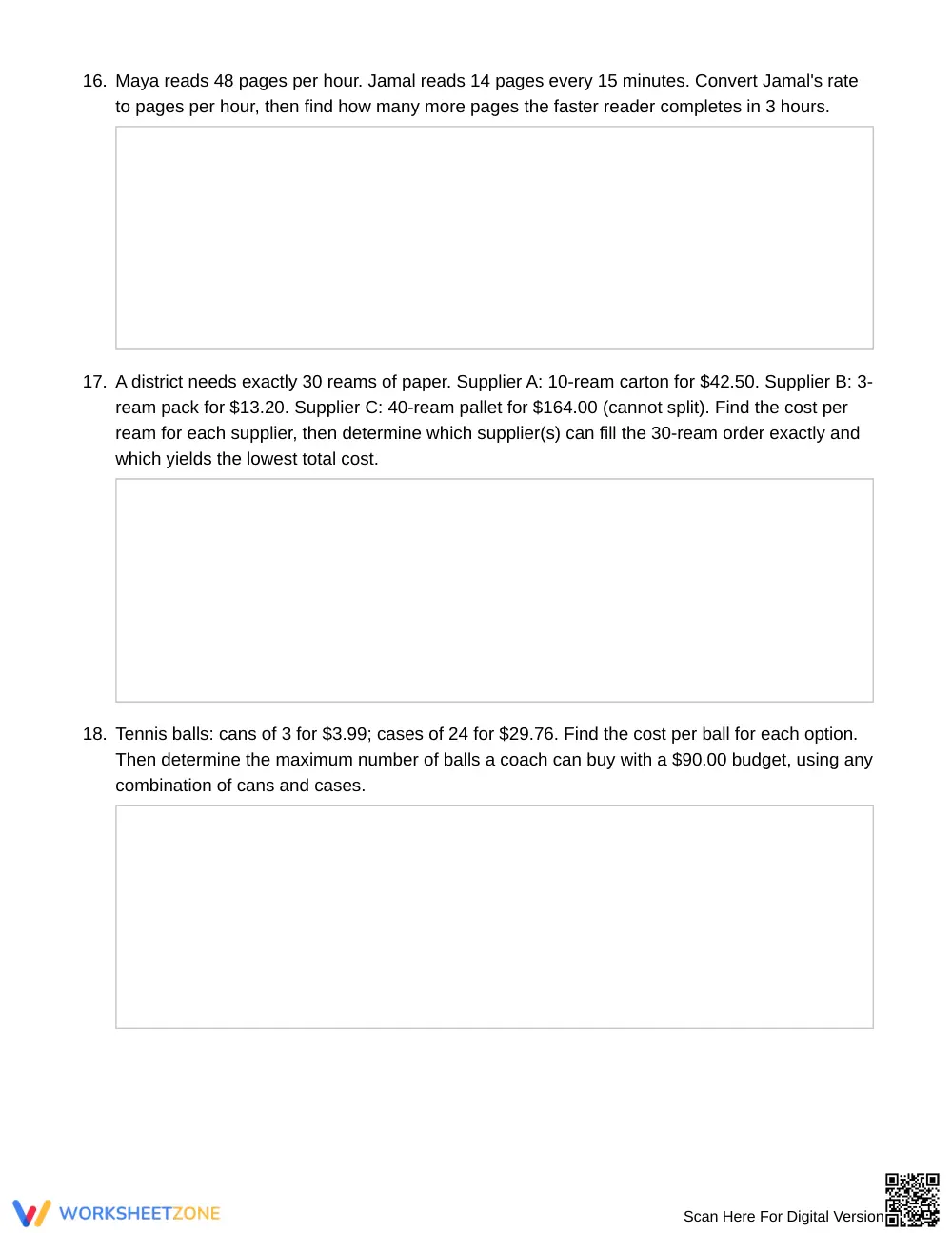
This targeted math worksheet builds student proficiency in calculating and comparing unit rates using consistent units of measurement. Students analyze real-world consumer scenarios, convert measurements when necessary, and determine the most cost-effective or efficient options across 18 focused practice problems.
At a Glance
- Grade: 6 · Subject: Math
- Standard:
6.RP.A.3— Solve real-world and mathematical problems using ratio and rate reasoning- Skill Focus: Comparing unit rates with consistent units
- Format: 5 pages · 18 problems · Answer key included · PDF
- Best For: Independent practice, homework, or targeted intervention
- Time: 40–50 minutes
What's Inside
Inside this 5-page printable resource, students find an initial reference box explaining rate division and conversion, followed by 18 categorized problems spanning three structural parts. A complete 3-page step-by-step answer key is provided to facilitate rapid grading and support self-checking.
Skill Progression
- Guided Practice (Part A, 4 problems): Foundation exercises where students compute basic unit rates (cost per bottle, pages per minute) with built-in reminders to display units and division steps.
- Supported Practice (Part B, 10 problems): Core application tasks requiring unit conversion (pounds to ounces), structured comparison tables, and qualitative explanations of purchasing decisions.
- Independent Practice (Part C, 4 problems): Multi-step challenge scenarios involving three-way unit price rankings, time conversions, and budget optimization constraints.
This sequence follows a gradual-release model, moving students systematically from procedural calculations to multi-step analytical reasoning.
Standards Alignment
This worksheet is aligned directly to standard `6.RP.A.3`, which requires students to use ratio and rate reasoning to solve real-world and mathematical problems, including unit pricing and constant speed. It also supports `6.RP.A.2` by reinforcing the concept of a unit rate associated with a given ratio. Both standard codes can be copied directly into lesson plans, IEP goals, or district curriculum mapping tools.
How to Use It
Use this resource after introducing the concept of unit rates through direct instruction. Assign Parts A and B during class to observe student division strategies, checking specifically whether learners correctly match units in their final statements. Part C works effectively for peer discussion or extension tasks, taking approximately 40 to 50 minutes for full completion.
Who It's For
This worksheet is designed for general education Grade 6 math classrooms, Tier 2 math intervention groups, and accelerated Grade 5 learners. Pair it with a unit rate anchor chart and real grocery circulars to ground abstract calculations in everyday decision-making.
Mastering unit rates and rate comparisons represents a critical milestone in middle school mathematics, bridging elementary arithmetic with advanced proportional reasoning in algebra. According to Fisher & Frey (2014), structured problem sets that progress from foundational single-step calculations to complex multi-step comparisons significantly improve conceptual retention and procedural fluency. This worksheet addresses standard 6.RP.A.3 by guiding students through 18 carefully sequenced exercises to compute unit rates and compare quantities using consistent measurement units. Students analyze everyday consumer scenarios, including grocery unit prices, reading speeds, and bulk purchasing decisions, which reinforces real-world mathematical literacy. By requiring learners to convert units before making direct comparisons, the material reinforces precision and prevents common missteps in ratio reasoning. Educators can deploy this resource for targeted interventions, small group practice, or independent checks for understanding.


