

































Complete Calculating Unit Rates Worksheet | Grade 6 Math

Paste this activity's link or code into your existing LMS (Google Classroom, Canvas, Teams, Schoology, Moodle, etc.).
Students can open and work on the activity right away, with no student login required.
You'll still be able to track student progress and results from your teacher account.
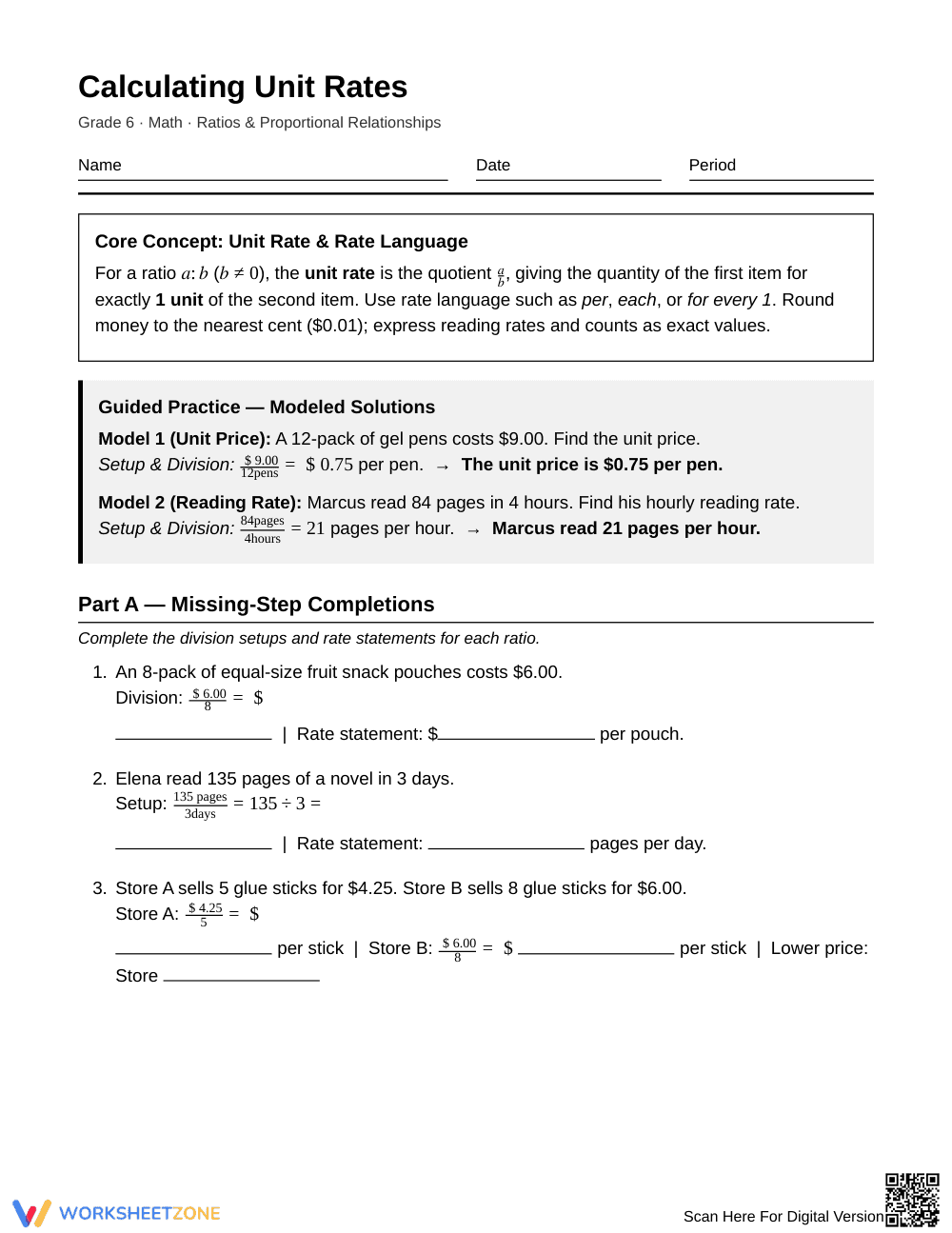
This Grade 6 math worksheet guides students through calculating unit rates and unit prices from contextual ratios. Learners calculate quotients, complete division setups, compare consumer purchases, and critique mathematical reasoning. Structured practice builds both procedural fluency and conceptual precision with rate language.
At a Glance
- Grade: 6 · Subject: Math
- Standard:
6.RP.A.3— Use ratio and rate reasoning to solve real-world and mathematical comparison problems- Skill Focus: Calculate a Unit Rate
- Format: 4 pages · 12 structured problems · Full answer key included · Printable PDF document
- Best For: Guided practice and targeted skill reinforcement
- Time: 35–45 minutes
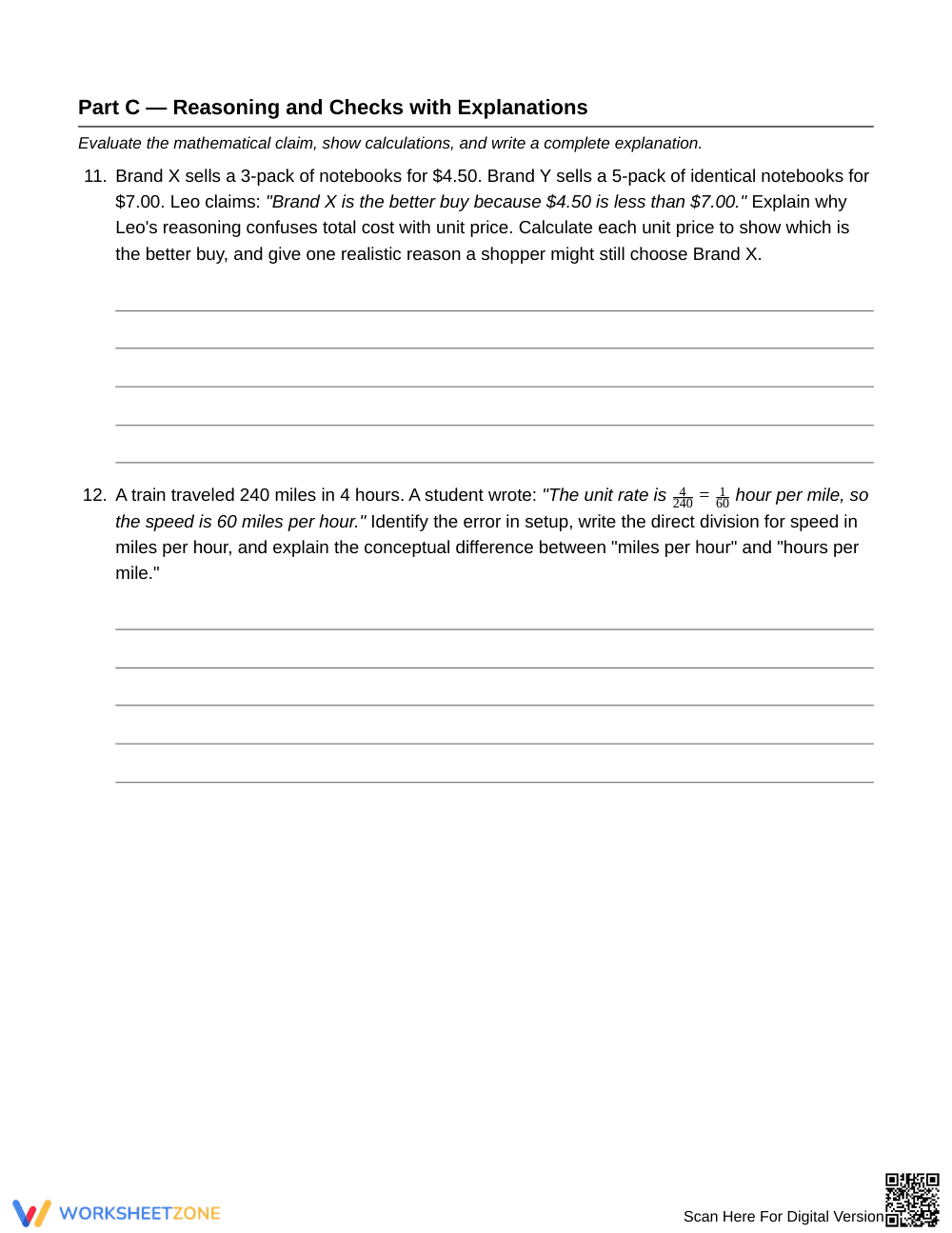
This 4-page document features a core concept box, two worked models, and 12 tiered student tasks across two student pages. Tasks include missing-step division setups, rate comparison tables, and error-analysis prompts. The remaining two pages supply a complete answer key with detailed quotient setups, proper unit labels, and sample written explanations.
Skill Progression
- Guided practice: Part A includes 4 missing-step problems with scaffolded division templates and fill-in rate statements.
- Supported practice: Part B provides 6 independent problems requiring unprompted setups, unit price comparisons, and multi-step rate calculations.
- Independent practice: Part C challenges learners with 2 conceptual reasoning tasks evaluating flawed setups and inverse rate orientations.
This progression applies a gradual-release model, shifting students from supported calculation to independent critical justification.
Standards Alignment
The primary standard is 6.RP.A.3, requiring ratio and rate reasoning to solve real-world problems. The worksheet also supports 6.RP.A.2 by emphasizing the unit rate quotient a/b and precise rate language. Both standard codes can be copied directly into lesson plans, IEP goals, or district curriculum mapping tools.
How to Use It
Use this resource directly after introducing ratio division. Model the introductory examples, complete Part A in pairs to check setup understanding, and assign Parts B and C for independent practice. Formatively check whether students divide dollars by units or invert the terms. Expect students to finish within 35 to 45 minutes.
Who It's For
This worksheet serves Grade 6 math students, intervention cohorts, and special education resource groups mastering proportional concepts. Tier 2 learners benefit from the scaffolded frames, while advanced students tackle the reasoning explanations. Pair this handout with an anchor chart defining unit rate vocabulary.
According to research from Fisher & Frey (2014) on effective instructional scaffolding, guided gradual release frameworks significantly improve middle school mathematics performance by helping students bridge conceptual understanding and procedural fluency. This worksheet addresses standard 6.RP.A.3 by systematically leading Grade 6 learners through the process of calculating unit rates from contextual ratios. Students begin with fill-in division setups, advance to multi-step comparative unit pricing, and finish with written justifications correcting common conceptual errors. The explicit integration of structured rate language reinforces mathematical communication alongside computation. By sequencing tasks from structured supports to independent evaluation, the resource ensures learners develop solid foundational mastery of rates before tackling complex proportional relationships in Grade 7. Educational practitioners can cite this targeted progression when documenting evidence-based interventions for Tier 1 core instruction or Tier 2 supplemental math support.


