





























Complete Author Purpose & Audience Worksheet | Grade 8 ELA
Paste this activity's link or code into your existing LMS (Google Classroom, Canvas, Teams, Schoology, Moodle, etc.).
Students can open and work on the activity right away, with no student login required.
You'll still be able to track student progress and results from your teacher account.
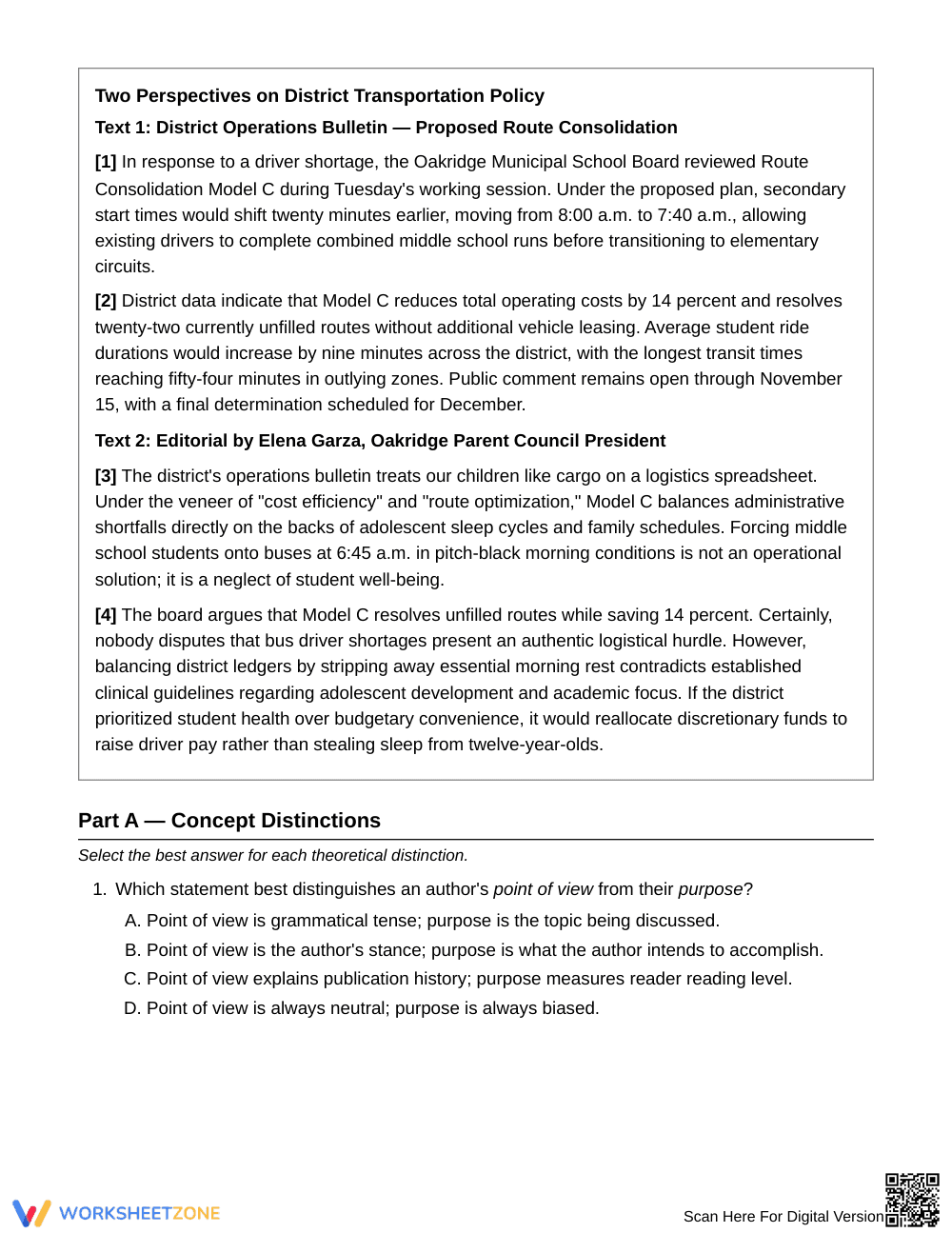
This Grade 8 informational text worksheet equips students to analyze how authors establish position, craft purpose, and address conflicting viewpoints across paired texts. By contrasting a neutral district bulletin with an editorial, learners evaluate rhetorical choices, analyze charged diction, and synthesize competing claims on school bus scheduling.
At a Glance
- Grade: 8 · Subject: ELA
- Standard:
RI.8.6— Determine author's point of view and analyze how conflicting viewpoints are addressed- Skill Focus: Position, Purpose, and Audience
- Format: 5 pages · 10 problems · Answer key included · PDF
- Best For: Informational text paired-passage analysis
- Time: 40–50 minutes
What's Inside
This 5-page printable resource features a foundational Core Concepts reference box, two opposing informational texts about school transportation, and 10 rigorous analysis items. The student tasks combine targeted multiple-choice questions with text-dependent constructed responses. A thorough 2-page answer key provides complete rationales, exemplary student responses, and paragraph citations for quick grading.
Skill Progression
- Guided practice: Tasks 1–3 introduce core definitions through targeted conceptual comparisons, clarifying point of view, audience adaptations, and concession versus rebuttal with definitional support.
- Supported practice: Tasks 4–8 require students to examine paired passages directly, identifying opposing purposes, isolating textual evidence, explaining audience targeting, and analyzing how charged diction conveys stance.
- Independent practice: Tasks 9–10 challenge students to write justified, paragraph-length explanations evaluating how opposing authors interpret identical statistical data and alternative policy proposals.
This sequence follows a gradual-release instructional model, moving from foundational concept recognition to sophisticated comparative textual analysis.
Standards Alignment
This worksheet aligns directly to RI.8.6: Determine an author's point of view or purpose in a text and analyze how the author acknowledges and responds to conflicting evidence or viewpoints. It also supports RI.8.8 as students evaluate the validity and reasoning of competing policy arguments. Both standard codes can be copied directly into lesson plans, IEP goals, or district curriculum mapping tools.
How to Use It
Deploy this worksheet after direct instruction on rhetorical analysis or point of view. For close reading, have students complete Part A collaboratively before tackling the paired passages independently. During independent work, monitor whether students can distinguish Garza's concession from her rebuttal in paragraph 4 to catch misunderstandings about counterarguments early. Expect completion in 40 to 50 minutes.
Who It's For
Designed for Grade 8 ELA classrooms, this activity supports on-grade readers and provides clear analytical scaffolds for striving readers via the Core Concepts anchor box. Pair this resource with a direct instruction lesson on rhetorical devices or an anchor chart distinguishing tone from mood.
Mastering standard RI.8.6 requires middle school readers to evaluate an author's point of view and dissect how writers acknowledge and respond to conflicting evidence. According to research by Fisher & Frey (2014), gradual release instructional frameworks substantially improve adolescent reading comprehension when students transition systematically from explicit conceptual definitions to complex paired-text evaluations. By examining contrasting informational perspectives on a shared community issue—school bus route consolidation—students discover that authors intentionally manipulate tone, highlight specific statistics, and frame counterarguments to influence target audiences. The structured progression in this 5-page resource guides eighth graders from multiple-choice recognition of rhetorical strategies to rigorous analytical justifications citing direct textual evidence. Grounding close reading in authentic opposing texts ensures that students recognize how rhetorical context shapes written communication. This evidence-based design strengthens disciplinary literacy and equips students to critique complex informational arguments effectively across academic domains.


