































Complete Adaptation Scenarios Worksheet | Grade 9 Biology

Paste this activity's link or code into your existing LMS (Google Classroom, Canvas, Teams, Schoology, Moodle, etc.).
Students can open and work on the activity right away, with no student login required.
You'll still be able to track student progress and results from your teacher account.
This high school biology worksheet trains students to analyze complex evolutionary dynamics by evaluating realistic ecological scenarios. Working through the quantitative Crimson Beetle case study, students identify environmental selective pressures, assess phenotypic trade-offs, and critique scientific claims regarding allele fixation and extinction risk to master natural selection principles.
At a Glance
- Grade: 9 · Subject: Biology
- Standard: Evaluate evidence explaining how natural selection leads to adaptation in biological populations
- Skill Focus: Adaptation Scenario Evaluation
- Format: 4 pages · 10 problems · Answer key included · PDF
- Best For: Natural selection analysis and claim critique
- Time: 35–45 minutes
What's Inside
The activity features a detailed introductory scenario containing quantitative ecological data, phenotypic frequency distributions, and environmental shifts. Across four pages, students encounter 10 structured analytical prompts paired with a comprehensive two-page teacher answer key providing complete explanatory rationales and sample student responses.
Skill Progression
- Guided practice (Tasks 1–2): Students examine the text to identify environmental constraints and specific resource limitations facing the beetle population under low scaffolded complexity.
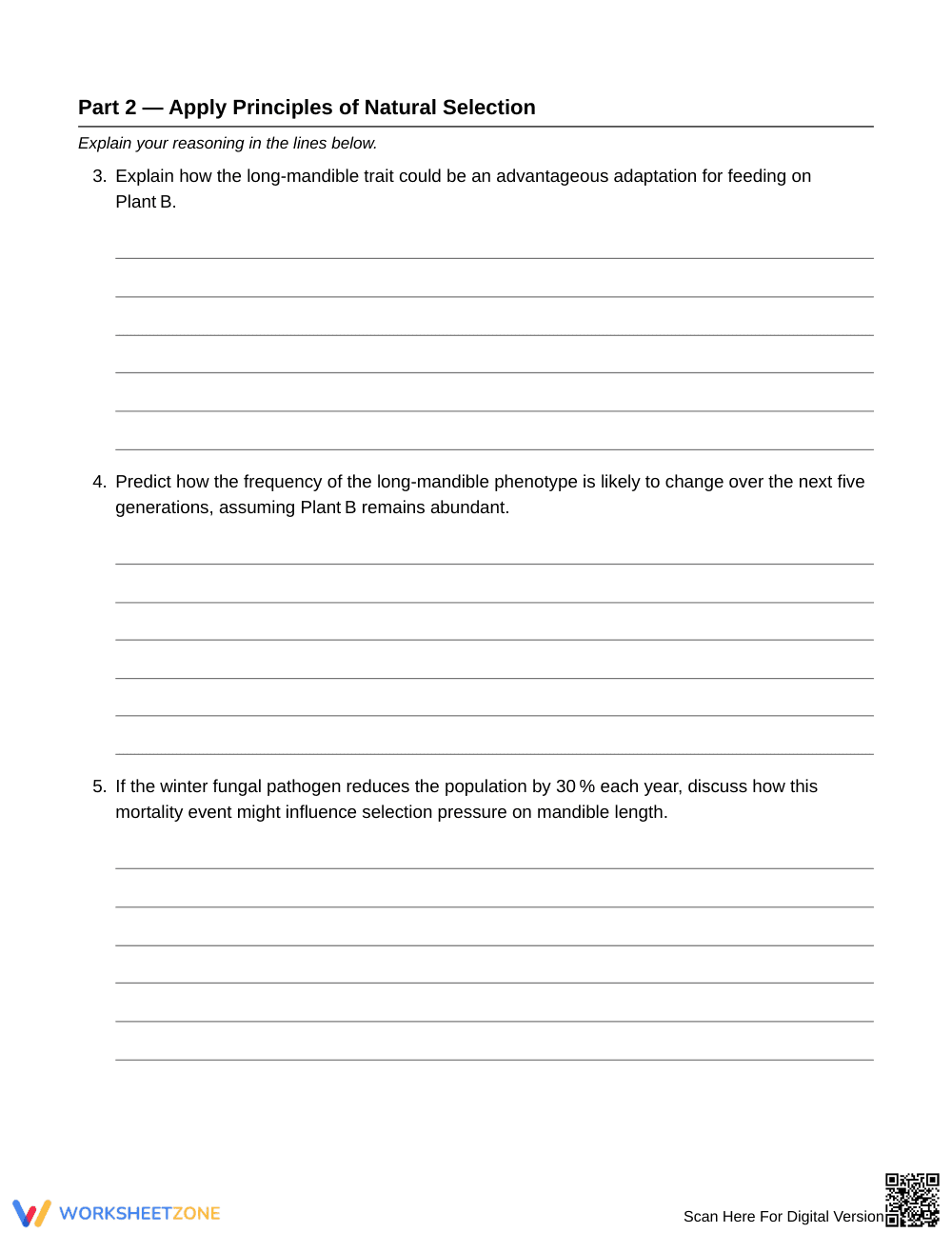
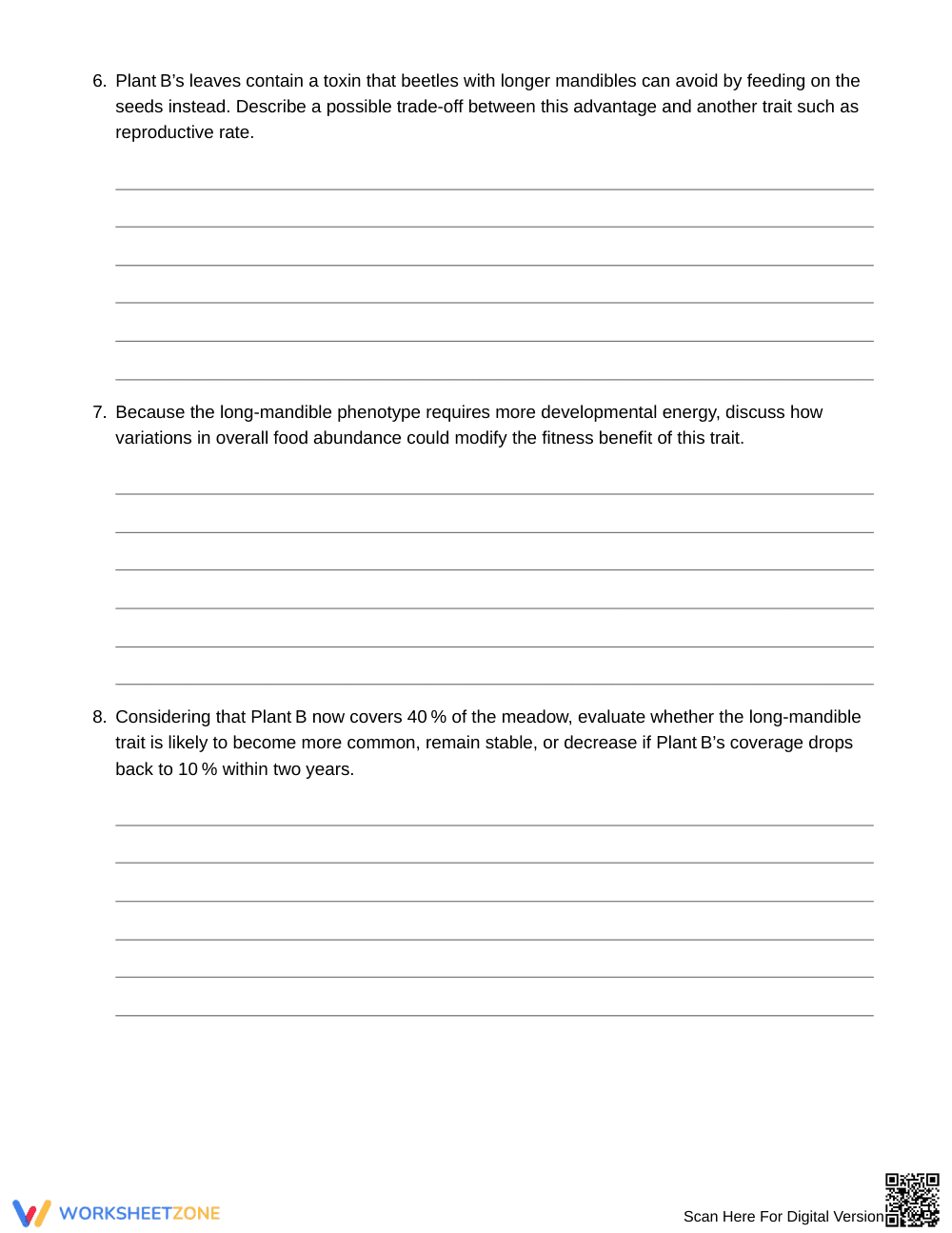
- Supported practice (Tasks 3–8): Learners apply natural selection mechanisms across six prompts to analyze energy trade-offs, phenotypic shifts across generations, and pathogen mortality effects.
- Independent practice (Tasks 9–10): Students independently evaluate external scientific claims to assess the validity of trait fixation and projected extinction outcomes.
This structured progression follows an explicit gradual-release model, moving high school learners from foundational variable identification to rigorous claim evaluation.
Standards Alignment
This biology resource aligns with high school life science standards requiring students to construct explanations based on evidence for how natural selection leads to adaptation in populations. The analytical exercises specifically evaluate trade-offs and differential survival across shifting environmental conditions. Standard descriptions can be copied directly into lesson plans, IEP goals, or district curriculum mapping tools.
How to Use It
Deploy this worksheet after direct instruction on natural selection mechanisms or as a collaborative mid-unit consolidation activity. During independent work time, circulate to monitor how students balance energetic costs against selective advantages in Task 6, providing immediate feedback on misconceptions regarding intentional adaptation. The complete activity takes approximately 35 to 45 minutes.
Who It's For
Designed for Grade 9 Biology students studying evolution and ecology, this resource supports diverse learners through data-embedded prompts and structured analytical questions. Pair this assignment with a population genetics anchor chart or an introductory lesson on allele frequencies to reinforce foundational concepts.
Evaluating biological adaptation scenarios enables students to move beyond rote memorization of evolutionary definitions toward rigorous scientific argumentation. According to research on structured disciplinary literacy and instructional scaffolding by Fisher & Frey (2014), systematic gradual-release tasks significantly improve secondary students' ability to synthesize multi-variable data and critique evidence-based assertions. This 10-task worksheet reinforces high school biology learning goals by requiring students to analyze environmental constraints, quantify phenotypic distributions, and assess fitness trade-offs in changing ecosystems. By engaging with realistic scenarios such as invasive plant introductions and energy costs, learners construct mechanistic explanations for natural selection and evaluate common misconceptions surrounding population-level extinction and trait fixation. The included comprehensive scoring key supports targeted formative evaluation, ensuring that educators can verify conceptual mastery while helping ninth-grade biology students develop critical reasoning skills necessary for advanced biological inquiry.


