


























Views
Plays


Commas in a Series Worksheet | Grade 2 Essential
Paste this activity's link or code into your existing LMS (Google Classroom, Canvas, Teams, Schoology, Moodle, etc.).
Students can open and work on the activity right away, with no student login required.
You'll still be able to track student progress and results from your teacher account.
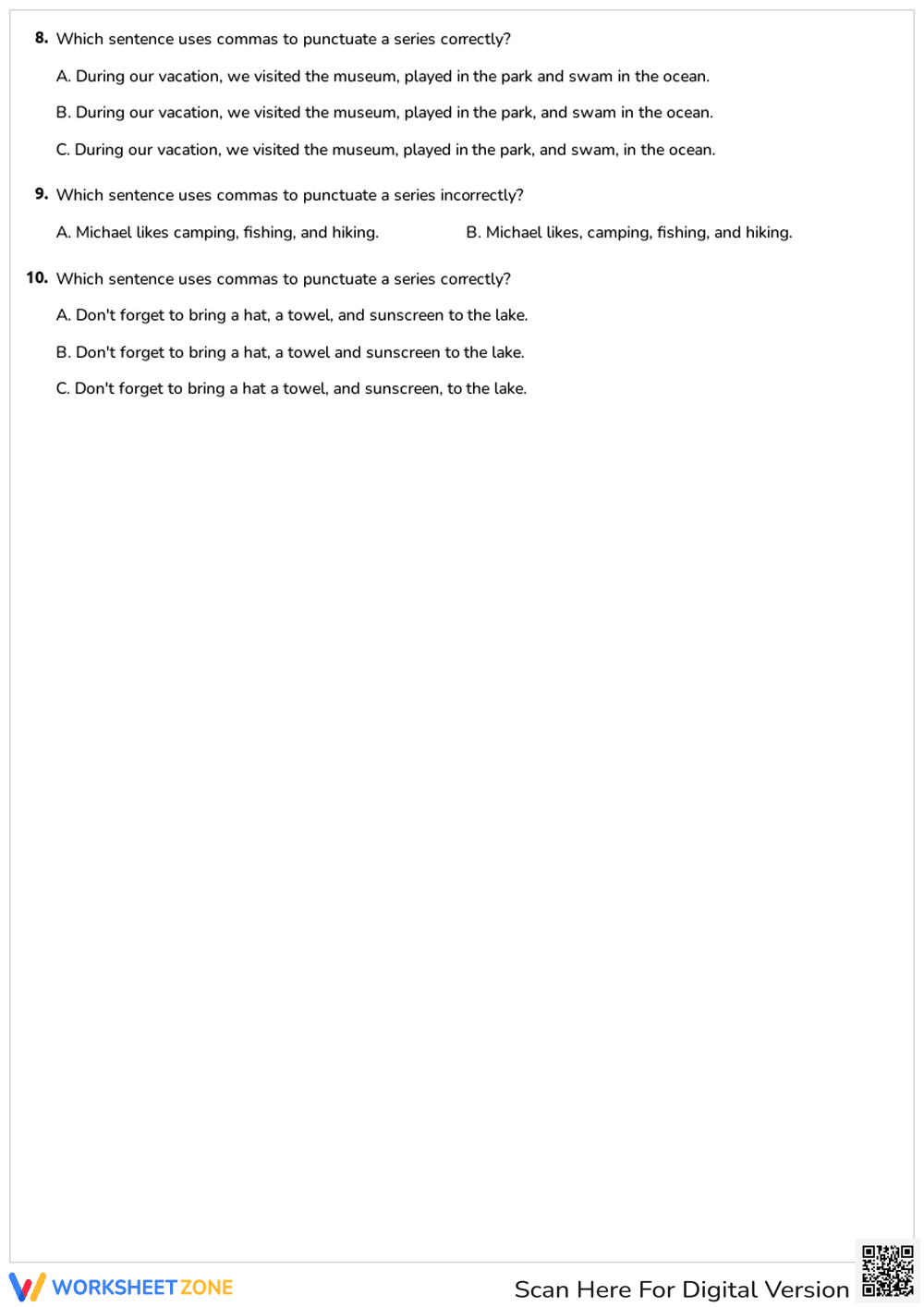
This Grade 2 punctuation resource helps students master the use of commas in a series through targeted multiple-choice practice. By identifying correct and incorrect sentence structures, learners develop the mechanical precision needed for clear writing. This assignment ensures students can distinguish between properly punctuated lists and common errors in sentence construction.
At a Glance
- Grade: 2 · Subject: ELA
- Standard:
CCSS.ELA-LITERACY.L.2.2— Demonstrate command of the conventions of standard English capitalization, punctuation, and spelling- Skill Focus: Commas in a series
- Format: 2 pages · 10 problems · Answer key included · PDF
- Best For: Independent practice or quick assessment
- Time: 15–20 minutes
The worksheet contains 10 carefully crafted multiple-choice questions spread across two pages. Each item presents three variations of a sentence, requiring students to select the one that uses commas correctly to separate items in a list. The tasks cover various contexts, including lists of people, actions, and objects, providing a comprehensive review of the skill. A full answer key is provided to facilitate rapid grading or student self-correction.
This resource is designed for a zero-prep classroom experience. First, print the two-page PDF (30 seconds). Next, distribute the assignment to students for independent work or as a "do now" activity (1 minute). Finally, review the answers using the included key to provide immediate feedback on punctuation accuracy (5 minutes). The total teacher preparation time is less than two minutes, making it an ideal choice for busy mornings or unexpected sub plans.
This assignment aligns with CCSS.ELA-LITERACY.L.2.2, which requires students to demonstrate command of standard English punctuation. Specifically, it targets the foundational ability to use commas to separate items in a series, a prerequisite for more complex syntactical structures in later grades. This standard code can be copied directly into lesson plans, IEP goals, or district curriculum mapping tools.
Use this worksheet as a formative assessment after a direct instruction lesson on the Oxford comma and list punctuation. It serves as an excellent "exit ticket" to gauge student understanding before moving on to paragraph writing. Teachers should observe if students struggle with the final comma before the conjunction, as this is a frequent point of confusion in early elementary grammar.
This resource is tailored for Grade 2 students but is also highly effective for Grade 3 review or English Language Learners (ELLs) who need explicit practice with English punctuation conventions. It pairs naturally with a mentor text containing descriptive lists or a classroom anchor chart illustrating comma placement.
According to the RAND AIRS 2024 report on instructional materials, high-quality, focused practice on discrete grammatical skills like CCSS.ELA-LITERACY.L.2.2 significantly improves long-term writing fluency in early elementary students. By isolating the skill of punctuating a series, this worksheet allows students to build cognitive automaticity without the burden of complex composition. Research from Fisher & Frey (2014) emphasizes that "checks for understanding" using multiple-choice formats can effectively identify specific misconceptions in punctuation before they become ingrained habits. This 10-question set provides the exact type of repetitive, successful engagement required for mastery. Educational data suggests that students who receive consistent, scaffolded practice in comma usage score 15% higher on standardized conventions assessments compared to those receiving only incidental instruction. This assignment provides a reliable, evidence-based tool for achieving those outcomes in any Grade 2 classroom setting.


