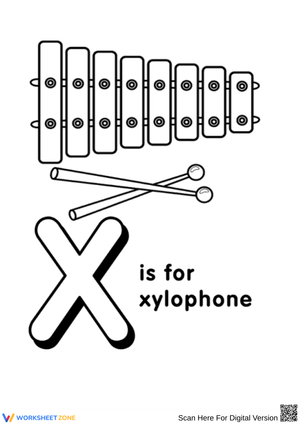
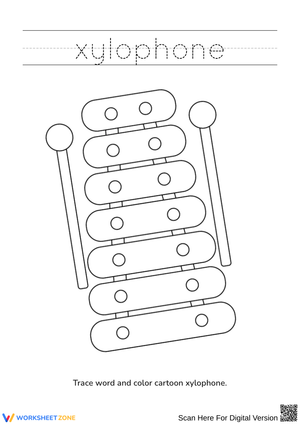
These xylophone coloring pages show a stepped row of bars, running from long bars for low notes to short bars for high notes, with two mallets resting across the top. Thick black outlines keep each bar easy to fill in with crayon, marker, or colored pencil without color bleeding past the edges. Some sheets add a wooden frame or resonator tubes underneath the bars, giving teens and older kids extra detail, while toddlers and preschoolers can stick to the simple bar-and-mallet shape for quick, satisfying coloring time.
What's Included in the Xylophone Coloring Set
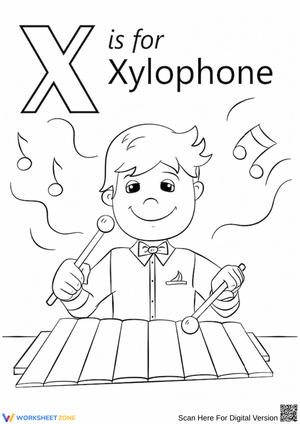
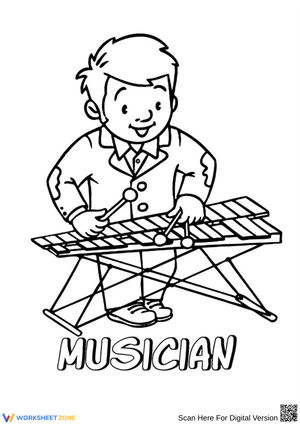
The set includes a single xylophone outline, a xylophone paired with floating music notes for a livelier scene, and a version showing a child striking the bars mid-song. Toy-style pages mimic the 8 to 15 colorful bars found on classroom and nursery instruments, while a concert-style option hints at the longer 42 to 48 bar layout professional players use. Each printable comes as a standard letter-size sheet, so the set works well for a music class matching activity, a birthday party handout, or quiet-time coloring on a rainy afternoon.
Coloring Tips for Rainbow Bars and Clean Mallets
For a toy-like look, color each bar its own bright shade, red, orange, yellow, green, blue, and purple, the way many kids' xylophones are painted from the box. For a calmer, wood-toned version, shade every bar in warm browns and tans with darker lines for shadow between them. Colored pencils work well for blending gradient bars, while markers give bold, solid color that pops on a bulletin board. Add a simple background, like music staff lines or a starburst, to turn a plain outline into a finished piece worth displaying.
Frequently Asked Questions
1. What colors work best on a xylophone coloring page?
A classic look uses one bright color per bar, red, orange, yellow, green, blue, and purple, just like a toy store xylophone. A wood-toned version works too: shade the bars in warm browns and tans with darker lines between each one for depth. Markers give the boldest, most solid color, while colored pencils blend smoothly for a softer, shaded finish.
2. Can these xylophone coloring pages work for music class?
Yes, teachers often hand out xylophone coloring pages during a unit on instrument families or rhythm, since kids can label bars, count them, or match colors to notes while they color. The simple bar-and-mallet outline also works as a quiet warm-up activity before a music lesson starts, and the letter-size PDF format prints cleanly for a full classroom set without any scaling or cropping issues.
3. What is a surprising fact about xylophone origins?
Wood-bar instruments like the xylophone date back roughly 4,000 years, with early versions built in Indonesia and China around 2000 B.C., long before the metal-bar glockenspiel existed. Concert xylophones can have up to 48 bars and often sit above hollow resonator tubes that make each note ring louder, a detail that turns a plain coloring outline into a more detailed, tube-and-bar design for advanced colorers.












 Interactive Worksheet Maker
 Quiz Maker
 Word Search Maker
 Crossword Puzzle Maker
 Word Scramble Generator
 Sentence Scramble Generator
 Handwriting Worksheet Generator
 Name Tracing Generator
 Fill In The Blank Generator