


























Views
Plays


Grade 9 Climate Characteristics: Printable Worksheet
Paste this activity's link or code into your existing LMS (Google Classroom, Canvas, Teams, Schoology, Moodle, etc.).
Students can open and work on the activity right away, with no student login required.
You'll still be able to track student progress and results from your teacher account.
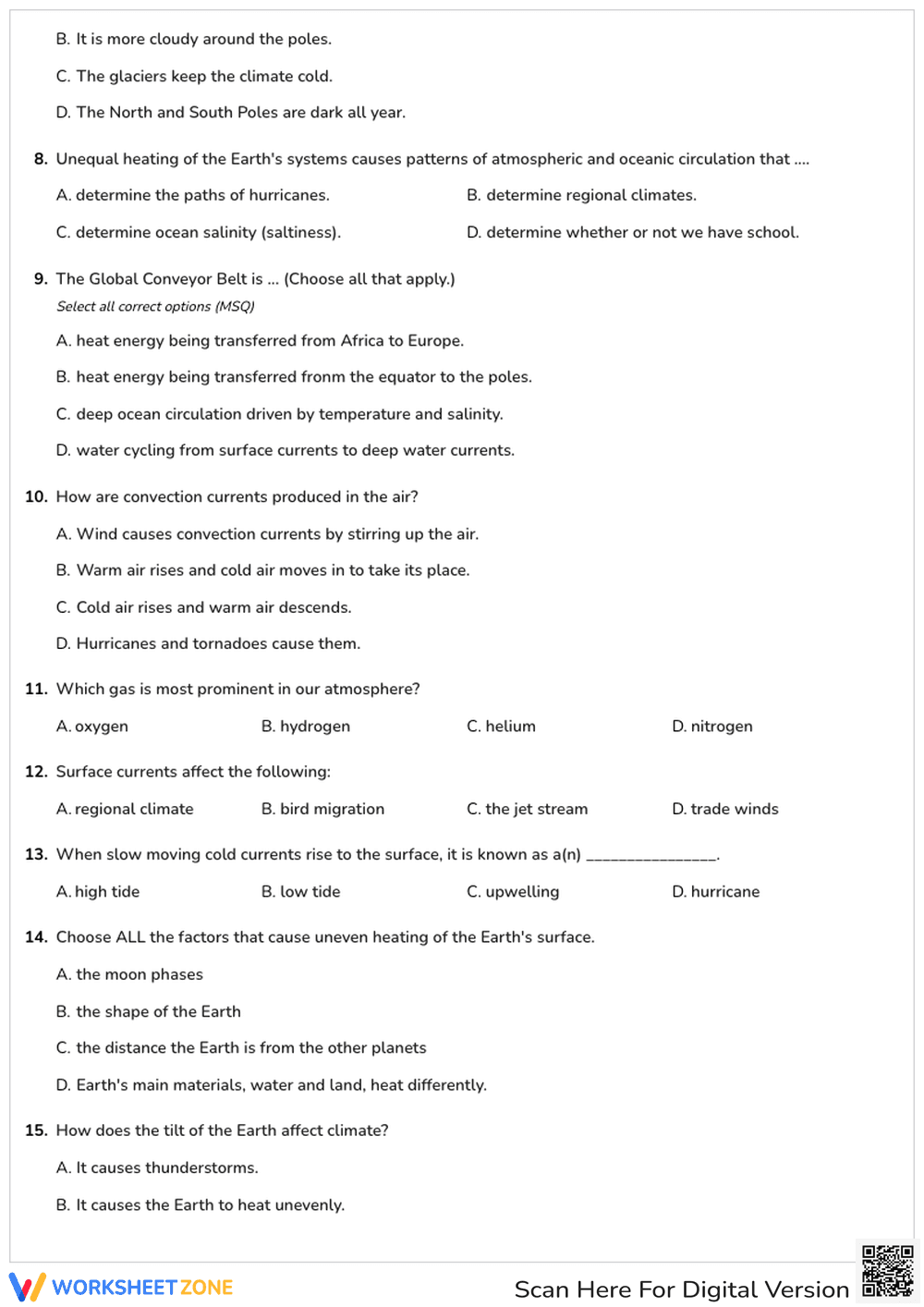
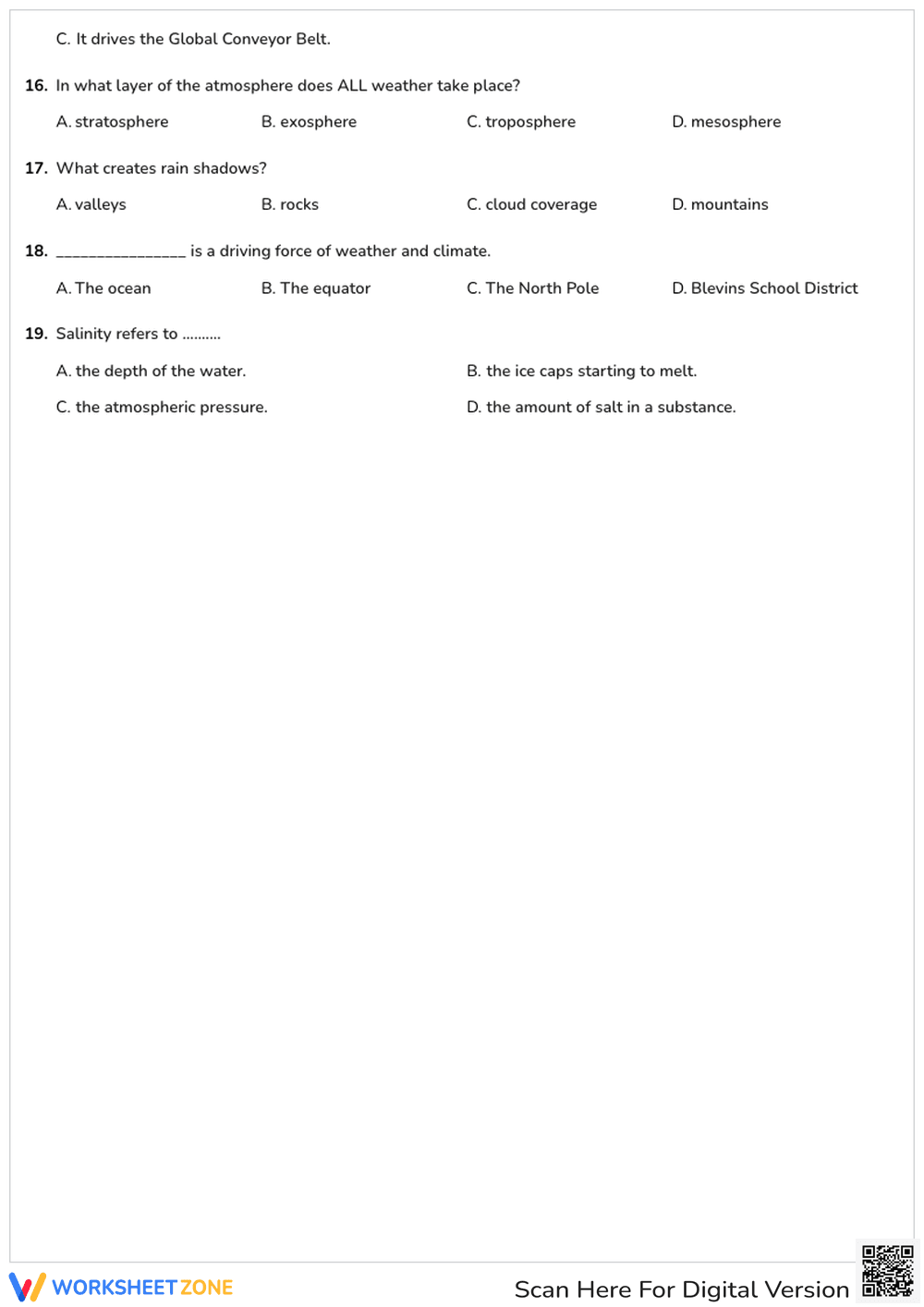
This Grade 9 science worksheet provides students with targeted practice on weather and climate characteristics. By completing these focused multiple-choice questions, learners will demonstrate their understanding of how uneven heating, ocean currents, and atmospheric conditions interact to shape regional climates across the globe.
At a Glance
- Grade: 9 · Subject: Science
- Standard:
MS-ESS2-6— Describe how unequal heating causes circulation patterns- Skill Focus: Weather and climate characteristics
- Format: 3 pages · 19 problems · PDF
- Best For: Formative assessment or independent practice
- Time: 20–25 minutes
This comprehensive assessment includes 19 multiple-choice questions spread across three pages. The task types range from basic vocabulary recall, such as distinguishing between weather and climate, to conceptual application questions about convection currents, the Global Conveyor Belt, and the rain shadow effect. The structured format ensures students can easily navigate the questions, making it an excellent tool for evaluating comprehension of complex Earth science systems.
- Print (1 minute): Simply download the PDF and print a class set. The clean layout requires no special formatting or color ink.
- Distribute (1 minute): Hand out the three-page packet at the start of class or as a structured review activity.
- Review (5 minutes): Go over the questions together as a class to correct misconceptions about atmospheric heating and ocean currents.
Total teacher prep time is under two minutes, making this an ideal resource for emergency sub plans or quick formative checks.
Aligned to MS-ESS2-6: Develop and use a model to describe how unequal heating and rotation of the Earth cause patterns of atmospheric and oceanic circulation that determine regional climates. It also supports high school foundational review for HS-ESS2-4 regarding energy flow in Earth's systems. Both standard codes can be copied directly into lesson plans, IEP goals, or district curriculum mapping tools.
This resource works perfectly as an end-of-unit quiz after direct instruction on Earth's atmosphere and oceans. Alternatively, use it as a pre-assessment to gauge prior knowledge before introducing advanced climate change topics. As a formative assessment observation tip, monitor which students struggle with questions about the Global Conveyor Belt to identify who needs a quick reteach on ocean salinity and temperature. Expected completion time is 20 to 25 minutes.
This worksheet is designed for 9th-grade general science or Earth science students. The straightforward multiple-choice format provides built-in scaffolding for students who benefit from having answer options rather than generating open-ended responses. It pairs naturally with a direct instruction lesson on the Coriolis effect or a hands-on lab demonstrating convection currents in water.
Aligning instructional materials to specific learning targets like MS-ESS2-6 ensures students can accurately describe how unequal heating causes circulation patterns. According to EdReports 2024, providing students with clear, standards-aligned practice opportunities significantly improves their ability to grasp complex scientific phenomena, such as the distinction between short-term weather and long-term climate. Structured multiple-choice assessments allow educators to quickly identify misconceptions regarding atmospheric layers, the rain shadow effect, and oceanic currents. By integrating targeted questions about Earth's systems, teachers can effectively measure student mastery and adjust subsequent instruction to address specific knowledge gaps in environmental science. Consistent exposure to rigorous, standard-specific vocabulary builds the foundational knowledge required for advanced high school science coursework and fosters a deeper understanding of global climate dynamics.


