


























Views
Downloads

Classroom Procedures Match-Up | Essential Grade 1-4 Sheet
Paste this activity's link or code into your existing LMS (Google Classroom, Canvas, Teams, Schoology, Moodle, etc.).
Students can open and work on the activity right away, with no student login required.
You'll still be able to track student progress and results from your teacher account.
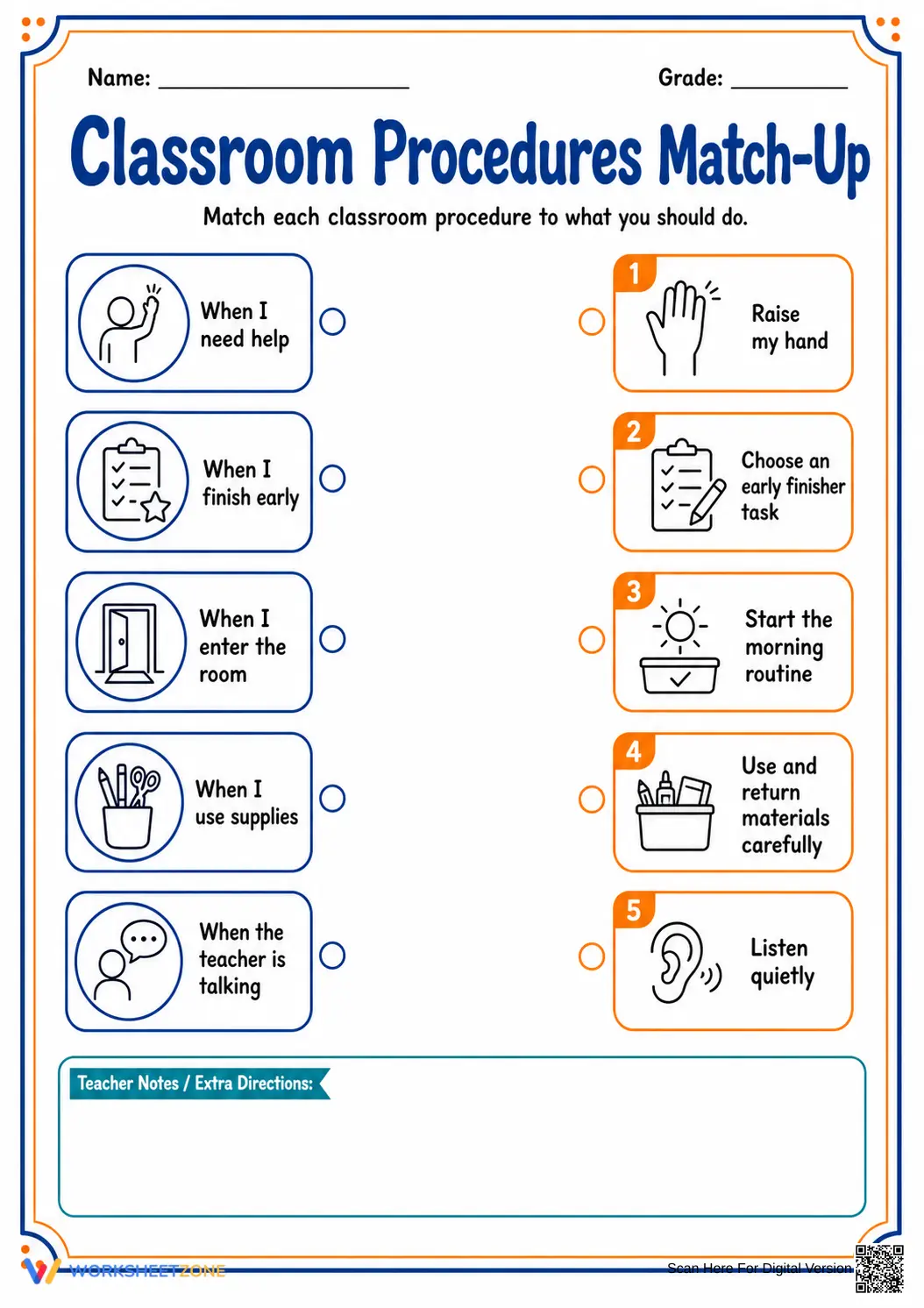
This Classroom Procedures Match-Up worksheet helps primary students internalize essential school routines through visual and textual association. By connecting specific scenarios to appropriate actions, learners develop the self-regulation skills necessary for a productive learning environment. It provides a clear framework for behavioral expectations during the critical first weeks of school.
At a Glance
- Grade: 1-4 · Subject: Classroom Management
- Standard:
CCSS.ELA-LITERACY.SL.1.1— Follow agreed-upon rules for discussions and participating in classroom activities- Skill Focus: Routine Recognition
- Format: 1 page · 5 problems · Answer key included · PDF
- Best For: First week of school routines
- Time: 10–15 minutes
The worksheet features a clean, dual-column layout with five distinct classroom scenarios on the left and five corresponding actions on the right. Each procedure is paired with a high-contrast 2D vector icon, such as a raised hand or a pencil cup, to support early readers and English Language Learners. A dedicated "Teacher Notes" section at the bottom allows for custom instructions or extensions.
This resource follows a zero-prep workflow designed for busy educators. First, print the single-page PDF (30 seconds). Next, distribute the sheets to students as a morning warm-up or transition activity (1 minute). Finally, review the matches as a whole group to reinforce the logic behind each procedure (5 minutes). Total teacher preparation time is under 2 minutes, making it an ideal choice for sub plans.
This activity aligns with CCSS.ELA-LITERACY.SL.1.1, which requires students to follow agreed-upon rules for discussions and carry out classroom tasks. By identifying the correct response to "When the teacher is talking" or "When I need help," students demonstrate mastery of foundational social-emotional standards. This standard code can be copied directly into lesson plans, IEP goals, or district curriculum mapping tools.
Use this worksheet during the first three days of the school year to establish a baseline for behavior. It serves as an excellent formative assessment; observe which students struggle to match "When I finish early" to "Choose an early finisher task" to identify who may need additional scaffolding. Expected completion time is 10 to 15 minutes depending on student reading levels.
This resource is ideal for students in Grades 1 through 4, including those in special education settings who benefit from visual cues. It pairs naturally with a classroom anchor chart or a direct instruction lesson on school expectations. It is also a reliable addition to any emergency substitute folder for quick, meaningful engagement.
According to the RAND AIRS 2024 report on school climate, explicit instruction in classroom procedures significantly reduces instructional friction and increases student engagement time. This worksheet applies these findings by providing a structured, low-stakes environment for students to practice routine recognition. By using visual icons alongside text, the resource supports the Fisher & Frey (2014) model of gradual release, moving from teacher-led modeling of rules to independent student identification. Research indicates that when students clearly understand the if-then logic of classroom behavior—such as matching a need for help with the action of raising a hand—they report lower levels of anxiety and higher levels of belonging. This 5-task matching activity serves as a concrete artifact of behavioral alignment, ensuring that CCSS.ELA-LITERACY.SL.1.1 is met through active student participation rather than passive listening.


