


























Views
Downloads

Classroom Agreement Worksheet | Grade 3-6 Essential
Paste this activity's link or code into your existing LMS (Google Classroom, Canvas, Teams, Schoology, Moodle, etc.).
Students can open and work on the activity right away, with no student login required.
You'll still be able to track student progress and results from your teacher account.
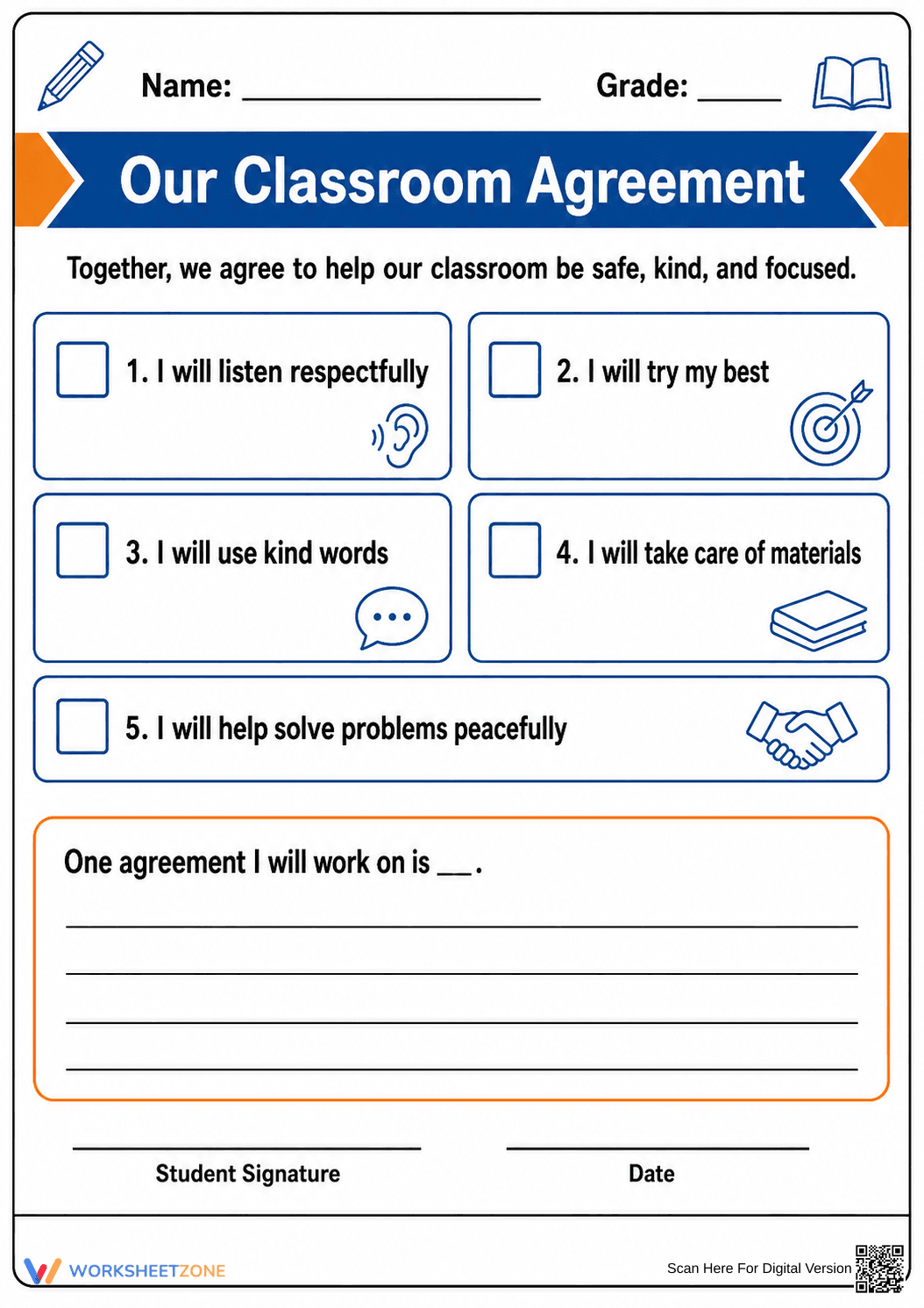
Establish a positive learning environment with this structured classroom contract. This worksheet helps students internalize behavioral expectations by actively committing to shared values like respect and responsibility. By signing this agreement, learners take ownership of their conduct, fostering a safe and focused community from day one.
At a Glance
- Grade: 3-6 · Subject: Social Emotional Learning
- Standard:
CCSS.ELA-LITERACY.SL.3.1— Follow agreed-upon rules for discussions and carry out assigned roles- Skill Focus: Classroom expectations and social contracting
- Format: 1 page · 7 tasks · No answer key needed · PDF
- Best For: Back-to-school community building and management
- Time: 15–20 minutes
This single-page printable features a professional layout with five core behavioral statements. Each statement includes a checkbox for student acknowledgement and a supporting icon to aid visual learners. The bottom half contains a dedicated reflection area with three writing lines for personalized goal setting, followed by formal signature and date lines to finalize the agreement.
Zero-Prep Workflow
- Print: Generate the A4 PDF and print enough copies for your roster in under 30 seconds.
- Distribute: Hand out the sheets and lead a 10-minute discussion on the five core values to ensure student buy-in.
- Review: Have students complete the reflection and sign the document in 5 minutes.
Total teacher preparation time is under 2 minutes, making it an ideal first-week activity or a reliable addition to a substitute teacher folder.
Standards Alignment
This worksheet aligns with `CCSS.ELA-LITERACY.SL.3.1`, which requires students to follow agreed-upon rules for discussions and collaborative work. It also supports broader Social Emotional Learning (SEL) frameworks regarding self-management and relationship skills. Both standard codes can be copied directly into lesson plans, IEP goals, or district curriculum mapping tools.
How to Use It
Use this worksheet during the first week of school to establish a formal Social Contract. After discussing each point, have students check the boxes to indicate understanding. It also serves as a formative assessment tool; observe which agreement students choose for their reflection to identify potential behavioral trends. Completion typically takes 15 to 20 minutes during a morning meeting or homeroom block.
Who It's For
This resource is designed for students in grades 3 through 6 who are transitioning into more independent social environments. It is particularly effective for inclusive classrooms where clear, visual expectations are necessary. Pair this with a classroom anchor chart or a read-aloud about community to reinforce the concepts throughout the school year.
Research from Fisher & Frey (2014) emphasizes that establishing clear, co-constructed expectations is a foundational element of effective classroom management and student engagement. This worksheet operationalizes that research by providing a tangible framework for the CCSS.ELA-LITERACY.SL.3.1 standard, which focuses on following agreed-upon rules for collaborative environments. By requiring a physical signature and a written reflection, the resource leverages the commitment and consistency principle of social psychology, increasing the likelihood that students will adhere to the stated norms. Data from the NAEP suggests that classrooms with high levels of perceived safety and clear behavioral boundaries show significantly higher academic achievement across core subjects. This printable serves as a professional, durable artifact of that boundary-setting process, ensuring that every student understands their role in maintaining a productive learning space. It is a vital tool for any educator looking to build a culture of mutual respect.


