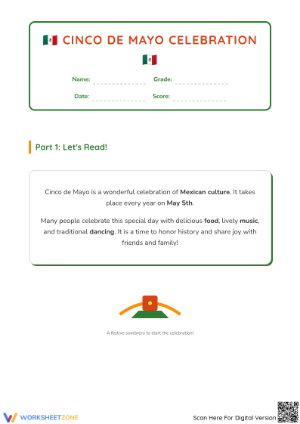
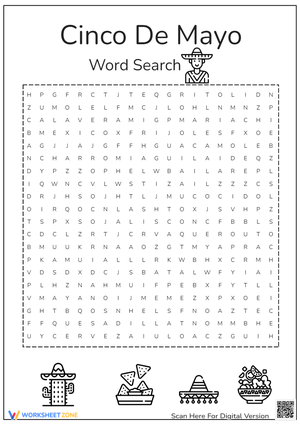
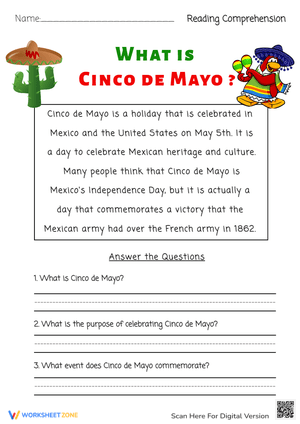
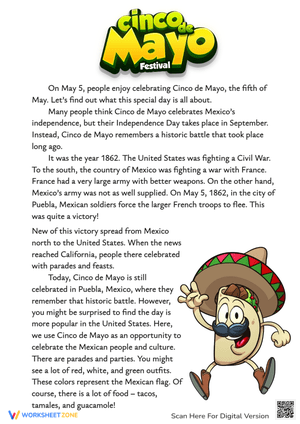
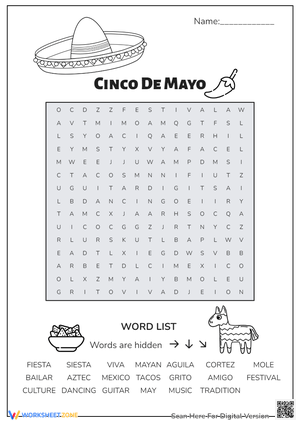
These cinco de mayo printable worksheets give teachers a direct path into one of the most commonly misrepresented cultural observances in American schools. The set covers the Battle of Puebla, the distinction between May 5th and Mexican Independence Day, key historical figures, and the cultural evolution of the holiday in the United States. Students come away understanding what actually happened on May 5, 1862 — not just that the date appears on the calendar.
The Misconception That Walks Into the Room Before You Teach a Word
Nearly every class arrives believing Cinco de Mayo is Mexico's Independence Day. This happens because the holiday carries the visual and emotional vocabulary of national pride — flags, patriotic colors, representations of Mexican identity — and American students reasonably map those signals onto what independence celebrations look like. Ask students to write what they already know on a sticky note before instruction begins, and expect "Mexico's independence" to appear in at least a third of the responses. The correct framing — that Mexico's actual Independence Day falls on September 16, marking the Grito de Dolores of 1810, fifty-two years before the Battle of Puebla — needs more than a single correction to stick. When a cinco de mayo printable worksheets addresses this distinction, format matters: a student who answers a true/false item correctly can still conflate the two events in a short-response explanation. The set uses multiple formats — sorting tables, side-by-side reading passages, fill-in timelines — because the misconception needs to be disrupted at more than one level of cognition.
What Each Worksheet Covers
The set spans social studies, language arts, and introductory Spanish, making individual worksheets easy to pull into an existing unit rather than treating this as a standalone holiday lesson. The specific tasks across the collection:
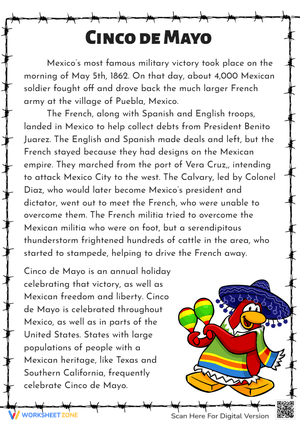
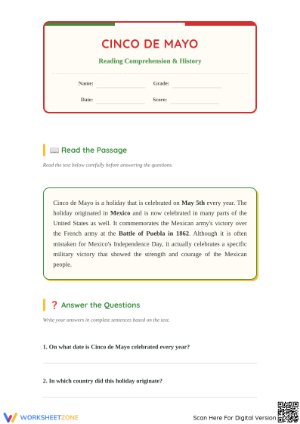
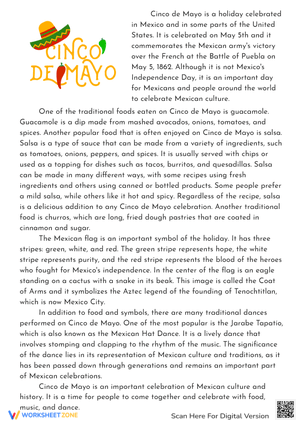
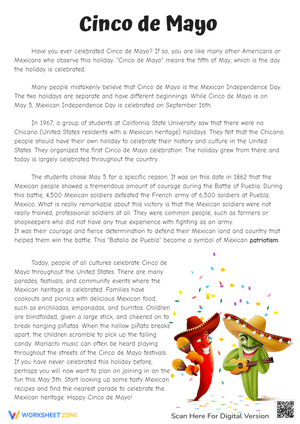
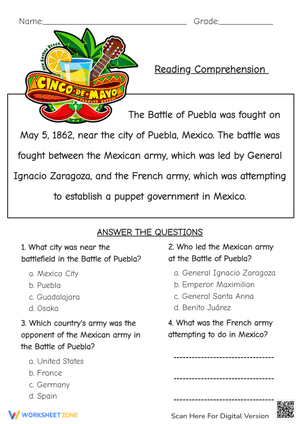
- Reading comprehension: Passages on the Battle of Puebla and the Second French Intervention, covering Napoleon III's territorial ambitions and the conditions that made the Mexican army's victory possible.
- Biographical profiles: Focused studies of General Ignacio Zaragoza, who commanded the Mexican forces, and President Benito Juárez, whose government was defending Mexican sovereignty throughout the Franco-Mexican War.
- Geography: Students locate Puebla and the port of Veracruz on a labeled political map of Mexico and examine the route of the French army's inland march, connecting physical terrain to military decision-making.
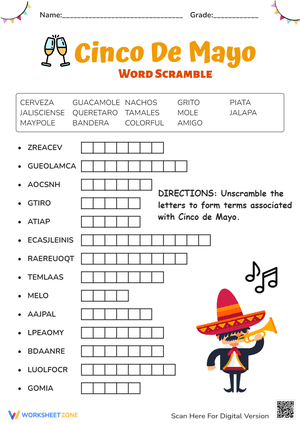
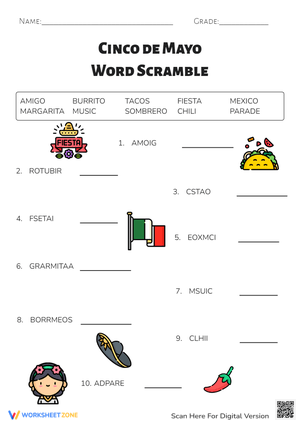
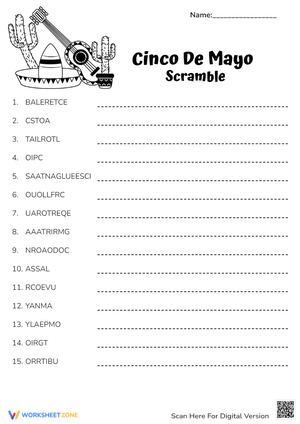
- Spanish vocabulary: Matching and sorting activities using terms related to the holiday, traditional music, and cultural observances — appropriate for introductory language classes or upper elementary grades.
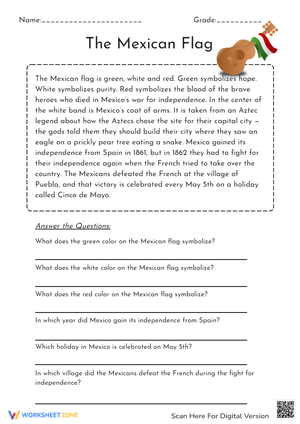
- Fact-sorting: Students categorize statements as belonging to the Battle of Puebla or to the Mexican War of Independence, directly targeting the most predictable error pattern with this topic.
Working These Worksheets Into Your Lesson Plans
Most teachers reach for a cinco de mayo printable worksheets in the days leading up to May 5th, but the content fits equally well inside a broader unit on 19th-century imperialism. The French military campaign in Mexico ran parallel, in both timing and structure, to European colonial expansion in Africa and Asia — placing the Battle of Puebla inside that global frame gives students a meaningful reason to track the outcome. When teaching it that way, open with the Zaragoza biography worksheet as a shared read on Monday: discuss what made the Mexican army's tactical position precarious before releasing students to complete the Battle of Puebla comprehension passage independently. For a single-period lesson, station rotations distribute the cognitive demands well — geography at one station, biography at a second, fact-sorting at a third — because the tasks draw on different skills and students rarely stall at all three simultaneously. Close the period with the exit-ticket worksheet so you know, before students leave the room, whether they can accurately distinguish May 5, 1862, from September 16, 1810.
Differentiating These Worksheets Across Your Class
For students who need more support, introduce four or five geographic and proper-name terms — Puebla, Veracruz, Napoleon III, Second French Intervention — before distributing any reading worksheet. Knowing those anchors going in keeps working memory free during the passage itself. Students ready for additional challenge take the biographical profiles further by writing a comparative paragraph on Zaragoza and Juárez — weighing the military and political role of each — rather than answering the provided questions. The fact-sorting worksheet has a useful built-in extension: students who finish early write a one-sentence correction for each false statement instead of simply marking it wrong, which shifts the task from recognition to explanation. One honest limitation worth stating upfront: the geography mapping worksheet assumes students can read a political map with labeled state borders. If that foundation is not yet in place, spend five minutes on a whole-class map orientation before releasing students to a cinco de mayo printable worksheets that depends on it — otherwise confusion about the map itself consumes the instructional time the lesson needs.
Standard Alignment
The reading comprehension worksheets connect to CCSS.ELA-LITERACY.RH.6-8.6, which asks students to distinguish an author's point of view from the evidence presented. In practice here, students compare a commercial description of the holiday to a historical account of the Battle of Puebla and identify what each source emphasizes or omits — exactly the sourcing task the standard targets. The geography worksheets address CCSS.ELA-LITERACY.RH.6-8.7, requiring students to integrate visual information with written text; locating Puebla and Veracruz on a political map while reading about troop movements makes that standard concrete rather than abstract. At the elementary level, the vocabulary and biographical worksheets align to CCSS.ELA-LITERACY.RI.4.3, which asks students to explain historical events and concepts using specific details from informational text. Teachers working within the C3 Framework will find the fact-sorting and comparative reading tasks aligned to the historical thinking practices in Dimension 2: History, particularly the expectations around sourcing evidence and analyzing events across distinct time periods.
Frequently Asked Questions
Is Cinco de Mayo a national holiday in Mexico?
No. It is observed most prominently in the state of Puebla, where the battle took place, but it remains a regular workday in most of the country. Government offices, banks, and schools outside of Puebla typically stay open. The holiday's scale as a major cultural event is largely an American phenomenon, shaped significantly by Chicano activists in the 1960s who drew symbolic connections between the Mexican army's defeat of a European imperial force and their own civil rights struggles.
Why does Cinco de Mayo receive more attention in the US than in most of Mexico?
The Chicano civil rights movement elevated May 5th as a day of cultural pride among Mexican-Americans, many of whom identified with the narrative of Indigenous Mexican soldiers defeating a European imperial army. Over subsequent decades, commercial interests amplified the holiday's visibility across the broader American market. Understanding that trajectory — from battlefield victory to civil rights symbol to national observance — is itself a substantive lesson in how historical moments accumulate cultural meaning over time, and several worksheets in the set treat that evolution as content rather than background.
How do I teach this topic without reducing it to cultural stereotypes?
Center the lesson on historical accuracy. These worksheets approach the subject through the Battle of Puebla, biographical study, and geographic context, which keeps instruction grounded in substance. The historical narrative of an outnumbered army defending national sovereignty against one of the most powerful military forces in the world is compelling enough to anchor the lesson on its own terms. When students understand what General Zaragoza actually accomplished on May 5, 1862, the holiday carries weight that no amount of festive decoration can substitute.












 Interactive Worksheet Maker
 Quiz Maker
 Word Search Maker
 Crossword Puzzle Maker
 Word Scramble Generator
 Sentence Scramble Generator
 Handwriting Worksheet Generator
 Name Tracing Generator
 Fill In The Blank Generator