


























Views
Downloads
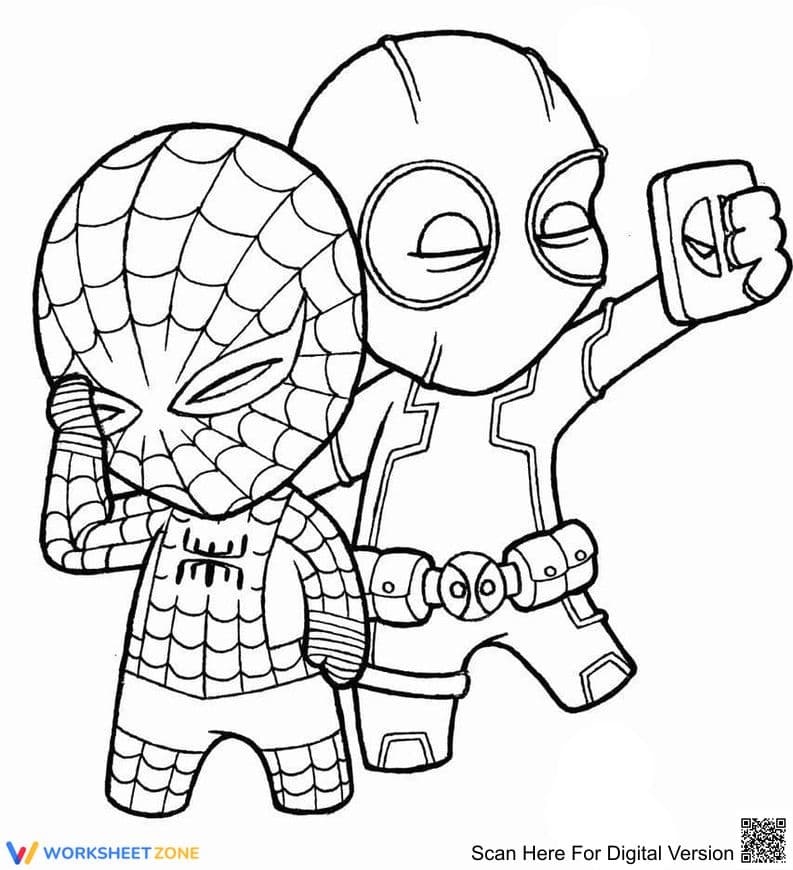

Chibi Spider-Man & Deadpool Coloring | Printable Page
Paste this activity's link or code into your existing LMS (Google Classroom, Canvas, Teams, Schoology, Moodle, etc.).
Students can open and work on the activity right away, with no student login required.
You'll still be able to track student progress and results from your teacher account.
This Chibi Miles Morales and Deadpool coloring worksheet provides a creative outlet for elementary students to develop essential fine motor control and artistic expression. By engaging with popular superhero characters, learners practice hand-eye coordination and spatial awareness. It serves as an ideal reward activity or a calming transition tool for busy classroom environments.
At a Glance
- Grade: K-5 · Subject: Arts & English
- Standard:
VA:Cr1.1.Ka— Engage in exploration and imaginative play with various art materials- Skill Focus: Fine motor development and color theory
- Format: 1 page · 1 task · No answer key required · PDF
- Best For: Early finishers and indoor recess
- Time: 15–30 minutes
The resource features a high-resolution line-art illustration of two iconic Marvel characters in a chibi aesthetic. The single-page PDF includes bold outlines to assist younger learners in staying within lines, while providing enough detail for older students to experiment with shading and blending. No additional teacher setup is required beyond printing, making it a reliable resource for any elementary setting.
The workflow for this activity is designed for maximum efficiency. First, print the desired number of copies in under 30 seconds. Second, distribute the pages along with crayons, markers, or colored pencils, taking less than 1 minute. Finally, allow students to work independently while you manage small groups or complete administrative tasks. This makes it a perfect emergency sub-plan addition that requires zero teacher prep time.
The primary standard addressed is `VA:Cr1.1.Ka`, which focuses on the student's ability to engage in exploration and imaginative play with materials. While primarily an arts standard, it supports `CCSS.ELA-LITERACY.L.K.1.A` by strengthening the intrinsic hand muscles necessary for legible handwriting and letter formation. Both standard codes can be copied directly into lesson plans, IEP goals, or district curriculum mapping tools.
Use this worksheet as a formative assessment of a student's grip strength and focus during independent work time. It is best assigned after a high-energy lesson to help students regulate their emotions and transition to a quiet reading block. Completion typically takes between 15 and 30 minutes depending on the student's attention to detail and choice of medium.
This activity is designed for Kindergarten through 5th-grade students, particularly those who benefit from visual-spatial tasks. It is an excellent resource for Occupational Therapy sessions or as a companion to a creative writing prompt where students describe the scene they have colored. Pair it with a superhero-themed storybook for a cohesive thematic unit that engages reluctant learners.
According to the RAND AIRS 2024 report, integrating creative arts into the primary curriculum significantly improves student engagement and emotional regulation. This worksheet targets the VA:Cr1.1.Ka standard by allowing students to explore color application and character design through the lens of popular culture. Research by Fisher & Frey (2014) emphasizes that fine motor activities, such as coloring within defined boundaries, serve as a foundational precursor to formal writing skills in early childhood education. By providing a low-stakes environment for artistic experimentation, educators can foster a positive classroom climate while simultaneously building the physical dexterity required for more complex academic tasks. This printable resource ensures that students remain productive during transitions, offering a structured yet creative break that aligns with national standards for visual arts and early literacy development.


