


























Views
Downloads

Character Inference Worksheet | Grade 6 Printable
Paste this activity's link or code into your existing LMS (Google Classroom, Canvas, Teams, Schoology, Moodle, etc.).
Students can open and work on the activity right away, with no student login required.
You'll still be able to track student progress and results from your teacher account.
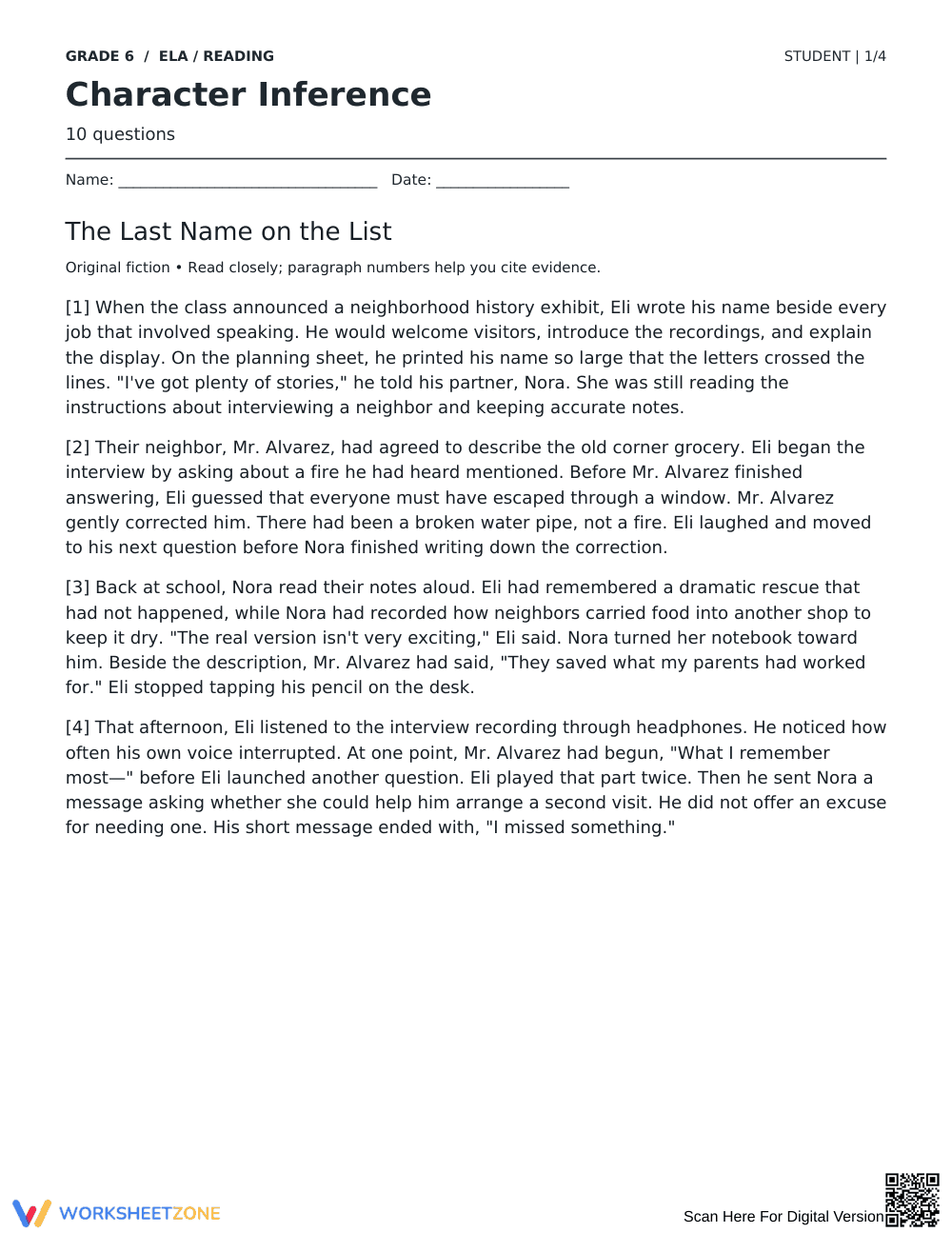
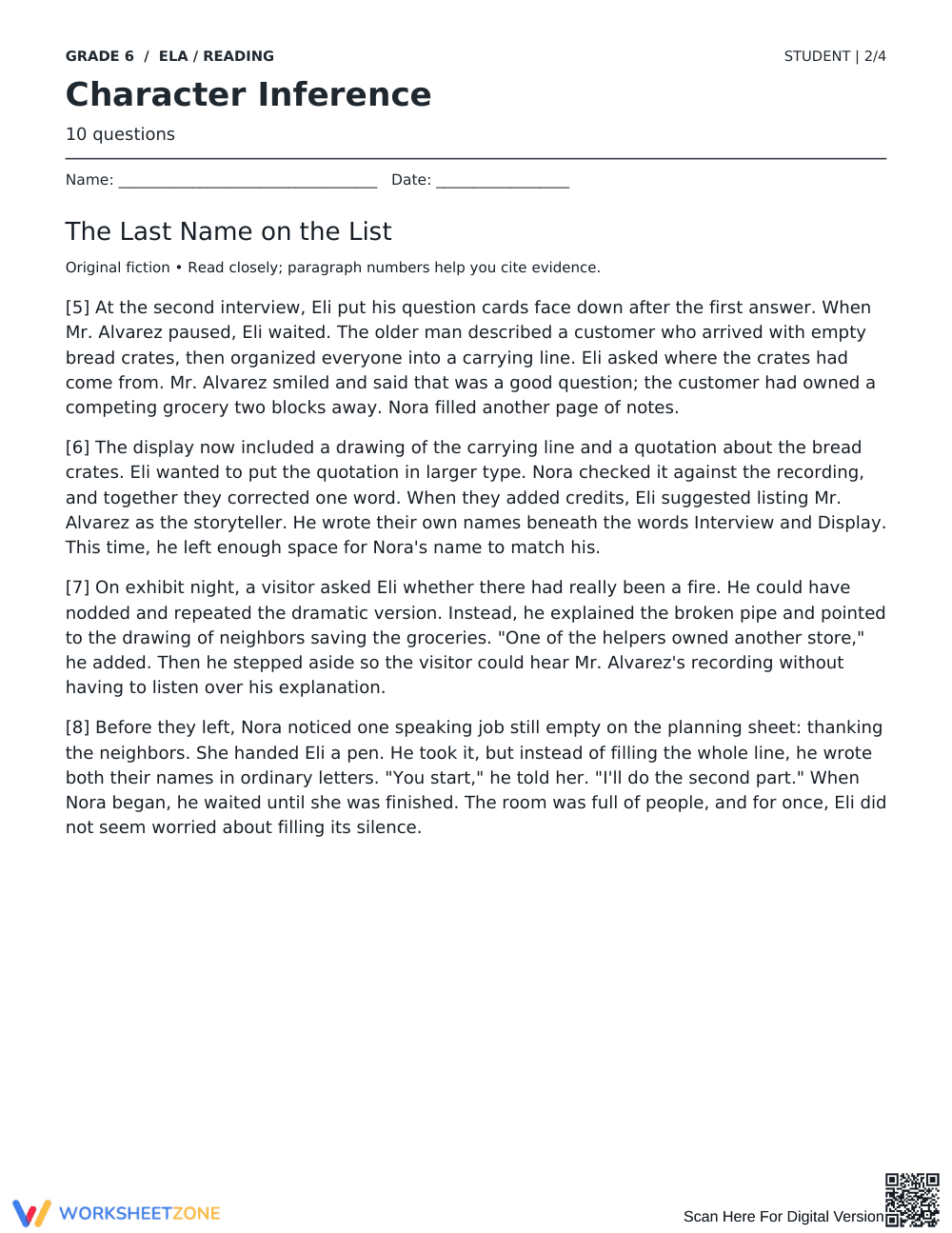
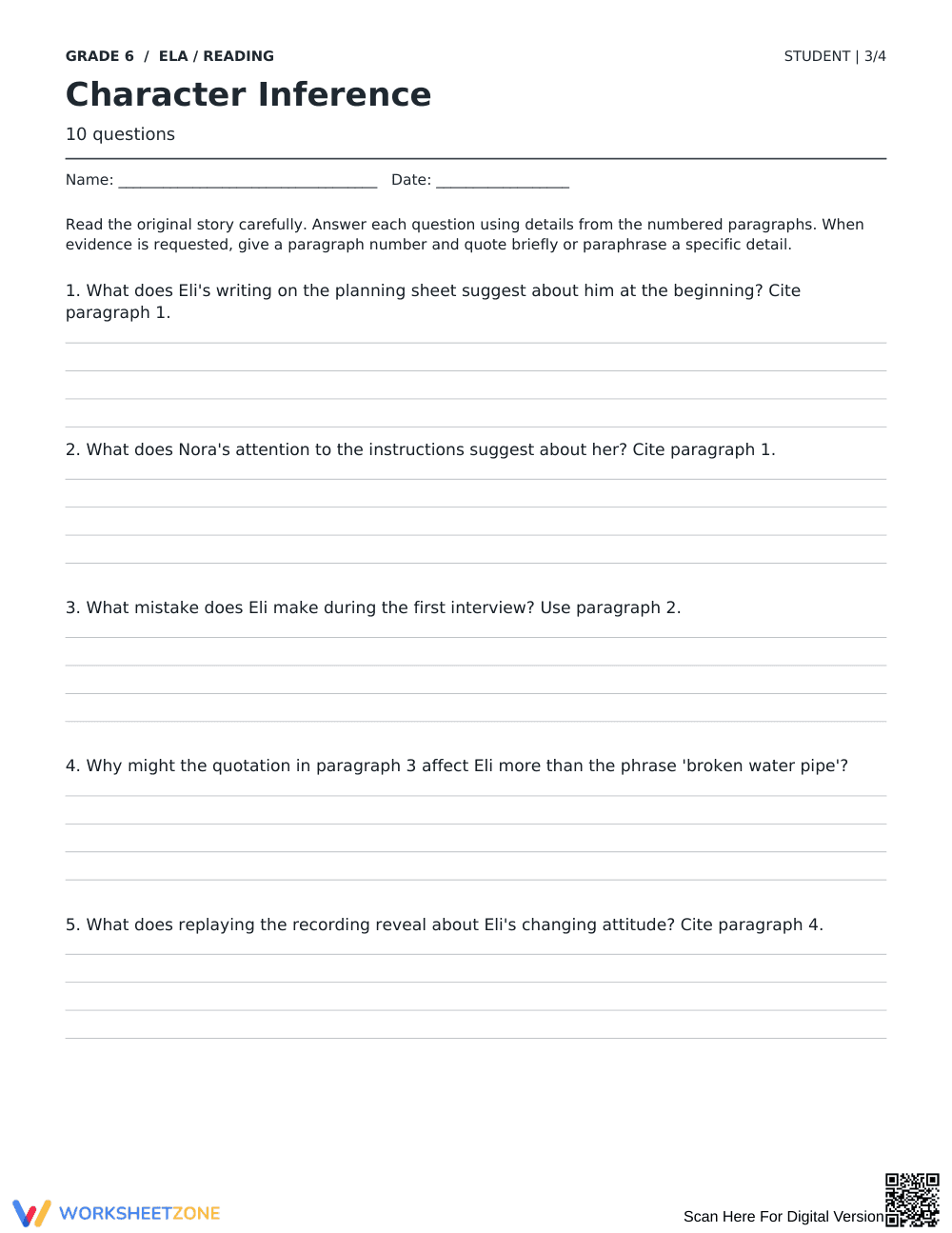
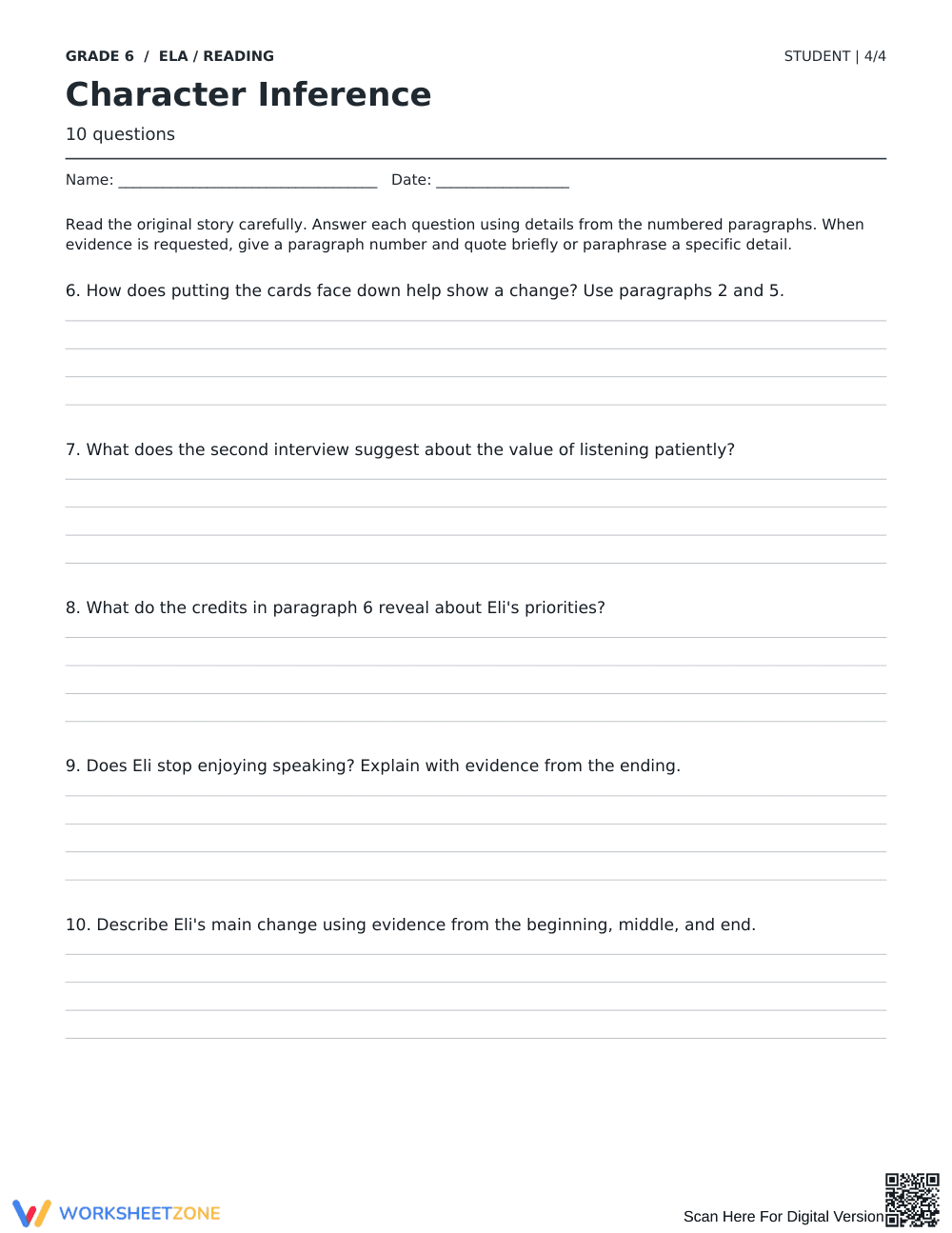
This Grade 6 character inference worksheet builds students' ability to read closely, cite textual evidence, and draw logical conclusions about characters' traits, motivations, and feelings. Across 18 structured tasks, students practice moving beyond surface-level reading to support every inference with direct proof from the passage.
At a Glance
- Grade: 6 · Subject: English / Reading
- Standard:
CCSS.ELA-LITERACY.RL.6.1— Cite textual evidence to support inferences drawn from a text- Skill Focus: Character inference using text evidence
- Format: 4 pages · 18 problems · Answer key included · PDF
- Best For: Independent practice after close-reading instruction
- Time: 25–40 minutes
The worksheet spans 4 student-facing pages and includes a short literary passage followed by 18 inference questions. Each question prompts students to identify a character trait or motivation and then locate the specific line or lines from the text that support their thinking. The included answer key provides model responses with acceptable evidence citations, making scoring straightforward for teachers and usable for student self-correction.
Skill Progression
- Guided practice (problems 1–6): Sentence-frame scaffolds direct students to name a trait and copy the supporting quote, reducing cognitive load while building the inference habit.
- Supported practice (problems 7–12): Frames are partially removed; students select the trait from a short word bank and write the evidence in their own words, bridging toward independence.
- Independent practice (problems 13–18): No scaffolds. Students generate the inference and locate evidence entirely on their own, mirroring the demand of on-grade assessments.
This gradual-release structure mirrors the I Do / We Do / You Do model, giving teachers a single resource that moves students from supported to fully independent performance within one sitting.
Standards Alignment
Primary standard: CCSS.ELA-LITERACY.RL.6.1 — Cite textual evidence to support analysis of what the text says explicitly as well as inferences drawn from the text. A supporting standard, CCSS.ELA-LITERACY.RL.6.3, is addressed naturally as students analyze how character responses and motivations develop across the passage. Both standard codes can be copied directly into lesson plans, IEP goals, or district curriculum mapping tools.
How to Use It
Use problems 1–6 during direct instruction as a shared-practice tool, projecting the page and completing items together before releasing students to problems 7–18. Alternatively, assign the full worksheet after a close-reading lesson as a formative check: scan student responses to problems 13–18 to identify who is citing specific lines versus paraphrasing vaguely — a quick indicator of who needs a re-teach on evidence selection. Most students complete the worksheet in 25–40 minutes.
Who It's For
Designed for on-grade sixth-grade readers, this worksheet also supports advanced fifth graders working on inference skills and seventh graders who need targeted review of textual evidence. Pair it with a character-traits anchor chart and a brief direct-instruction lesson on the difference between explicit information and inference for maximum impact.
This four-page printable targets CCSS.ELA-LITERACY.RL.6.1, the standard requiring sixth graders to cite textual evidence when making inferences about literary text. Character inference — identifying traits, motivations, and feelings from indirect clues — is a foundational comprehension skill. According to NAEP data, fewer than 40% of eighth graders perform at or above the Proficient level in reading, with evidence-based inference identified as a persistent gap. Fisher & Frey (2014) link structured gradual-release frameworks directly to measurable gains in text-dependent reasoning. The 18-problem sequence in this worksheet moves students from scaffolded to independent inference in a single session, providing teachers with an efficient formative snapshot. The included answer key supports both immediate scoring and student self-assessment, making this resource practical for core instruction, small-group intervention, and independent work stations.


