


























Views
Downloads
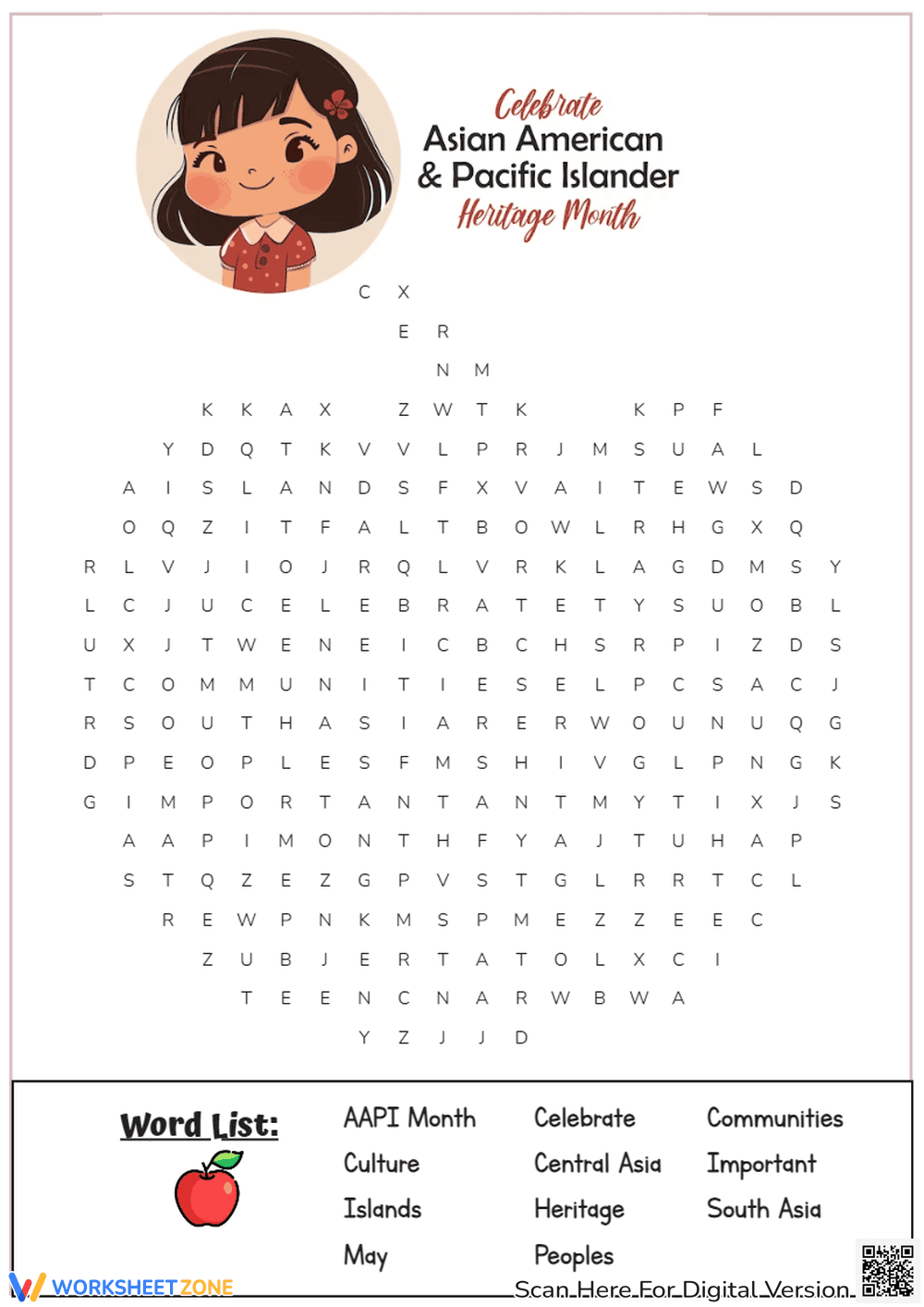

AAPI Heritage Month Word Search | Essential Grade 1-3
Paste this activity's link or code into your existing LMS (Google Classroom, Canvas, Teams, Schoology, Moodle, etc.).
Students can open and work on the activity right away, with no student login required.
You'll still be able to track student progress and results from your teacher account.
This Grade 1-3 AAPI Heritage Month word search provides a meaningful way for students to engage with cultural vocabulary while strengthening their spelling and pattern recognition skills. By identifying 11 key terms related to Asian American and Pacific Islander history, learners develop a foundational understanding of diversity and community. This printable resource ensures students master essential academic language.
At a Glance
- Grade: 1-3 · Subject: ELA & Social Studies
- Standard:
CCSS.ELA-LITERACY.L.2.6— Use words and phrases acquired through reading and responding to texts.- Skill Focus: Vocabulary & Cultural Awareness
- Format: 1 page · 11 problems · Answer key included · PDF
- Best For: Seasonal morning work or sub plans
- Time: 15–20 minutes
The worksheet features a unique apple-shaped letter grid containing 11 hidden vocabulary words. The word list includes specific geographic regions like "Central Asia" and "South Asia," alongside broader concepts such as "Heritage" and "Communities." This single-page PDF is designed with clear, legible fonts suitable for early elementary learners and includes a comprehensive answer key for quick grading.
This resource is designed for a zero-prep classroom workflow. Teachers can print the single-page PDF in less than 30 seconds. Distribution takes approximately 1 minute during a transition period or morning meeting. Reviewing the answers as a whole group allows for a 5-minute discussion on the meaning of the cultural terms, bringing the total teacher involvement to under 10 minutes. It is an ideal solution for emergency sub plans.
This activity aligns with `CCSS.ELA-LITERACY.L.2.6`, which requires students to use words and phrases acquired through reading, including adjectives and adverbs that describe. It also supports social studies standards regarding cultural diversity and historical recognition. Both standard codes can be copied directly into lesson plans, IEP goals, or district curriculum mapping tools.
Use this worksheet as a hook at the beginning of a Social Studies unit on Asian American and Pacific Islander Heritage Month. It serves as an excellent formative assessment to gauge student familiarity with geographic terms like "Islands" or "Asia." Alternatively, assign it as a quiet-time activity for early finishers to maintain engagement while reinforcing spelling patterns. Completion typically ranges from 15 to 20 minutes.
This resource is tailored for Grade 1, 2, and 3 students, including English Language Learners (ELL) who benefit from visual word-recognition tasks. It pairs naturally with a read-aloud picture book about AAPI heroes or a classroom anchor chart defining "Heritage" and "Culture." The simple layout ensures that students with diverse learning needs can participate successfully in the seasonal celebration.
According to the RAND AIRS 2024 report on supplemental literacy materials, thematic vocabulary activities like this AAPI Heritage Month word search serve as critical entry points for cultural competency in early elementary settings. By engaging with 11 specific terms including "Heritage," "Culture," and "Communities," students build the lexical foundations required by CCSS.ELA-LITERACY.L.2.6. Research indicates that word-finding tasks reinforce orthographic processing and pattern recognition, which are essential for Grade 1-3 reading fluency. This worksheet provides a structured, low-stakes environment for students to encounter complex social studies concepts while practicing spelling. Integrating seasonal heritage resources into the standard curriculum has been shown to increase student engagement and foster a more inclusive classroom environment. Educators can use this tool to bridge the gap between abstract cultural celebrations and concrete language acquisition goals, ensuring that diverse histories are represented through high-quality instructional materials.


