


























Views
Downloads

Essential Percentage Worksheet: Currency & Whole Numbers
Paste this activity's link or code into your existing LMS (Google Classroom, Canvas, Teams, Schoology, Moodle, etc.).
Students can open and work on the activity right away, with no student login required.
You'll still be able to track student progress and results from your teacher account.
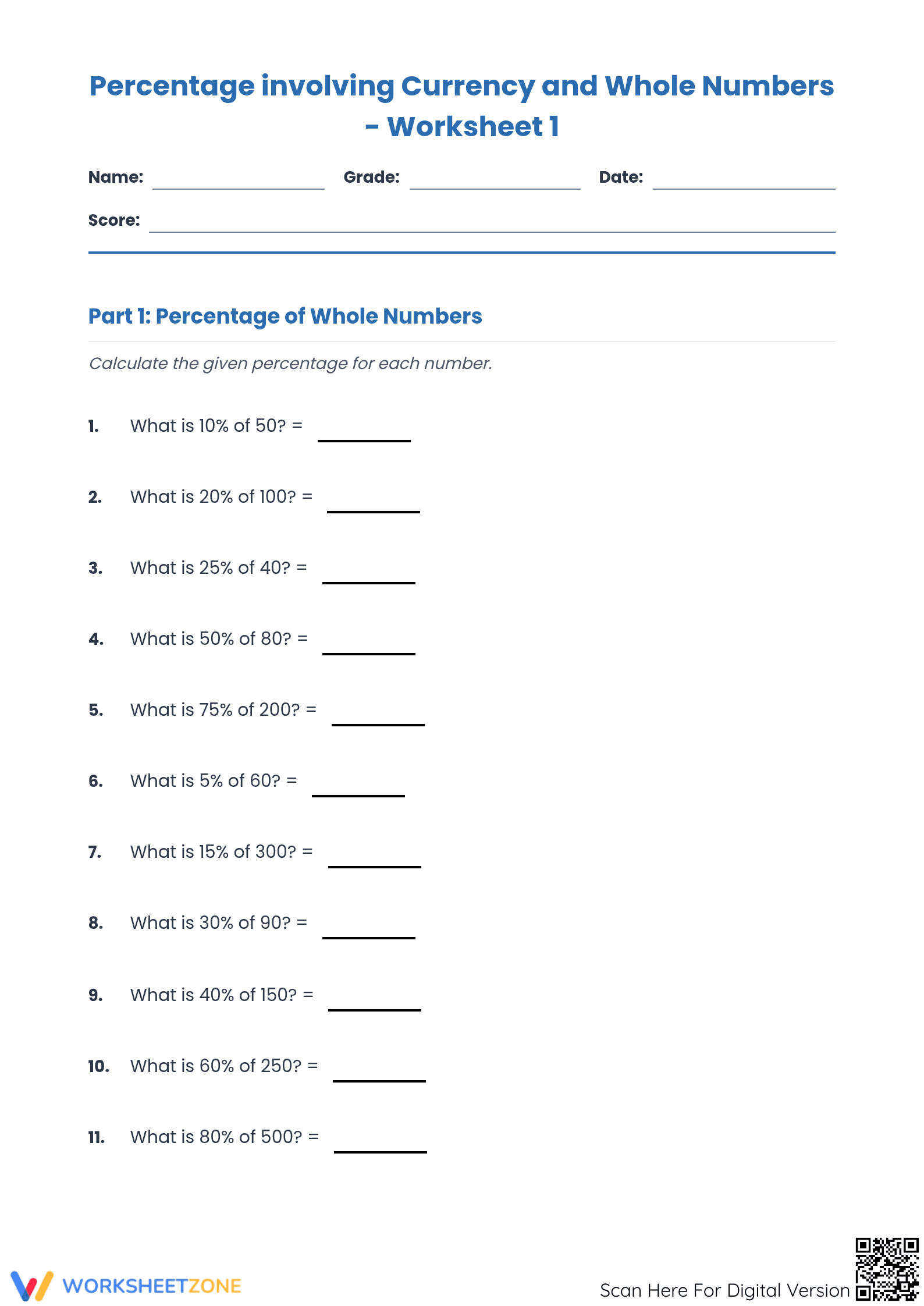
This comprehensive percentage worksheet enables students to master the foundational skill of calculating parts of a whole across different contexts. By transitioning from simple whole numbers to currency and multi-step real-world applications, learners build the proportional reasoning necessary for middle school math success. It provides a structured path toward total procedural fluency.
At a Glance
- Grade: 6-7 · Subject: Math
- Standard:
CCSS.MATH.CONTENT.6.RP.A.3.C— Find a percent of a quantity as a rate per 100- Skill Focus: Percentages of currency and whole numbers
- Format: 4 pages · 41 problems · Answer key included · PDF
- Best For: Independent practice and financial math introduction
- Time: 45–60 minutes
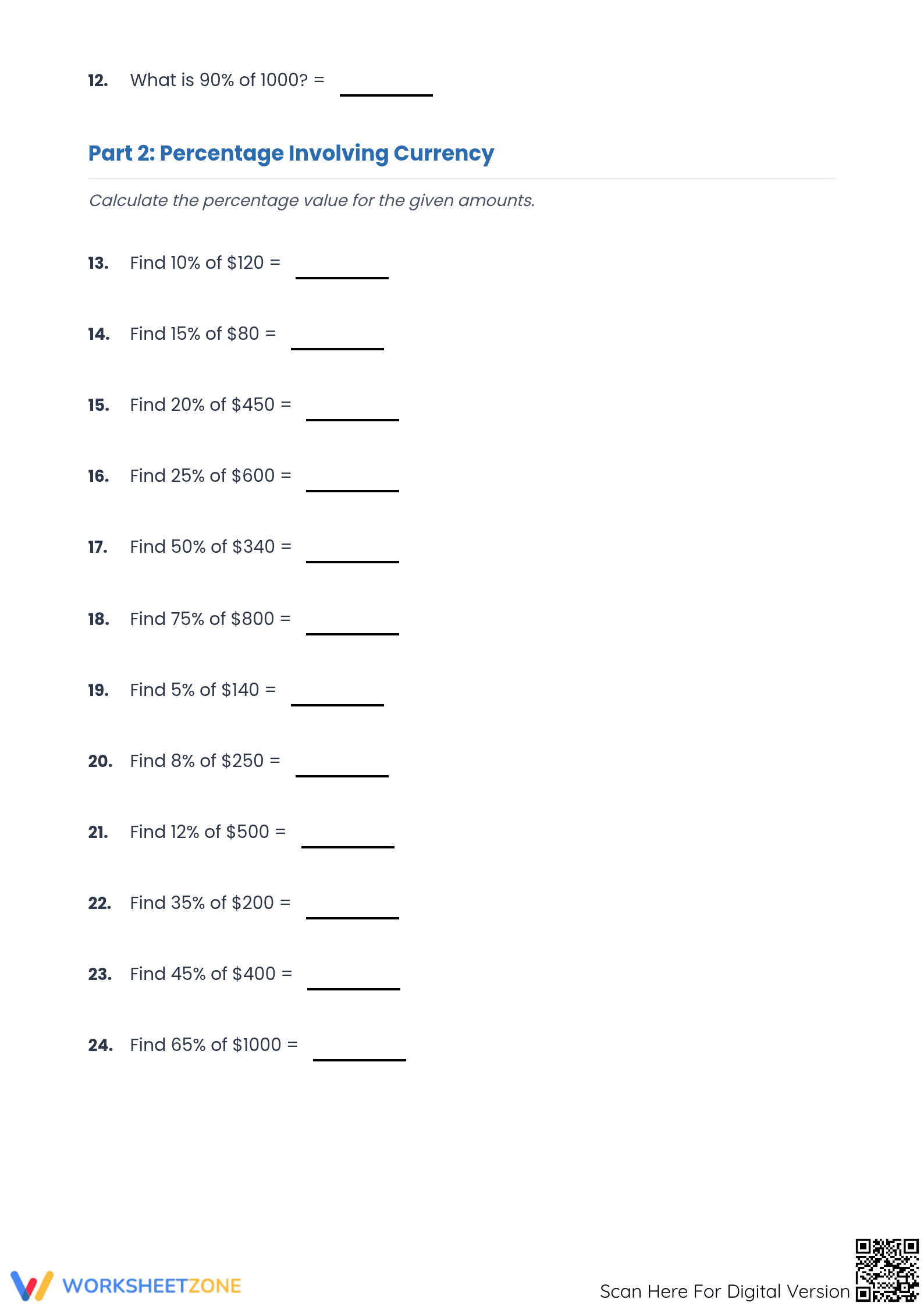
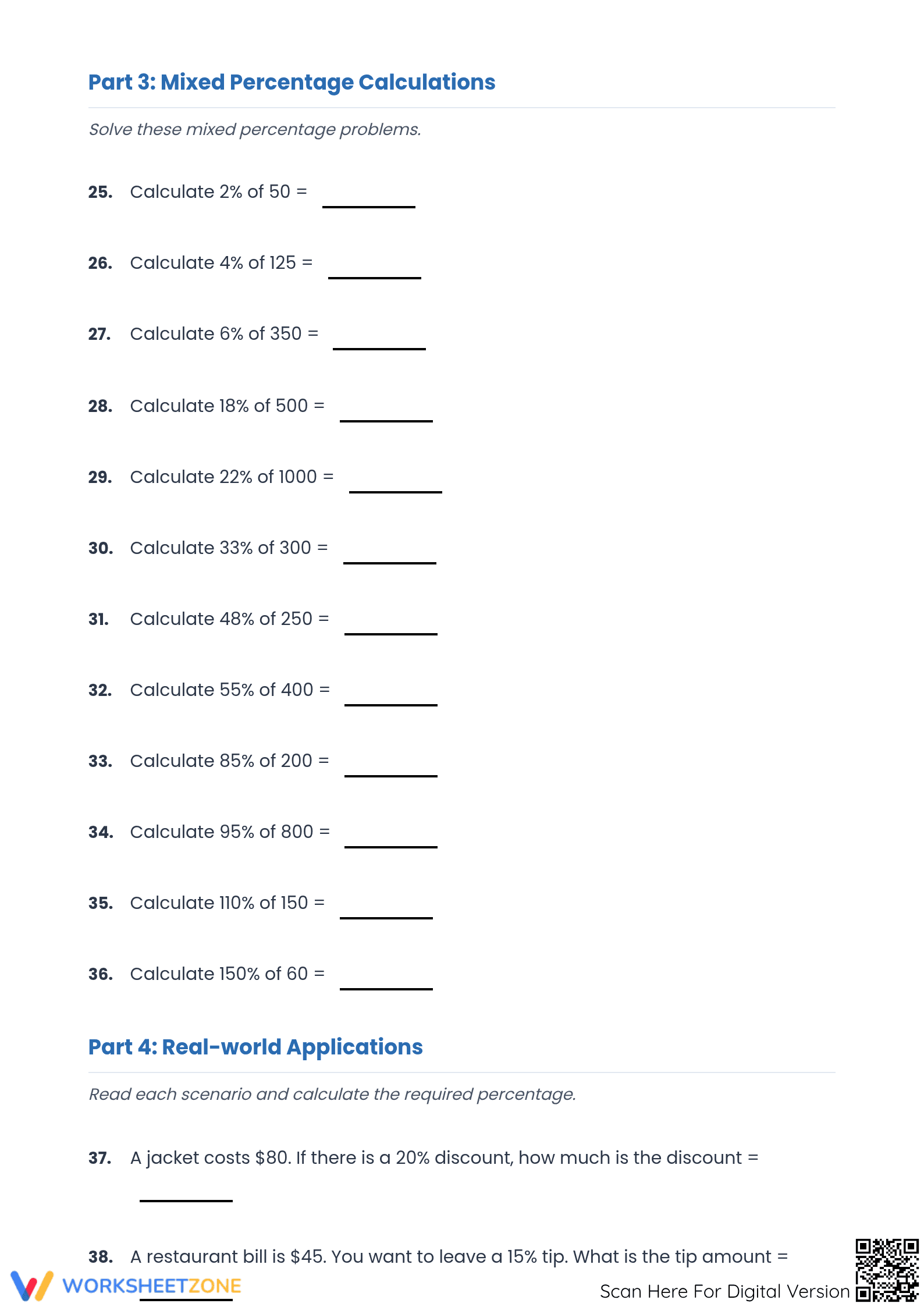
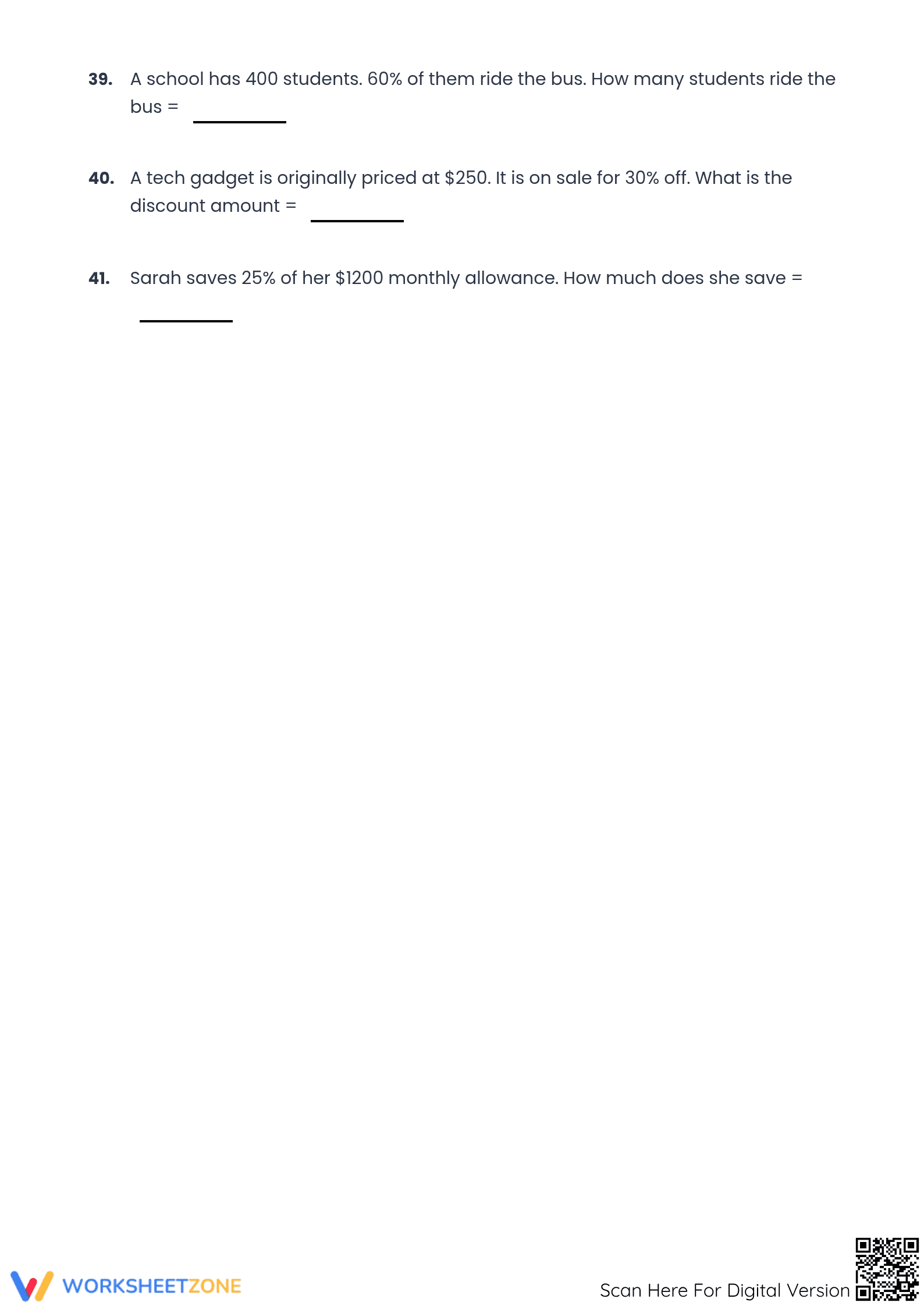
This four-page resource is divided into four distinct sections to ensure a gradual release of responsibility. Part one features 12 problems focused on whole number percentages. Part two introduces currency, requiring students to apply calculations to dollar amounts. Part three challenges learners with mixed calculations, including percentages greater than 100%. Finally, part four provides five real-world scenarios involving discounts and tips to test practical application.
Zero-Prep Workflow
The zero-prep design of this worksheet makes it an ideal choice for busy classrooms. First, simply print the four-page PDF for your class, which takes less than one minute. Second, distribute the sheets to students; the clear section headings allow them to begin working independently. Third, use the included comprehensive answer key to review results in under five minutes, providing immediate feedback on student mastery of proportional reasoning.
Standards Alignment
The primary focus of this resource is `CCSS.MATH.CONTENT.6.RP.A.3.C`: "Find a percent of a quantity as a rate per 100; solve problems involving finding the whole, given a part and the percent." This is supported by 7.RP.A.3, as students use these proportional relationships to solve multistep percent problems in the final section. Both standard codes can be copied directly into lesson plans, IEP goals, or district curriculum mapping tools.
How to Use It
Use this worksheet as a summative assessment after direct instruction on the relationship between decimals, fractions, and percentages. During independent work time, circulate and observe if students are correctly placing decimals when calculating currency values, as this is a common struggle. The 41-problem set is expected to take between 45 and 60 minutes for most students to complete thoroughly during a standard class period.
Who It's For
This practice set is designed for middle school students in Grades 6 through 8 who are developing their ratio and proportion skills. It is particularly effective for students requiring extra reinforcement in financial literacy or those who benefit from concrete currency-based examples. For differentiation, teachers can pair this with a percentage anchor chart or a calculator for students focusing on conceptual application rather than mental math.
According to the RAND AIRS 2024 report on mathematical literacy, the ability to fluently calculate percentages is a critical gateway skill for secondary financial literacy and algebraic readiness. This worksheet aligns with the CCSS.MATH.CONTENT.6.RP.A.3.C standard, requiring students to find a percent of a quantity as a rate per 100, specifically applying this to currency and whole numbers. Research from Fisher & Frey (2014) emphasizes that scaffolding from abstract whole numbers to concrete currency contexts helps students internalize the proportional relationships inherent in percentage calculations. By providing 41 structured tasks, this resource ensures that learners move beyond rote memorization toward procedural fluency. The inclusion of real-world applications like discounts and tips further bridges the gap between classroom theory and practical life skills. Educators can use this data-driven practice set to identify specific misconceptions in decimal placement or proportional reasoning before advancing to multi-step interest calculations.


