


























Views
Downloads

Essential 6.RP.A.3.c Worksheet: Calculate Original Amount
Paste this activity's link or code into your existing LMS (Google Classroom, Canvas, Teams, Schoology, Moodle, etc.).
Students can open and work on the activity right away, with no student login required.
You'll still be able to track student progress and results from your teacher account.
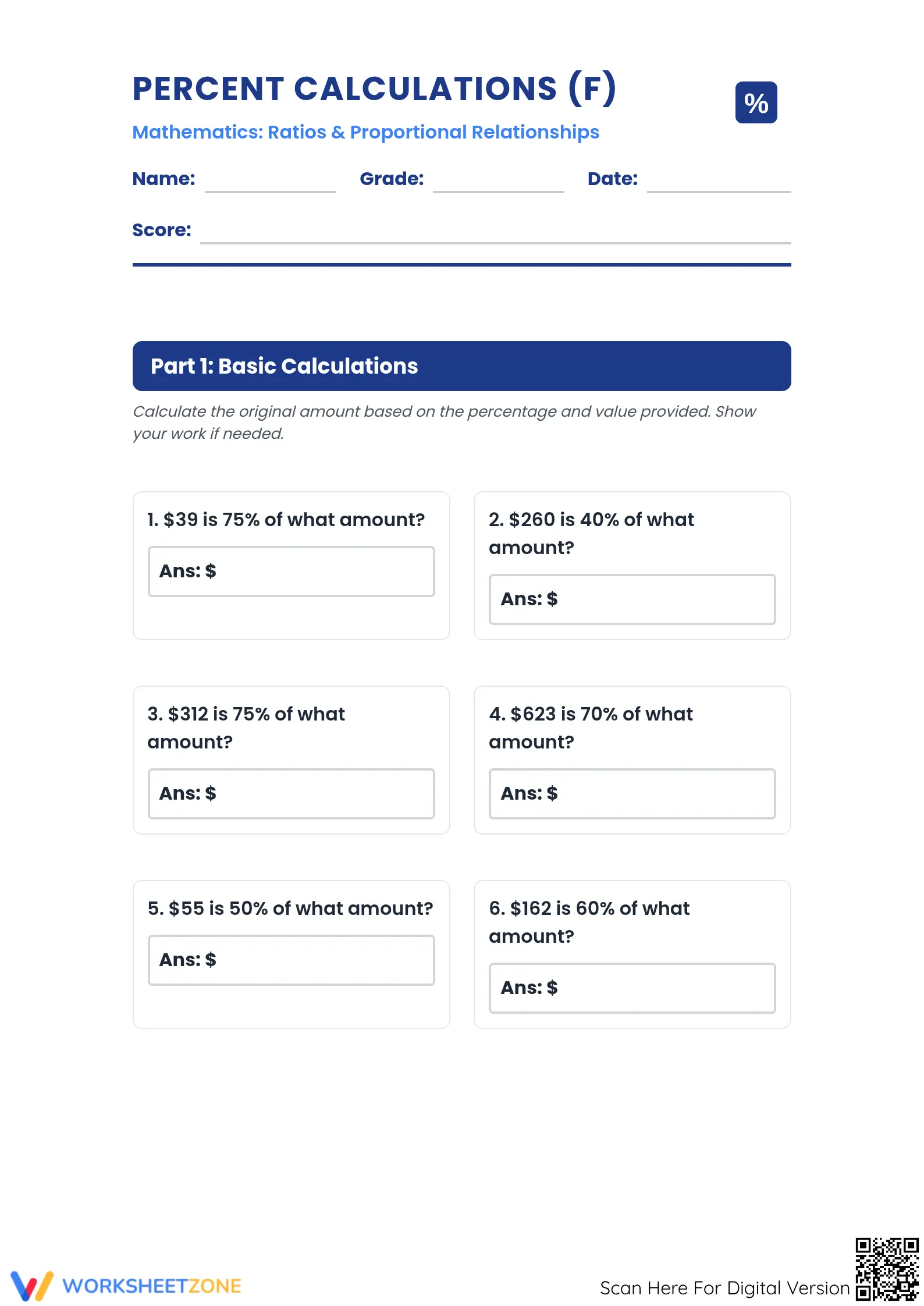
This Grade 6 Mathematics worksheet provides essential practice for students learning to calculate the original amount (the whole) when given a specific percentage and its corresponding value. By mastering these backtracking percentage problems, students develop a robust understanding of proportional relationships and algebraic reasoning necessary for success in higher-level mathematics courses.
At a Glance
- Grade: 6 · Subject: Math
- Standard:
6.RP.A.3.c— Find the whole, given a part and the percent- Skill Focus: Calculating original amounts (reverse percentages)
- Format: 5 pages · 29 problems · Answer key included · PDF
- Best For: Independent practice and standards mastery
- Time: 45–60 minutes
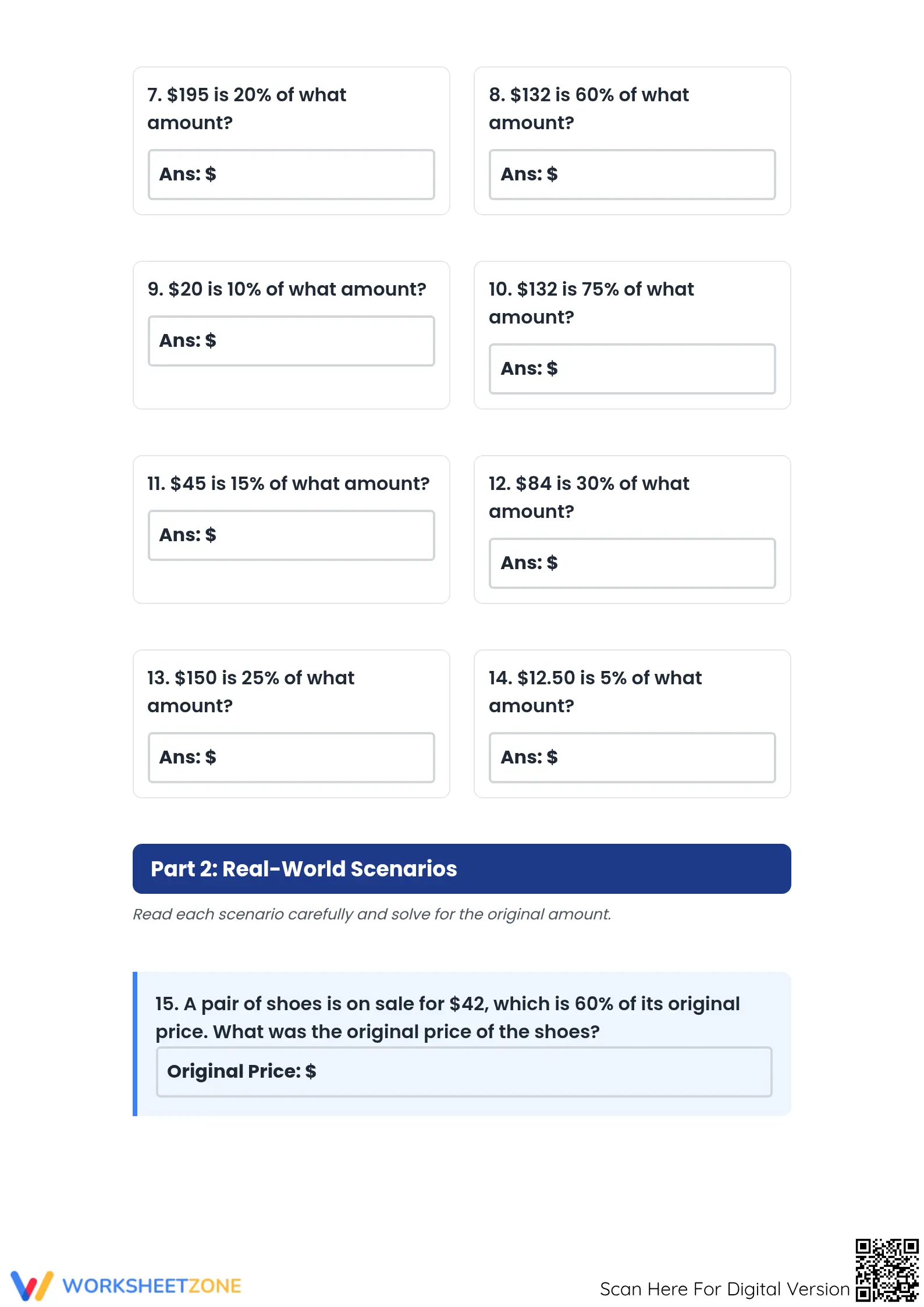
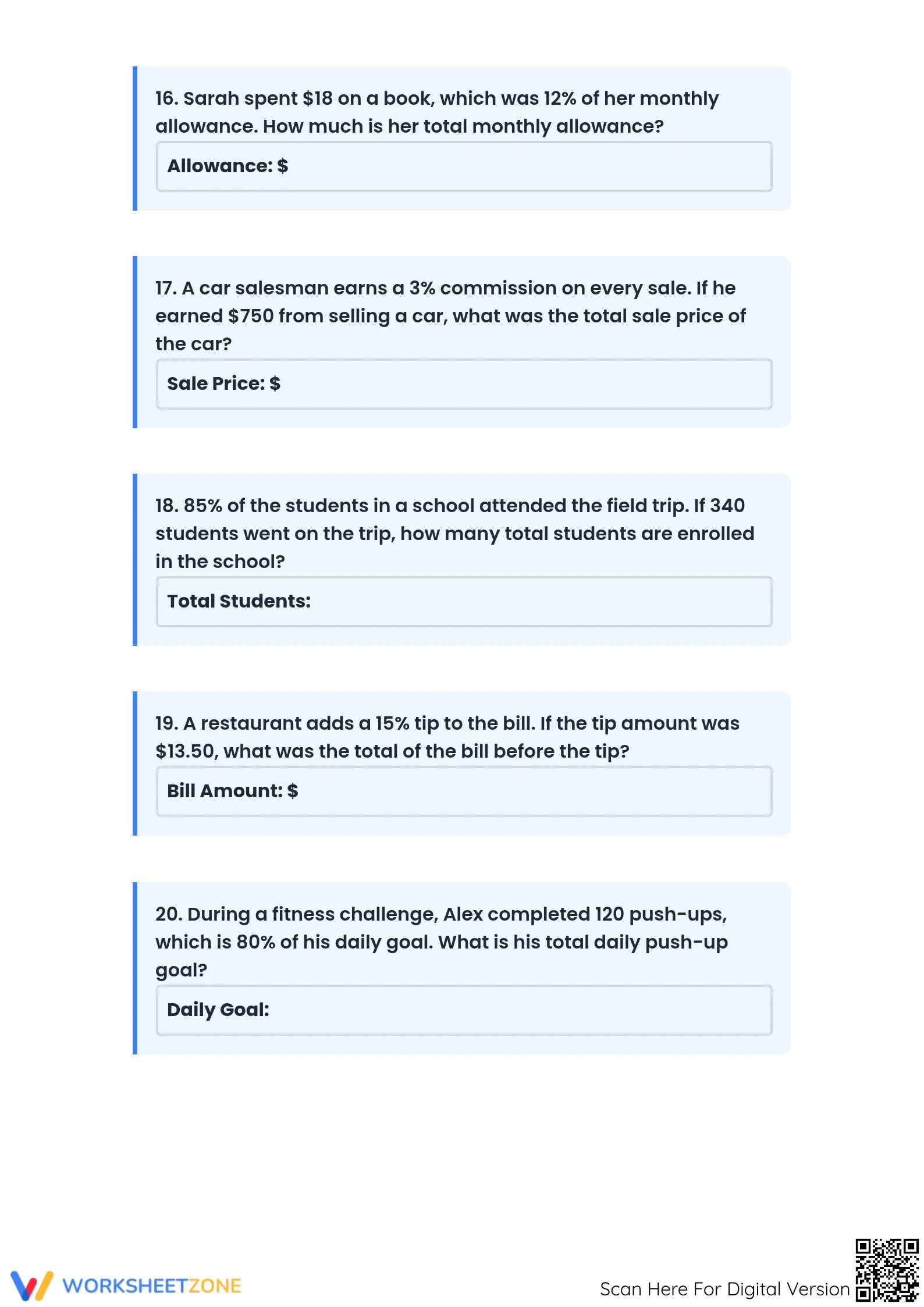
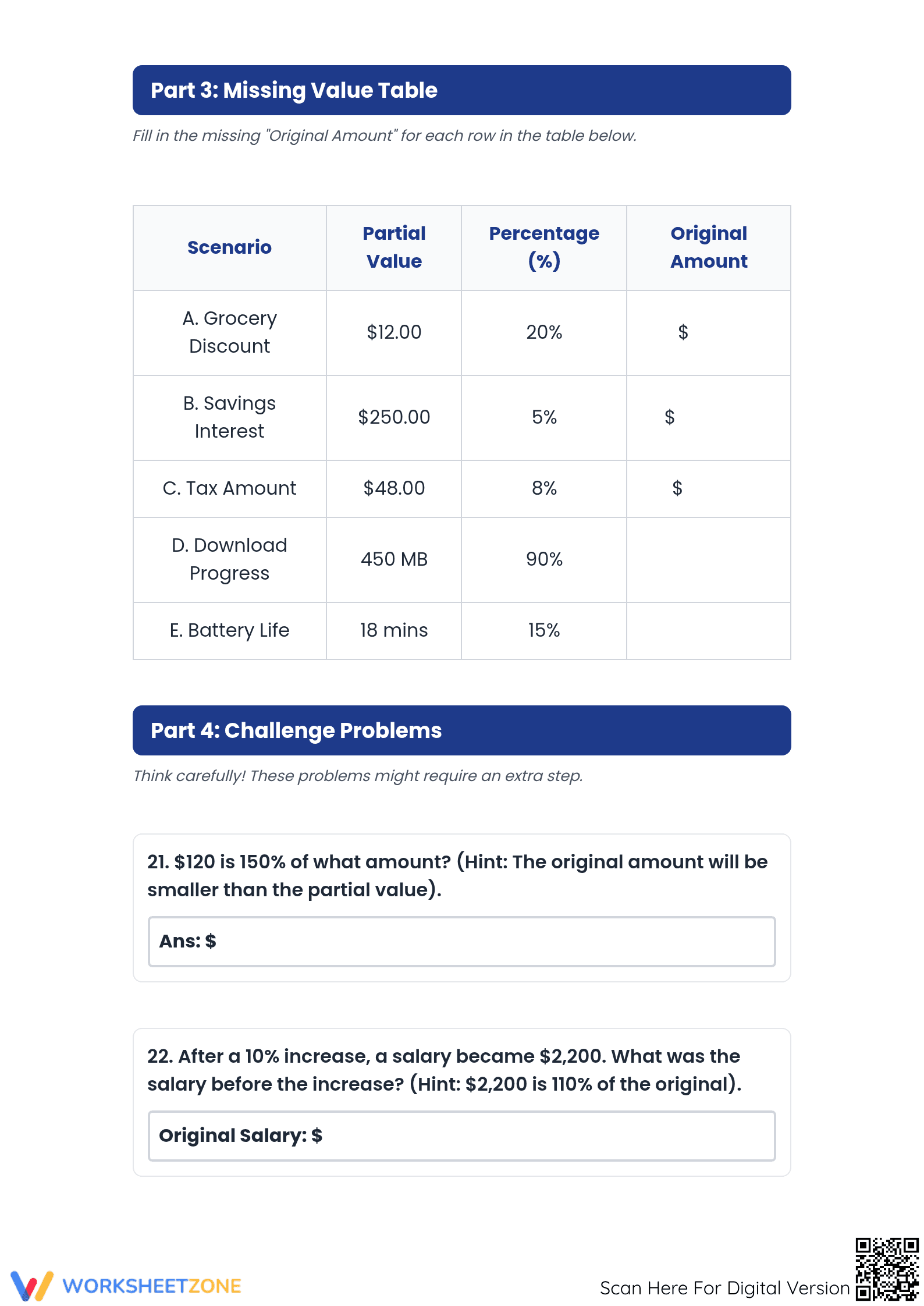
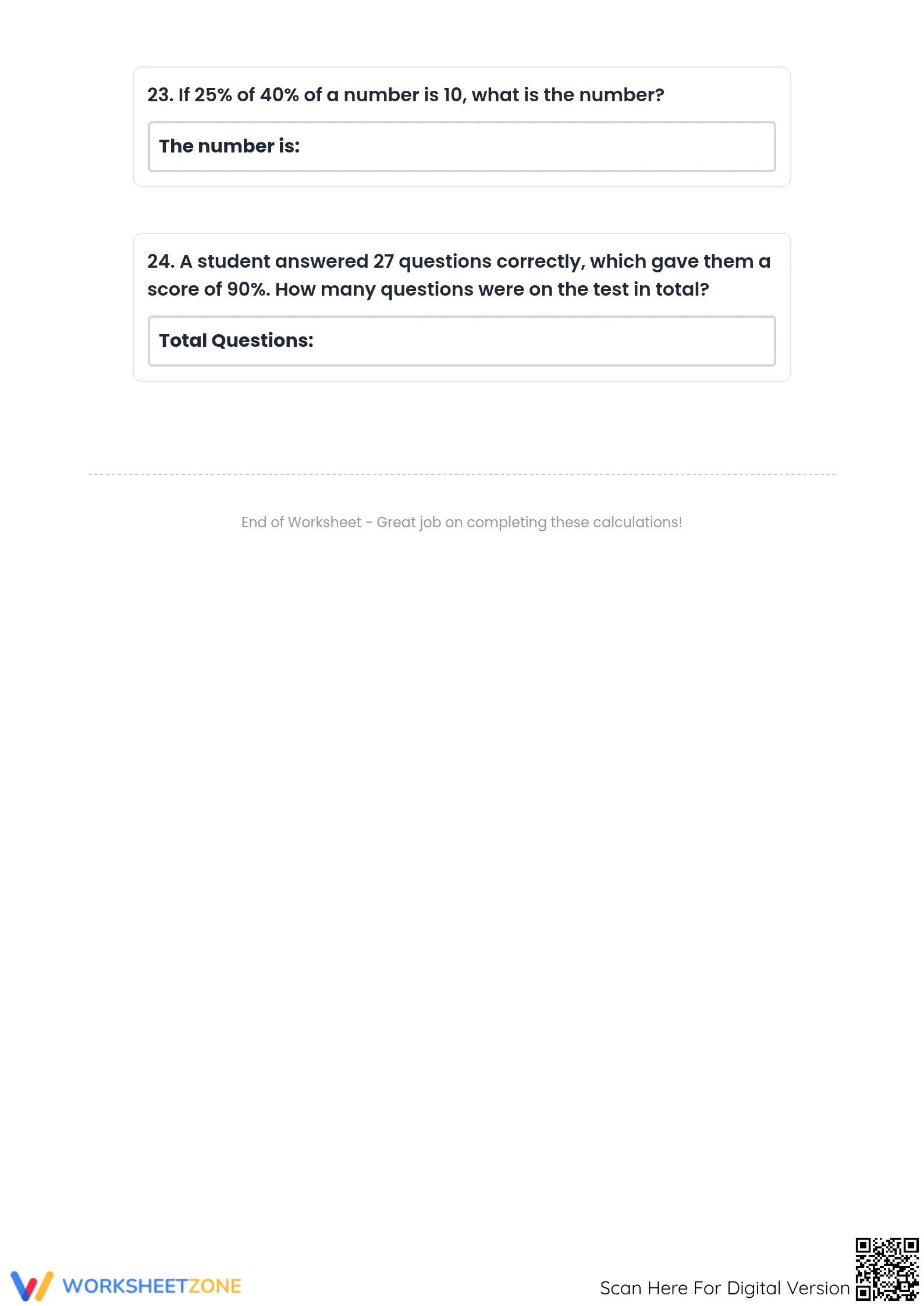
This comprehensive five-page resource contains 29 structured problems designed to move students from basic computation to complex application. The worksheet begins with 14 straightforward Part 1 calculations, followed by 6 Part 2 real-world scenarios involving allowance, commissions, and goals. Part 3 features a missing value table for data organization, while Part 4 introduces 4 challenge problems covering percentage increases and nested percentages.
Each section of this worksheet is carefully mapped to the 6.RP.A.3.c standard, allowing teachers to pinpoint specific areas where students may struggle. Part 1 assesses the Approaching tier, focusing on pure numerical manipulation. The final challenge problems target the Exceeding level, requiring students to handle multi-step logic. Scores can be recorded directly in gradebooks or used for IEP progress notes and goal monitoring.
The primary focus of this worksheet is `6.RP.A.3.c`: "Find a percent of a quantity as a rate per 100; solve problems involving finding the whole, given a part and the percent." Students practice identifying the part, the percent, and the unknown whole across various contexts. This standard code can be copied directly into lesson plans, IEP goals, or district curriculum mapping tools.
This resource is ideal for the Independent Practice phase of a lesson on ratios and proportions. Teachers can assign the first page during class to observe student accuracy and then provide the remaining pages as homework for consolidation. For a formative assessment tip, check Part 4, Problem 22; students who struggle here likely need a refresher on adding percentages to a base. Completion typically takes 50 minutes.
Designed for Grade 6 students following CCSS or similar state frameworks, this worksheet is also suitable for Grade 7-8 intervention or as an enrichment activity for advanced 5th graders. It pairs naturally with an anchor chart demonstrating the part-to-whole formula or a direct instruction lesson on bar models for visual percentage representation.
The ability to calculate the original amount from a percentage value is a critical bridge between arithmetic and algebra. According to RAND AIRS (2024), student proficiency in proportional reasoning at the middle school level is one of the strongest predictors of success in High School Algebra I. This worksheet addresses the common misconception that calculating a percent always involves multiplication, forcing students to cognitively shift toward division and algebraic inversion. Fisher & Frey (2014) emphasize that backtracking exercises—where the result is known but the starting value is missing—provide the cognitive friction necessary for deep conceptual mastery rather than rote procedural fluency. By providing 29 diverse tasks ranging from simple currency calculations to multi-step challenge problems, this 6.RP.A.3.c resource ensures that Grade 6 learners can accurately find the whole in both abstract and real-world contexts, meeting the rigorous demands of modern standards and preparing them for future functional relationship studies.


