


























Views
Downloads

Essential 25% Percentage Worksheet: Find Original Amounts
Paste this activity's link or code into your existing LMS (Google Classroom, Canvas, Teams, Schoology, Moodle, etc.).
Students can open and work on the activity right away, with no student login required.
You'll still be able to track student progress and results from your teacher account.
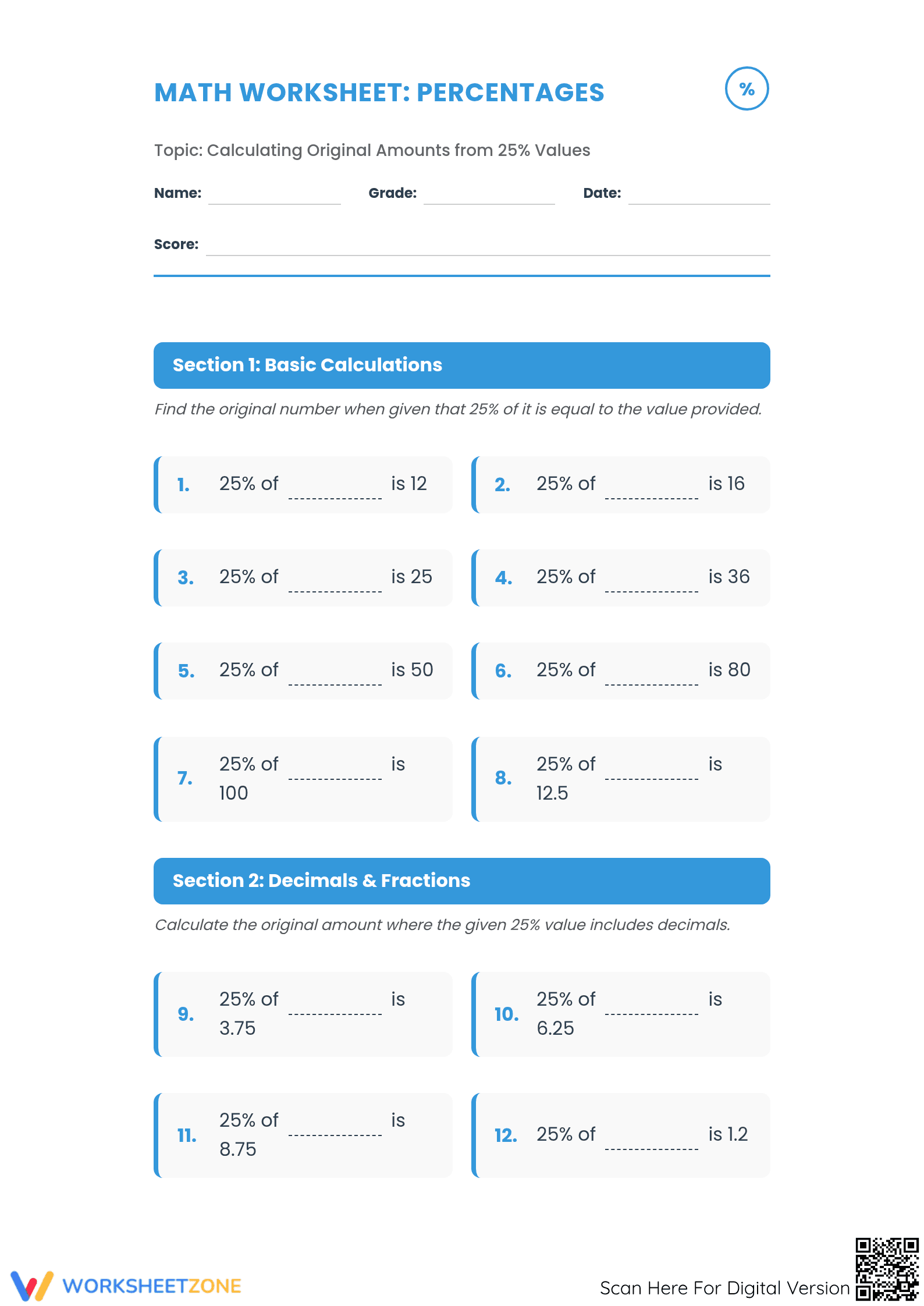
This 3-page percentage worksheet provides students with targeted practice in calculating original amounts when 25% of the value is known. By mastering this 'backtracking' skill, learners move beyond simple calculation to a deeper algebraic understanding of part-whole relationships. It is an essential tool for building mathematical fluency in middle school ratios and proportions.
At a Glance
- Grade: 6 · Subject: Math
- Standard:
CCSS.MATH.CONTENT.6.RP.A.3.c— Find the whole, given a part and the percent- Skill Focus: Inverse percentage calculations (25%)
- Format: 3 pages · 36 problems · Answer key included · PDF
- Best For: Independent practice and skill reinforcement
- Time: 30–45 minutes
What's Inside
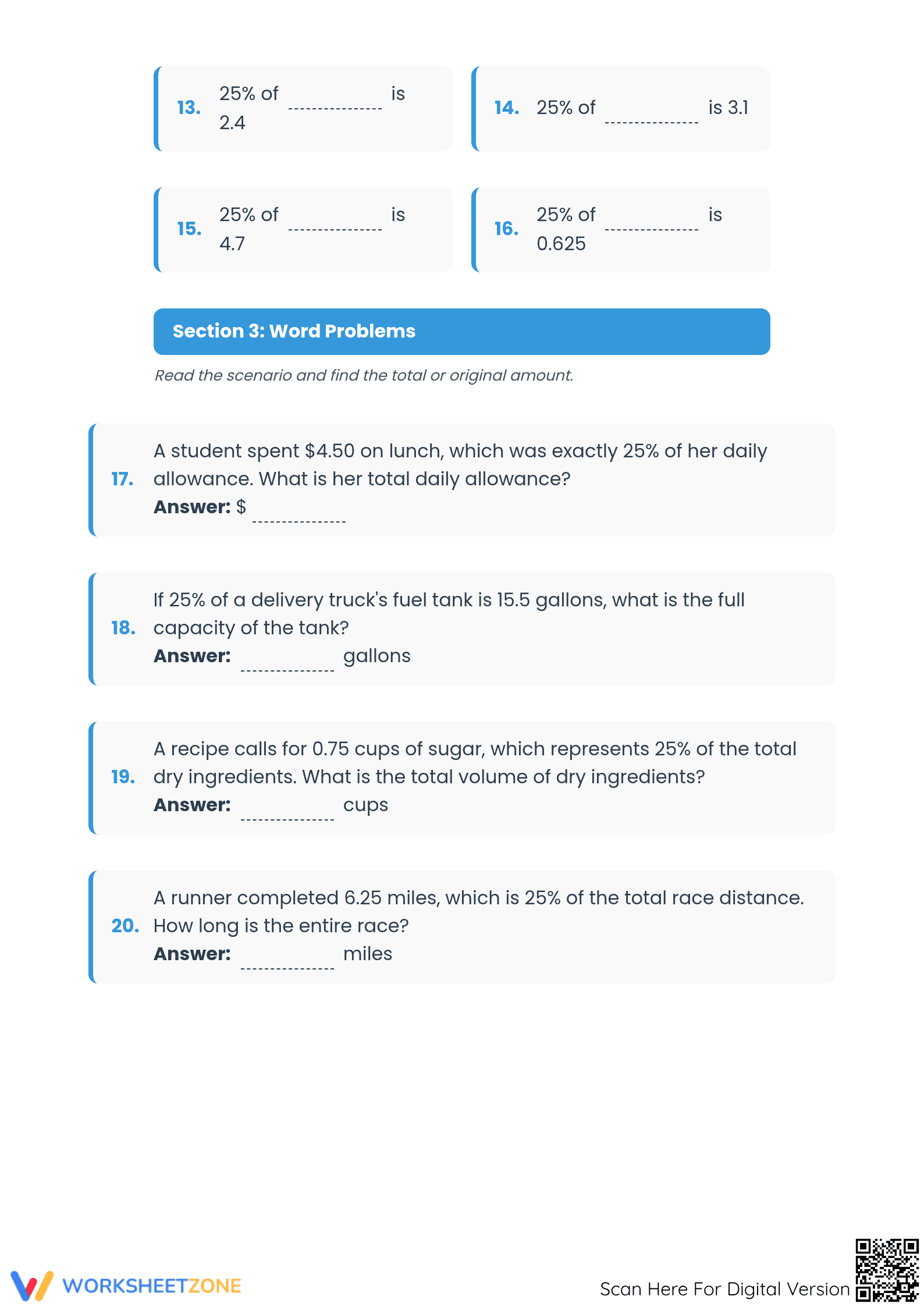
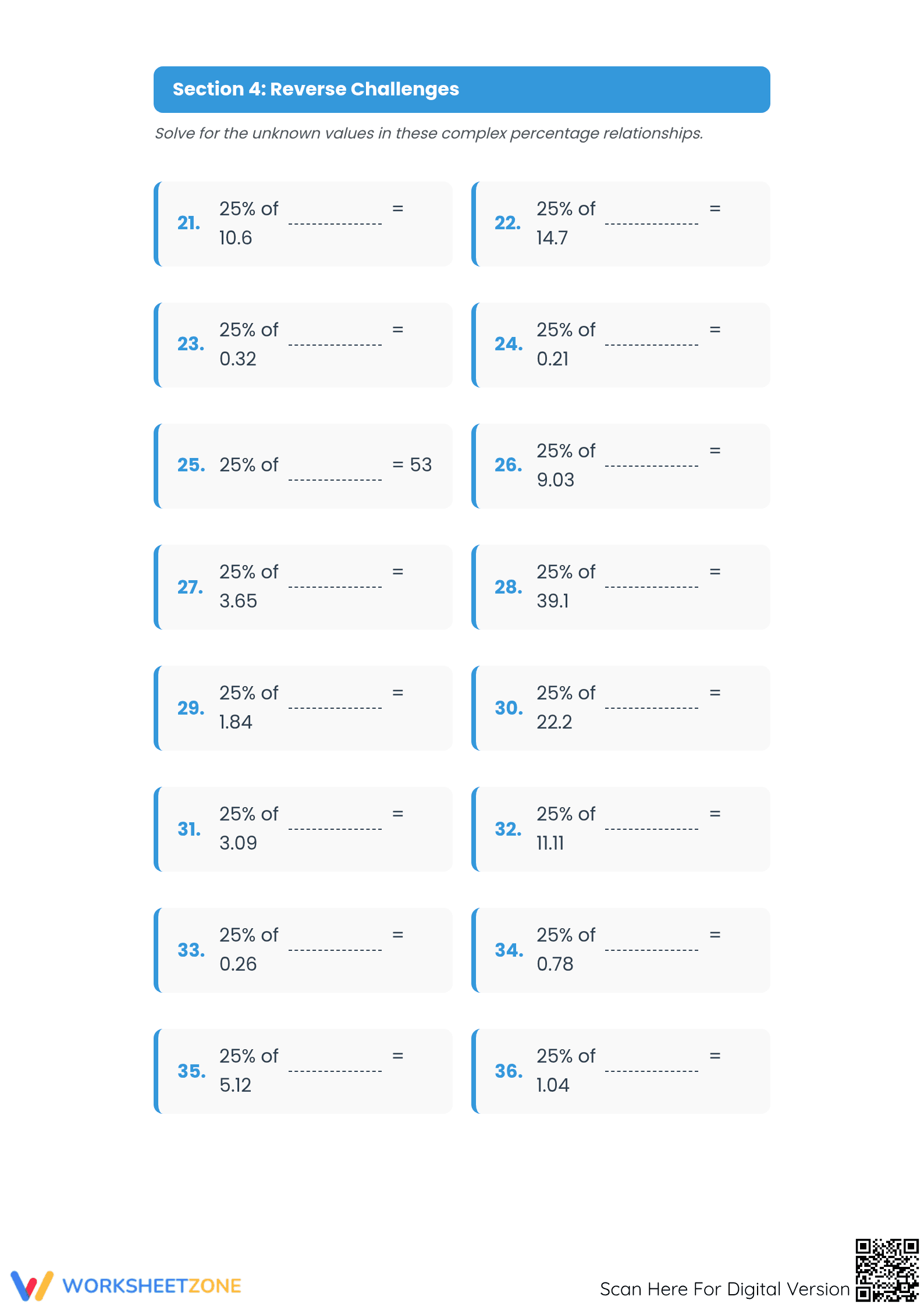
This resource contains 36 structured problems across three pages, carefully sequenced to guide students from basic mental math to complex application. The worksheet includes 16 basic calculations, 12 problems involving decimals and fractions, 4 contextualized word problems, and 4 high-difficulty reverse challenges. A full answer key is provided to facilitate quick grading or student self-correction.
Skill Progression
- Guided Practice: 12 initial problems using whole numbers and simple fractions to establish the 'multiply by 4' conceptual shortcut.
- Supported Practice: 16 problems introducing multi-digit decimals and complex values to build computational stamina and precision.
- Independent Practice: 8 multi-step word problems and reverse challenges requiring students to apply logic without visual scaffolds.
The worksheet follows a proven gradual-release model, moving from 'I Do' style basic structures to independent 'You Do' application in real-world scenarios.
Standards Alignment
The primary alignment is `CCSS.MATH.CONTENT.6.RP.A.3.c`, which requires students to 'find a percent of a quantity as a rate per 100; solve problems involving finding the whole, given a part and the percent.' This resource specifically targets the second half of that standard, demanding higher-order inverse thinking. Both standard codes can be copied directly into lesson plans, IEP goals, or district curriculum mapping tools.
How to Use It
Use this worksheet as a secondary practice set during a unit on ratios and proportions. It works best as an independent station activity after students have mastered basic percentage finding. Teachers should observe students' choice of strategy—whether they use fractional equivalence (1/4) or decimal division (0.25)—to assess conceptual depth. Expect completion within 40 minutes for most Grade 6 learners.
Who It's For
This resource is designed for sixth-grade students but serves as excellent remediation for seventh or eighth graders struggling with multi-step algebraic equations. It is particularly effective when paired with a percentage bar model anchor chart or direct instruction on the 'is over of' proportion method for diverse learners.
According to the RAND AIRS 2024 analysis, students who engage in repetitive practice of inverse operations demonstrate significantly higher retention rates in algebraic reasoning. This worksheet facilitates that mastery by isolating the 25% calculation (CCSS.MATH.CONTENT.6.RP.A.3.c), allowing students to focus on the procedural 'backtracking' required to find a whole from a known part. By providing 36 problems that progress from simple integers to complex word problems, the resource aligns with Fisher & Frey’s (2014) focus on scaffolded independent practice. Research indicates that automating these proportional relationships is a prerequisite for success in high school functions. This material is an essential component of a rigorous middle school mathematics curriculum, providing the volume of practice necessary to bridge the gap between conceptual introduction and computational fluency in real-world mathematical contexts.


