


























Views
Downloads


Grade 2 Elapsed Time — Printable No-Prep Worksheet
Paste this activity's link or code into your existing LMS (Google Classroom, Canvas, Teams, Schoology, Moodle, etc.).
Students can open and work on the activity right away, with no student login required.
You'll still be able to track student progress and results from your teacher account.
Mastery of time management begins with understanding the duration of events. This Grade 2 elapsed time worksheet provides structured practice for students to calculate the interval between start and end times. By moving from tabular data to real-world word problems, learners develop the fluencies needed for complex scheduling and daily time-telling tasks in early elementary mathematics.
At a Glance
- Grade: 2 · Subject: Math
- Standard:
2.MD.C.7— Tell and write time from analog and digital clocks to the nearest five minutes- Skill Focus: Calculating Elapsed Time Intervals
- Format: 2 pages · 8 problems · Answer key included · PDF
- Best For: Homework, independent practice, or math centers
- Time: 15–25 minutes
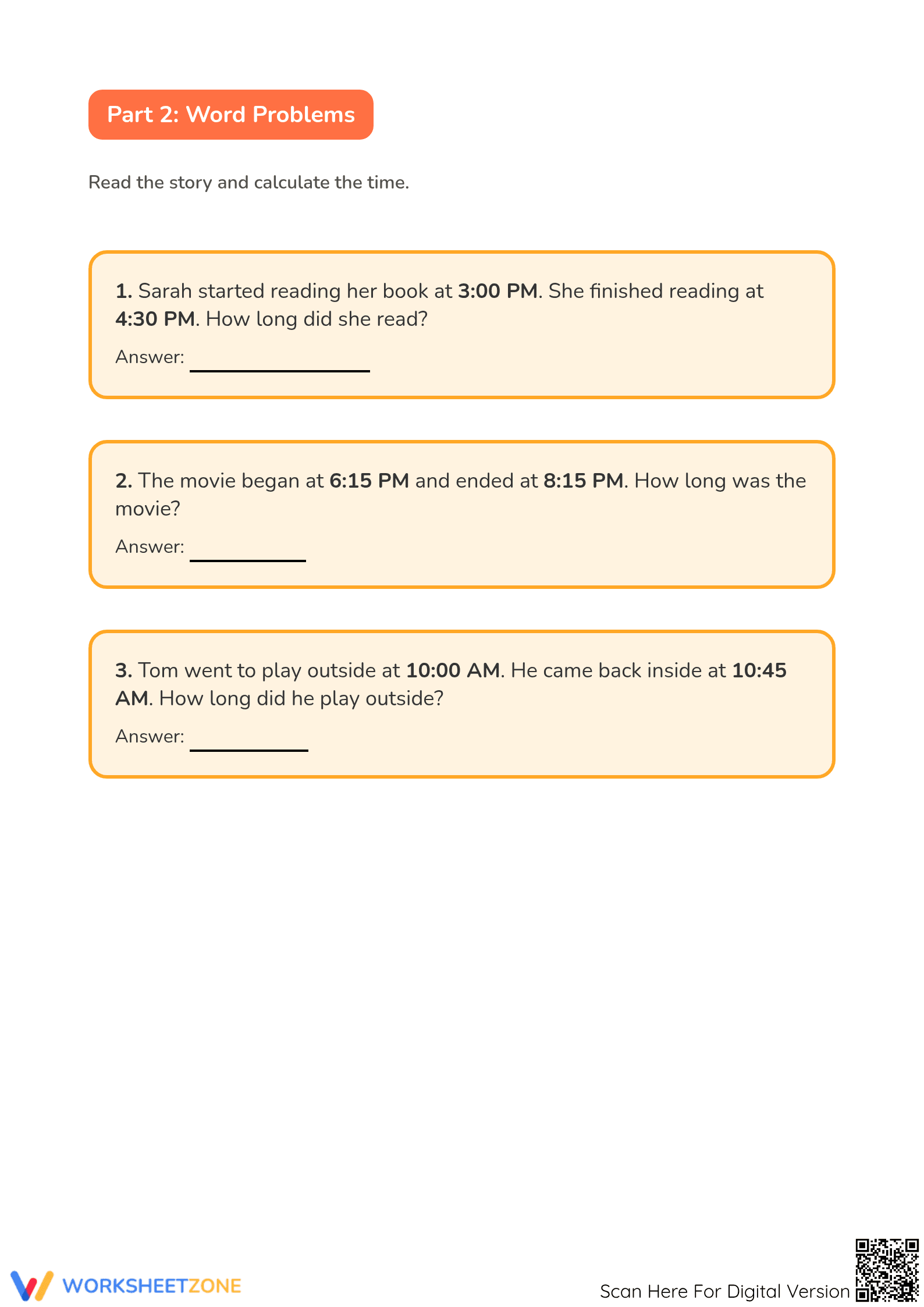
This comprehensive 2-page PDF features two distinct instructional parts designed to build calculation confidence. Part 1 presents a start-and-end-time table with five scenarios using a.m. and p.m. designations, requiring students to find the exact duration between 15-minute and 30-minute intervals. Part 2 transitions to three situational word problems involving reading, movies, and outdoor play. A full answer key is provided for rapid grading and immediate feedback.
Implementing this resource requires less than two minutes of teacher preparation. First, print the two-page PDF directly from your browser or PDF viewer (30 seconds). Second, distribute the sheets to students along with pencils (30 seconds). Third, use the included answer key to review student work or facilitate a whole-class check (1 minute). Its clear layout and self-explanatory instructions make it an ideal emergency sub plan resource or a zero-prep station activity.
The worksheet is primarily aligned to 2.MD.C.7, focusing on the student's ability to "Tell and write time from analog and digital clocks to the nearest five minutes, using a.m. and p.m." It also serves as a critical bridge to Grade 3 measurement standards involving intervals of time. This standard code can be copied directly into lesson plans, IEP goals, or district curriculum mapping tools to ensure instructional coherence and high-quality alignment.
This resource is best utilized during the independent practice phase of a lesson. After demonstrating how to count minutes on a clock face or a number line, assign the table in Part 1 to solidify the concept. For a formative assessment tip, observe students as they solve the word problems; notice if they use an additive clock strategy or subtract the hours and minutes separately. This activity typically takes 20 minutes to complete.
Designed for Grade 2 students, this worksheet is also suitable for Grade 3 learners requiring remediation or Grade 1 students ready for advanced enrichment. The simple sentence structures and clear formatting support English Language Learners and students with diverse processing needs. Pair this worksheet with a physical analog clock or a classroom anchor chart showing 60 minutes in an hour to maximize student success.
According to research from EdReports 2024, high-quality mathematics instructional materials must balance procedural fluency with conceptual applications. This Grade 2 elapsed time worksheet achieves this by requiring students to decode standard 2.MD.C.7 time notations and apply them to determine duration. Calculating elapsed time is more than a mechanical task; it is a vital life skill that bridges basic numeracy with real-world logical reasoning. By providing both structured data tables and context-rich word problems, the resource ensures students move beyond rote memorization to functional literacy. The inclusion of a.m. and p.m. indicators reinforces the distinction between temporal cycles, a core requirement of the early elementary mathematics curriculum. Educators can confidently integrate this worksheet into diverse classroom environments, knowing it meets the rigorous expectations for standards-aligned practice and student-centered mastery in the modern educational landscape.


