


























Views
Downloads

Printable Multiplication & Division Puzzles | Grade 3
Paste this activity's link or code into your existing LMS (Google Classroom, Canvas, Teams, Schoology, Moodle, etc.).
Students can open and work on the activity right away, with no student login required.
You'll still be able to track student progress and results from your teacher account.
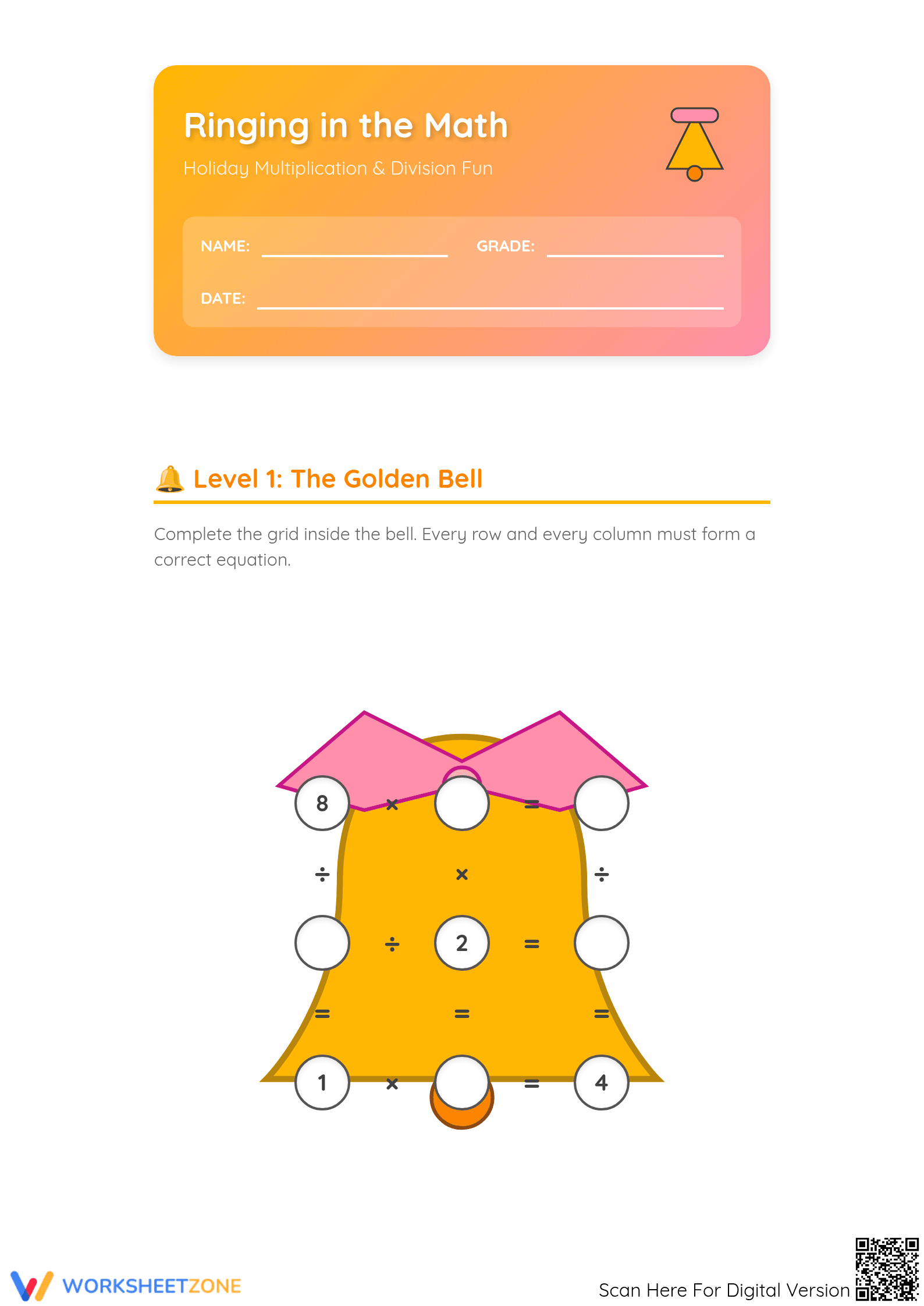
This comprehensive multiplication and division worksheet helps students master the inverse relationship between operations through engaging bell-shaped puzzles. Students solve for missing factors and quotients across four increasing levels of difficulty, building the mental flexibility needed for higher-level algebraic thinking. By completing these equations, learners solidify their understanding of fact families in a festive, printable format.
At a Glance
- Grade: 3 · Subject: Math
- Standard:
CCSS.MATH.CONTENT.3.OA.A.4— Determine the unknown whole number in multiplication or division equations accurately- Skill Focus: Fact Family Relationships
- Format: 5 pages · 16 problems · Answer key included · PDF
- Best For: Holiday-themed math stations and skill review
- Time: 25–35 minutes
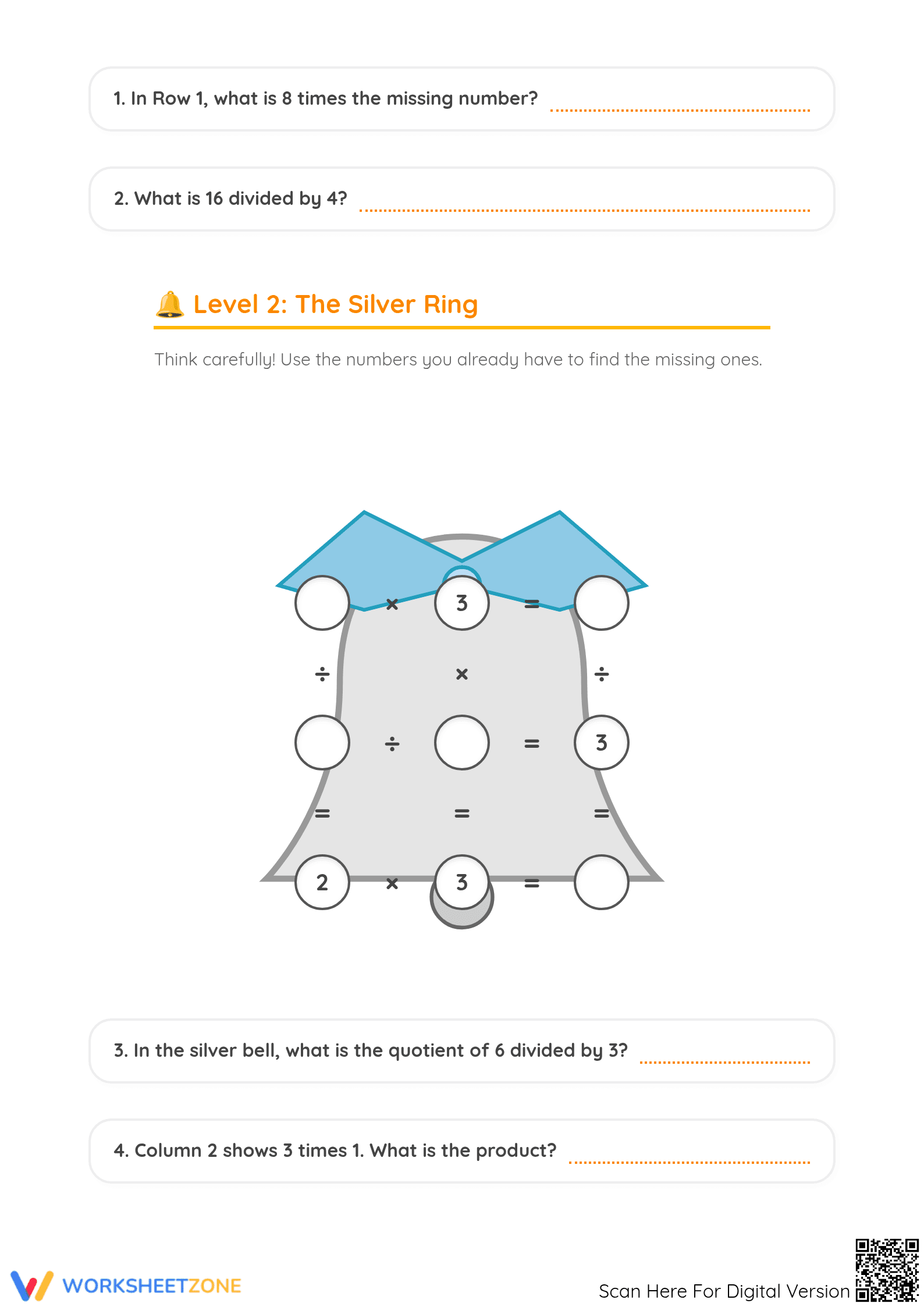
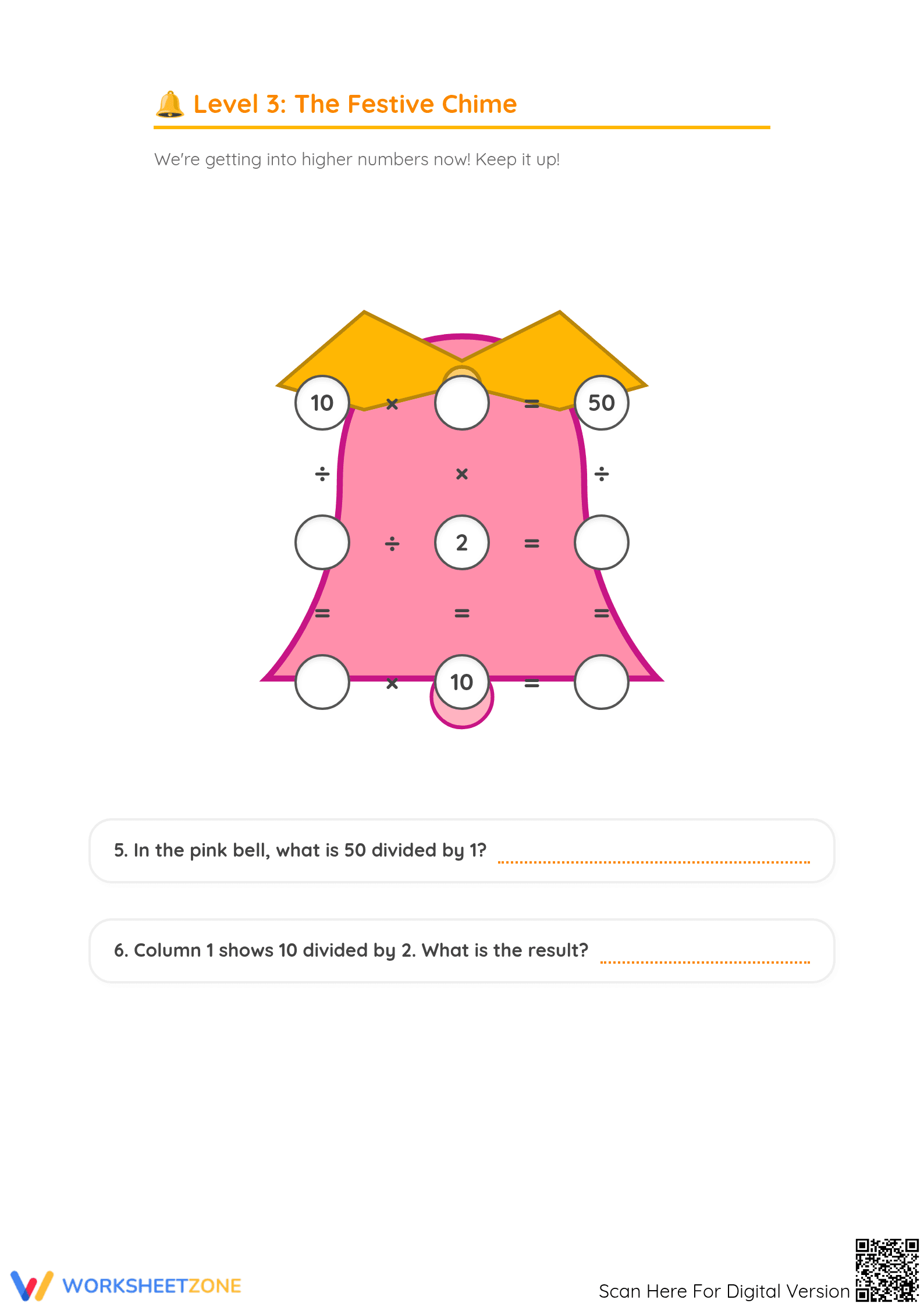
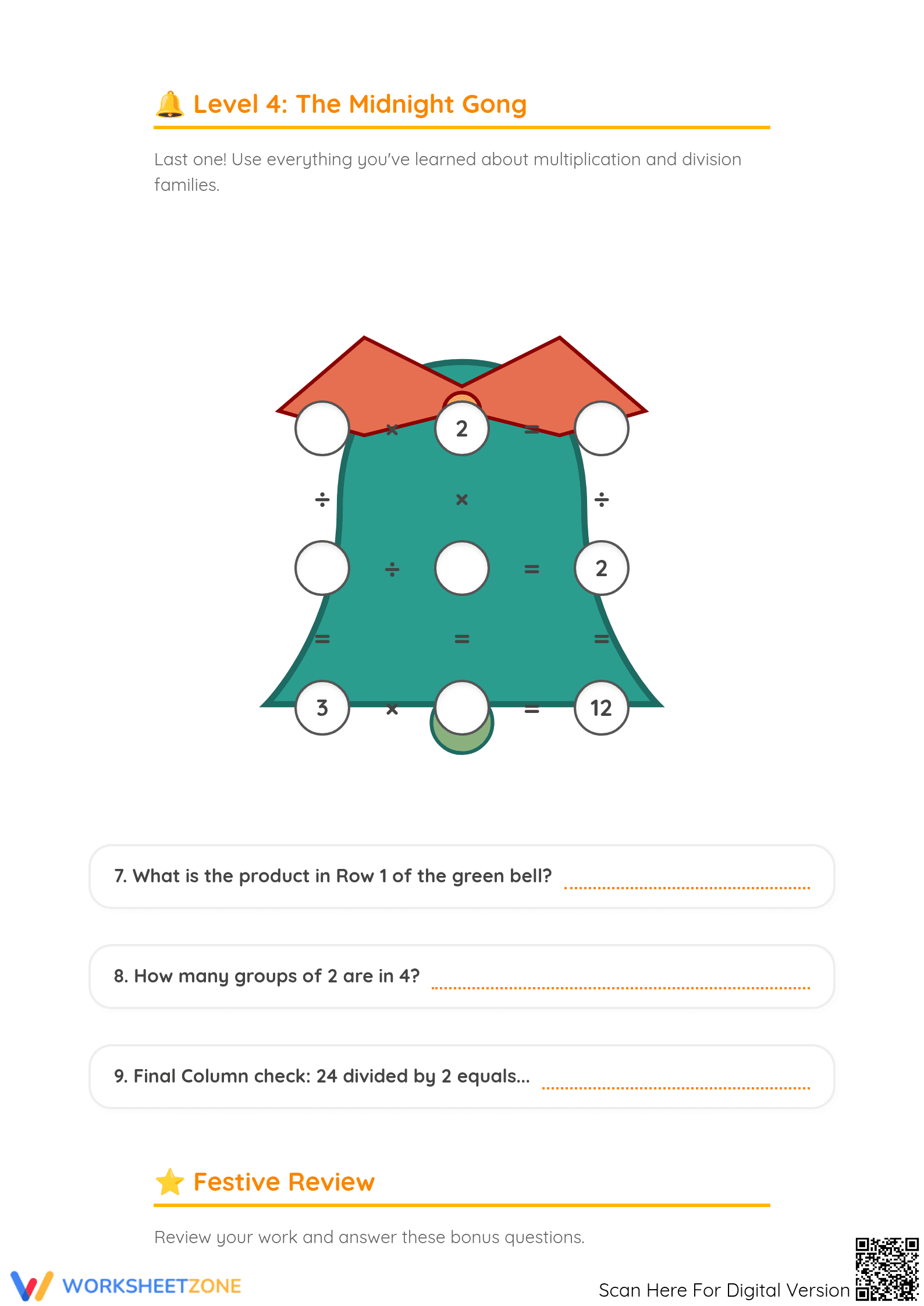
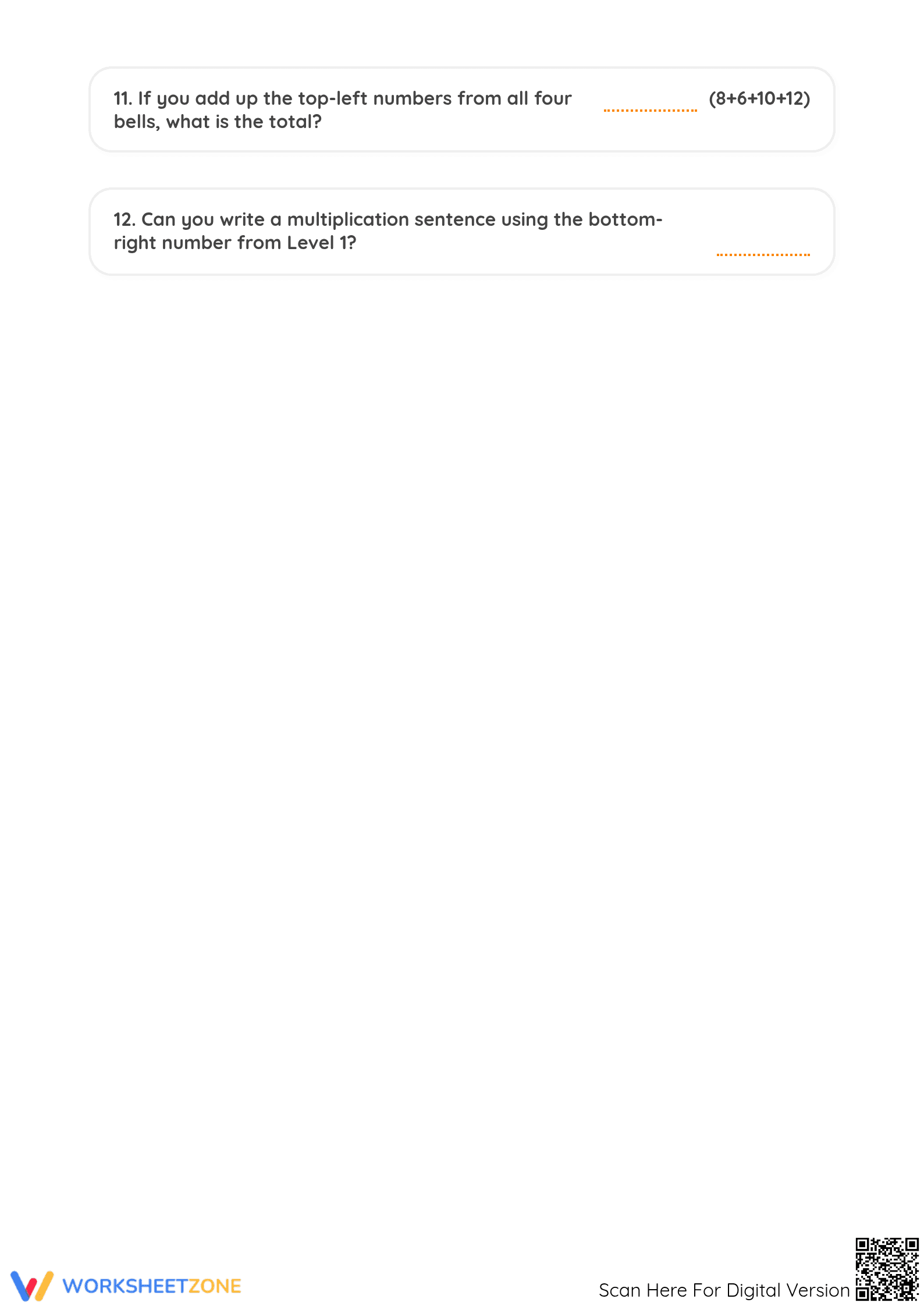
Across five beautifully designed pages, this resource provides four primary "Bell Puzzle" grids and 12 supporting comprehension questions. The structure includes 16 total tasks that transition from basic single-digit factors to higher products and quotients. A complete answer key is provided for every puzzle and question, allowing for quick grading or student self-correction during independent work periods.
- Guided Practice: The "Golden Bell" puzzle provides high scaffolding with multiple starting numbers to help students identify the first move in a three-step equation series.
- Supported Practice: Level 2 and 3 introduce more blank fields and higher numerical values, requiring students to apply division as the inverse of multiplication to find missing values.
- Independent Practice: The "Midnight Gong" and festive review sections remove most scaffolding, challenging students to construct and verify their own fact family sentences independently.
Standards Alignment
Primary Standard: `CCSS.MATH.CONTENT.3.OA.A.4` — Determine the unknown whole number in a multiplication or division equation relating three whole numbers. This worksheet also supports CCSS.MATH.CONTENT.3.OA.C.7 by providing fluently-based practice within 100. Both standard codes can be copied directly into lesson plans, IEP goals, or district curriculum mapping tools.
How to Use It
Use this worksheet as a festive warm-up game during the holiday season or as a focused math station after direct instruction on fact families. During the activity, observe if students start with multiplication or division to solve the puzzles; this identifies their operational comfort level. Expect most Grade 3 students to complete the five pages in 25–35 minutes, making it an ideal independent practice activity.
Who It's For
This resource is designed for Grade 3 and Grade 4 students who are working toward fluency in multiplication and division. It is particularly effective for learners who benefit from visual math models and non-standard problem formats. Pair this worksheet with a multiplication chart or holiday-themed math passage for a complete, zero-prep thematic lesson.
According to RAND AIRS 2024, the integration of non-traditional problem formats, such as the cross-equation bell puzzles featured here, significantly enhances student engagement with cognitive-heavy math operations like division. This 5-page worksheet targets CCSS.MATH.CONTENT.3.OA.A.4, requiring students to determine unknown whole numbers in multiplication and division equations. By presenting these operations as interconnected puzzles, the resource fosters a deeper understanding of inverse relationships rather than isolated rote memorization. Educational analysis indicates that varied instructional modalities—moving from guided puzzle completion to independent word-based reflection—improve long-term retention of basic facts. The inclusion of a full answer key ensures immediate feedback, a critical component in the mastery learning model for elementary mathematics.


