


























Views
Plays

Boundaries Quiz: Essential Grade 3-5 Behavior Worksheet
Paste this activity's link or code into your existing LMS (Google Classroom, Canvas, Teams, Schoology, Moodle, etc.).
Students can open and work on the activity right away, with no student login required.
You'll still be able to track student progress and results from your teacher account.
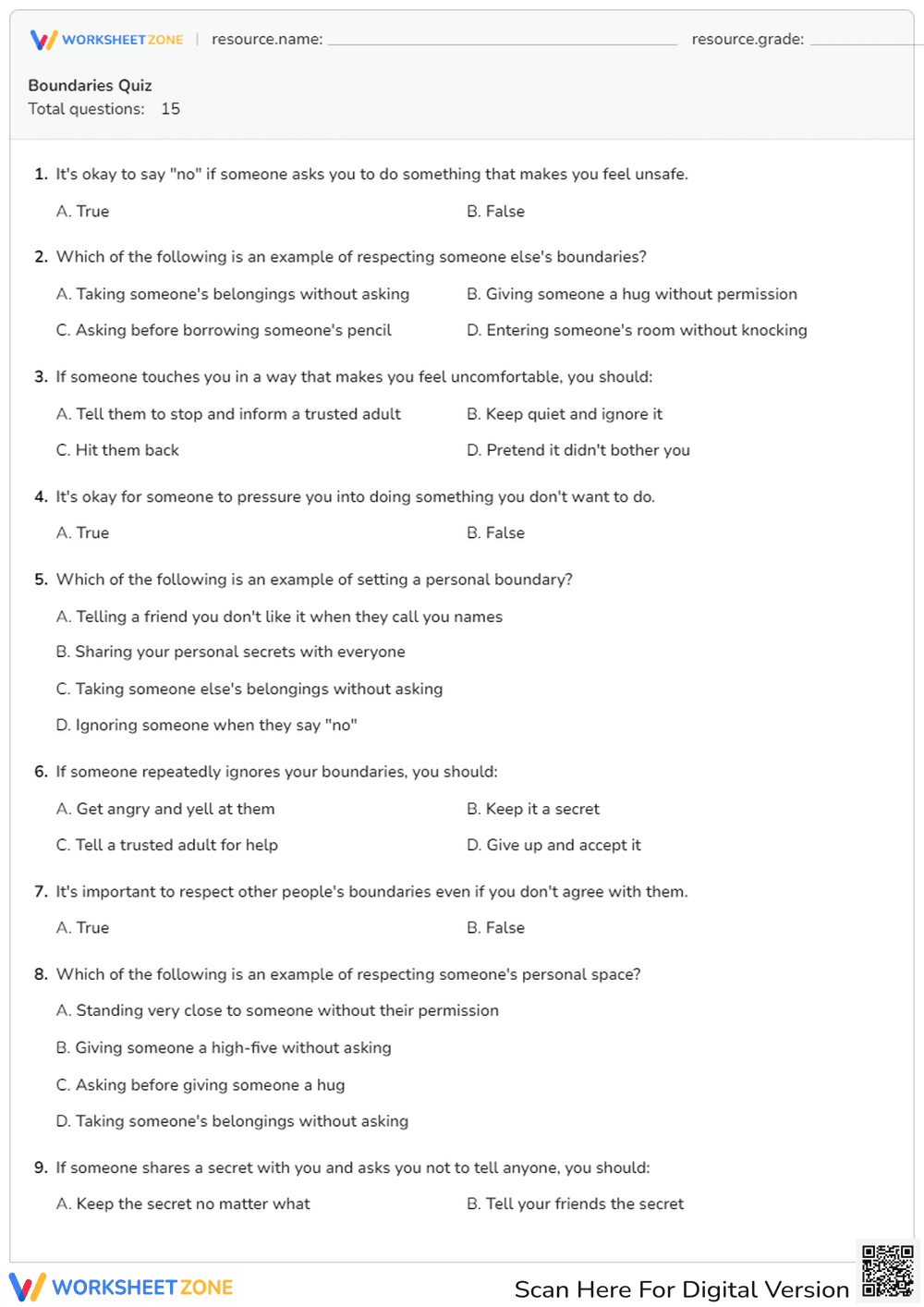
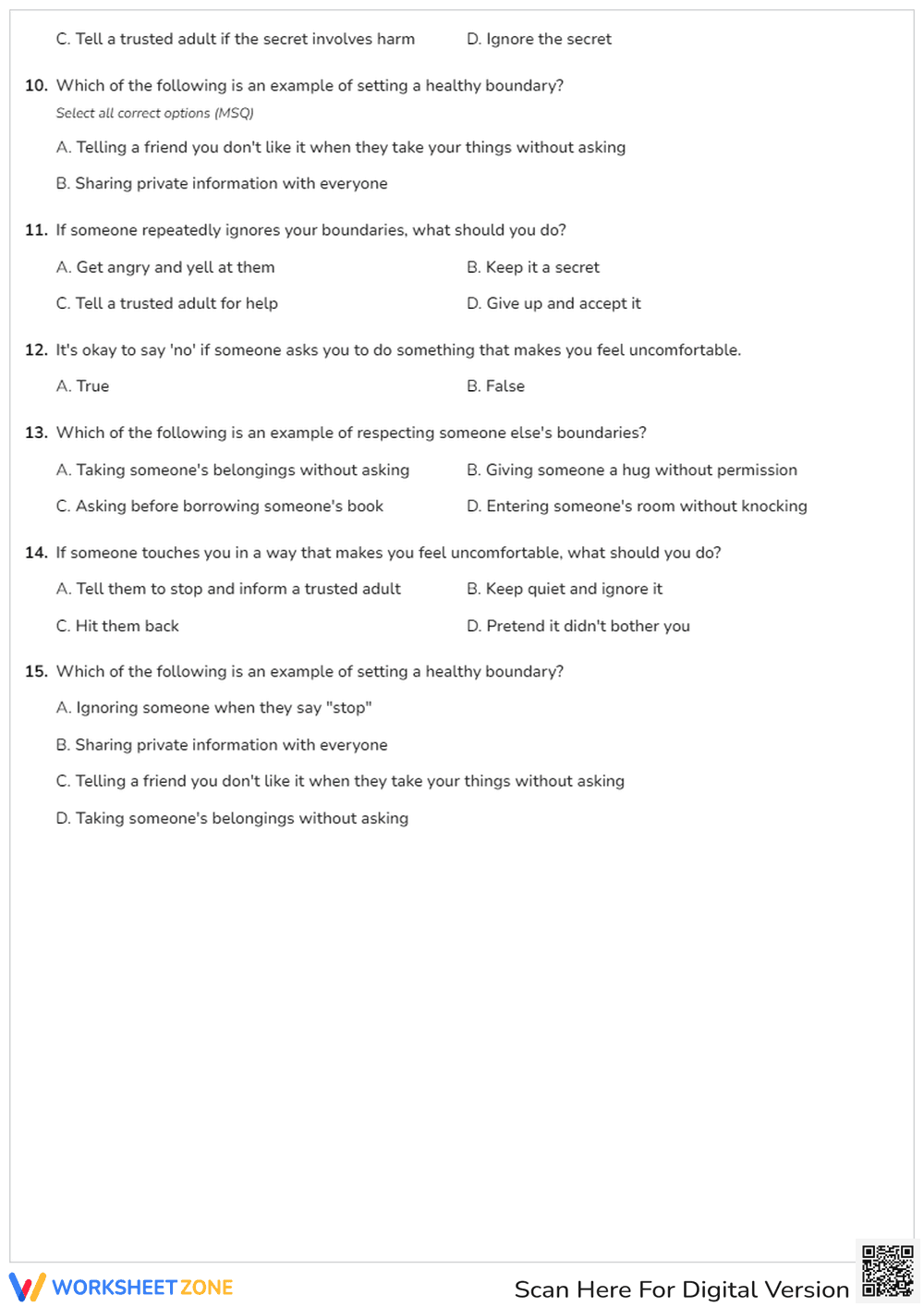
This Boundaries Quiz provides a comprehensive assessment of a student's understanding of personal space, consent, and social safety. By presenting 15 realistic scenarios, the worksheet helps students identify healthy versus unhealthy interactions. It serves as a vital tool for educators to gauge social-emotional maturity and ensure students can articulate their needs effectively in various social environments.
At a Glance
- Grade: 3-5 · Subject: Behavior Worksheets
- Standard:
CCSS.ELA-LITERACY.RI.4.1— Refer to details in a text when explaining explicit meanings- Skill Focus: Personal boundaries and safety
- Format: 2 pages · 15 problems · Answer key included · PDF
- Best For: SEL assessment and social skills instruction
- Time: 15–20 minutes
The resource consists of a two-page layout featuring 15 multiple-choice questions. Each question is designed with clear, age-appropriate language suitable for upper elementary learners. The tasks cover a range of topics including physical boundaries, digital privacy, and the importance of seeking help from trusted adults. The clean formatting ensures that students can focus on the content, and a full answer key is provided for quick grading.
This worksheet is designed for immediate classroom implementation with a total teacher prep time of less than two minutes. First, print the two-page PDF for your group. Second, distribute the quiz as a quiet, independent activity to assess baseline knowledge. Finally, review the answers as a whole group to facilitate a deeper discussion about social norms and safety. Its straightforward design also makes it an ideal choice for emergency sub plans.
The primary alignment for this resource is CCSS.ELA-LITERACY.RI.4.1, which requires students to refer to details and examples in a text when explaining what the text says explicitly. While focused on behavior, the quiz demands that students analyze the specific details of each social scenario to select the correct response. Both standard codes can be copied directly into lesson plans, IEP goals, or district curriculum mapping tools.
Use this quiz as a formative assessment following a direct instruction lesson on personal safety. It is particularly effective when administered mid-unit to identify students who may need additional small-group support regarding social boundaries. Teachers should observe which questions cause the most hesitation, as these often indicate areas where social norms are less clear. Expect completion within 20 minutes.
This resource is tailored for students in Grades 3 through 5, including those in general education and special education settings. It is an excellent pairing for school counselors delivering SEL curriculum or for classroom teachers looking to reinforce positive behavior expectations. It pairs naturally with anchor charts regarding personal space to provide a complete instructional cycle.
Social-emotional learning (SEL) assessments, such as this 15-question boundaries quiz, are vital for measuring a student's ability to interpret social cues and establish personal safety protocols. According to Fisher & Frey (2014), the use of structured scenarios in formative assessments allows educators to identify specific gaps in a student's social-emotional vocabulary and situational judgment. This worksheet aligns with CCSS.ELA-LITERACY.RI.4.1 by requiring students to refer to specific details within social scenarios to determine the most appropriate and safe response. By evaluating student performance on these 15 tasks, teachers can provide targeted interventions that support healthy peer interactions and personal agency. Research indicates that explicit instruction in boundaries reduces classroom conflict and improves overall student well-being. This resource provides a quantifiable measure of mastery for standard CCSS.ELA-LITERACY.RI.4.1, making it an effective tool for both general education classrooms and specialized behavioral support settings where social skill development is a primary instructional goal.


