


























Views
Downloads

Black History Word Scramble | Essential Grade 3-5 Activity
Paste this activity's link or code into your existing LMS (Google Classroom, Canvas, Teams, Schoology, Moodle, etc.).
Students can open and work on the activity right away, with no student login required.
You'll still be able to track student progress and results from your teacher account.
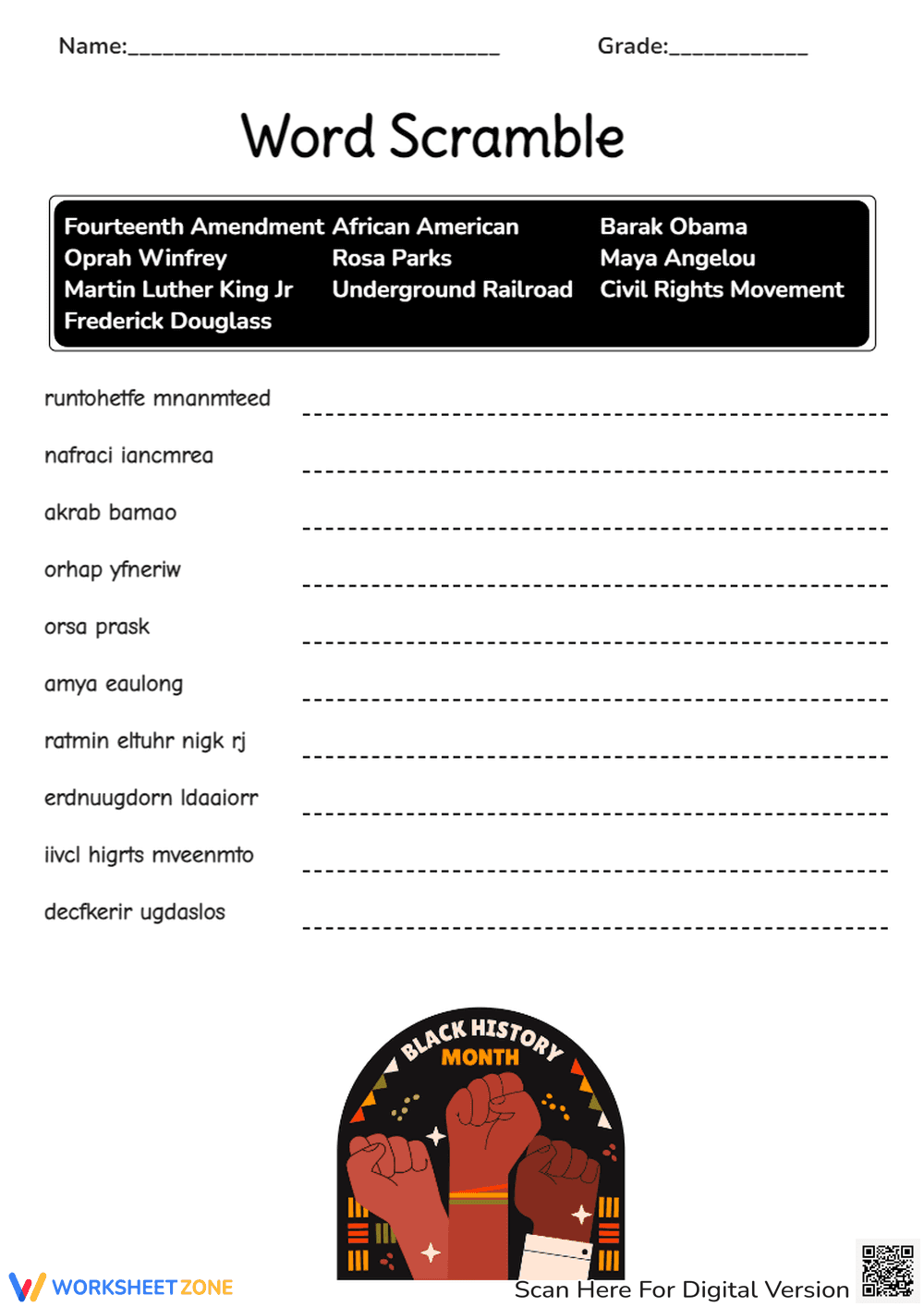
This Black History Word Scramble Challenge provides Grade 3, 4, and 5 students with a focused vocabulary activity centered on influential figures and pivotal historical milestones. By unscrambling key terms, learners reinforce their spelling skills while building familiarity with the names and concepts that define the Civil Rights Movement and beyond.
At a Glance
- Grade: 3-5 · Subject: Social Studies & ELA
- Standard:
CCSS.ELA-LITERACY.L.4.4— Determine or clarify the meaning of unknown and multiple-meaning words and phrases- Skill Focus: Historical Vocabulary & Spelling
- Format: 1 page · 10 problems · Answer key included · PDF
- Best For: Morning work or fast-finisher activity
- Time: 10–15 minutes
The worksheet features 10 distinct word scramble tasks. A clear word bank is provided at the top of the page, containing names like Frederick Douglass and Maya Angelou, as well as terms like the Fourteenth Amendment. This single-page PDF includes a structured layout with dedicated lines for student responses, ensuring a clean and organized workspace for young learners to practice their orthographic processing skills.
This resource is designed for a zero-prep classroom environment. Teachers can print the single-page PDF in less than 30 seconds. Distribution takes approximately 1 minute, and the activity serves as an excellent independent task while the teacher handles attendance or small-group transitions. Reviewing the 10 answers as a whole class takes roughly 5 minutes, providing a quick check for understanding and a springboard for discussing the historical significance of each term. It is an ideal sub-plan addition during February.
Aligned to CCSS.ELA-LITERACY.L.4.4, which focuses on determining or clarifying the meaning of unknown and multiple-meaning words and phrases. By engaging with specific historical terminology, students expand their academic vocabulary and improve their ability to recognize complex proper nouns. This standard code can be copied directly into lesson plans, IEP goals, or district curriculum mapping tools to ensure all seasonal activities remain instructionally relevant.
Use this as a morning work activity during February to introduce daily Black History Month themes. It also functions well as a formative assessment to gauge student familiarity with historical figures before starting a deeper research project. Teachers should observe which students rely heavily on the word bank versus those who can unscramble the letters independently. Expect students to complete the scramble in 10 to 15 minutes depending on their reading level.
This worksheet is ideal for general education elementary classrooms, ESL students needing vocabulary support, and homeschool environments. It pairs naturally with a Black History Month anchor chart or a short biography reading passage about the individuals listed in the word bank. The inclusion of the word bank makes it accessible for students who may be struggling with spelling while still providing a cognitive challenge.
According to research by Fisher & Frey (2014), the use of word puzzles and scrambles in the classroom serves as an effective scaffold for academic vocabulary acquisition, particularly when terms are situated within a specific thematic context like Black History Month. This worksheet targets the CCSS.ELA-LITERACY.L.4.4 standard by requiring students to recognize and correctly spell complex proper nouns and historical terms. By engaging with the 10 specific tasks provided, learners move beyond rote memorization toward visual word recognition. The inclusion of a word bank supports orthographic processing, allowing students to map scrambled letter sequences to known historical concepts. This method is particularly beneficial for Grade 3 through Grade 5 students who are developing the cognitive flexibility required for advanced literacy. Educational analysis suggests that such focused, short-form activities improve retention of historical names and events when integrated into a broader social studies curriculum or literacy block.


