




























Views
Downloads



Bill Nye Motion Worksheet | Grade 3-5 Essential

Paste this activity's link or code into your existing LMS (Google Classroom, Canvas, Teams, Schoology, Moodle, etc.).
Students can open and work on the activity right away, with no student login required.
You'll still be able to track student progress and results from your teacher account.
This Grade 3-5 science worksheet provides a comprehensive review of forces and motion concepts, moving students from basic term recognition to high-level explanation. By engaging with 33 structured tasks, learners master the vocabulary necessary to describe physical phenomena like inertia and velocity. This resource ensures students can accurately apply physics terminology in both written and verbal scientific arguments.
At a Glance
- Grade: 3-5 · Subject: Science
- Standard:
3-PS2-1— Plan and conduct investigations to provide evidence of the effects of forces on motion- Skill Focus: Physics Vocabulary & Conceptual Application
- Format: 3 pages · 33 problems · Answer key included · PDF
- Best For: Video companion or sub plan activity
- Time: 30–45 minutes
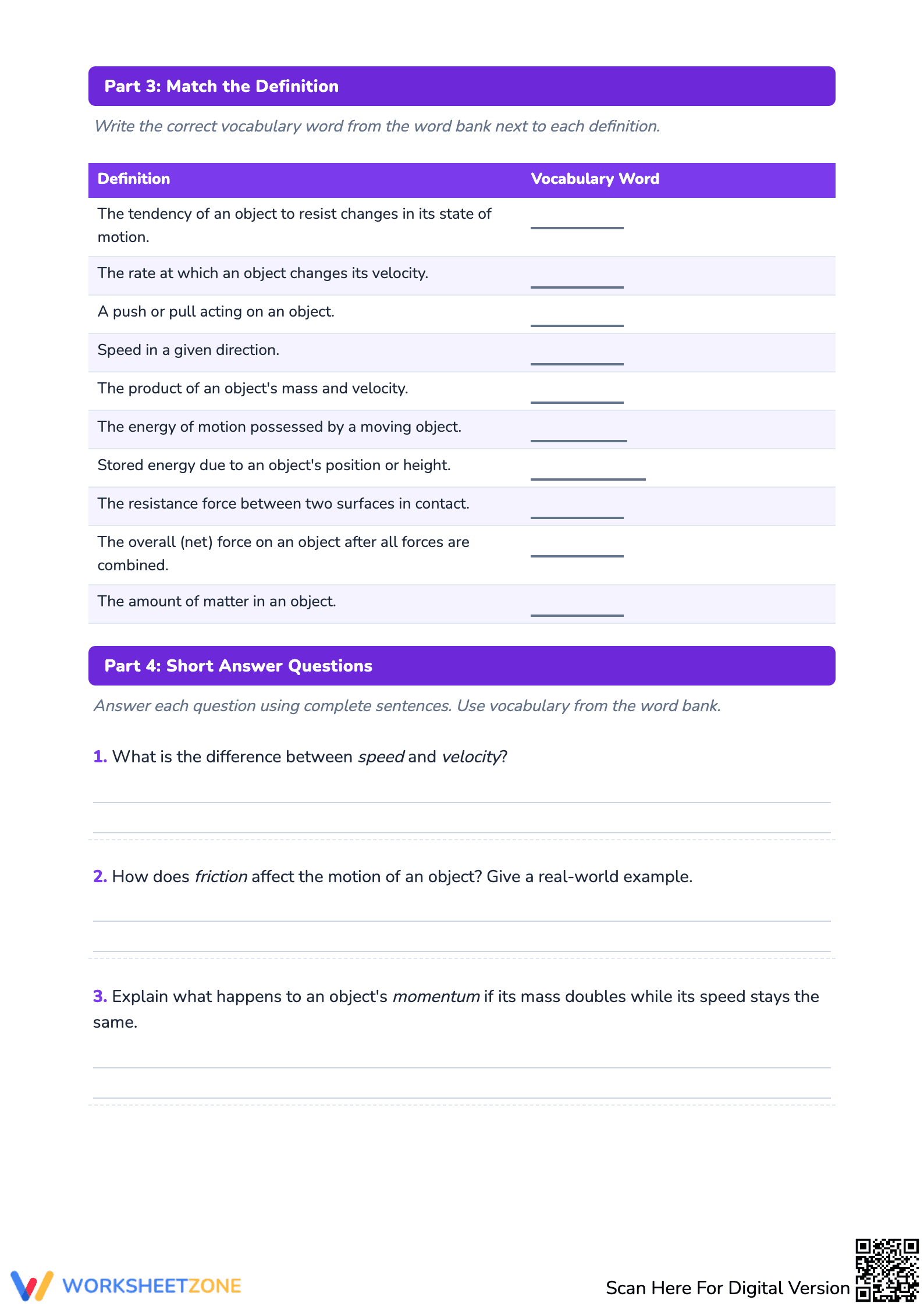
This three-page resource scaffolds learning through varied interaction types. It begins with a 17-word search grid to familiarize students with the spelling and visual recognition of physics terms. The second section features a 10-item matching task where students connect terms like momentum and displacement to their formal scientific definitions. Finally, five short-answer questions require students to synthesize knowledge, such as explaining the difference between speed and velocity.
The zero-prep design of this resource allows for immediate implementation in any science classroom. Teachers can follow a simple three-step workflow: Print the three-page PDF (30 seconds), Distribute the packets to students (1 minute), and Review the answers using the included key (5 minutes). Total teacher prep time is under two minutes, making this an ideal solution for unexpected absences or as a high-quality activity during testing weeks.
This resource is primarily aligned with `3-PS2-1`: "Plan and conduct an investigation to provide evidence of the effects of balanced and unbalanced forces on the motion of an object." It also supports 4-PS3-1 by addressing the relationship between speed and energy. Both standard codes can be copied directly into lesson plans, IEP goals, or district curriculum mapping tools to demonstrate rigorous alignment.
Use this worksheet as a companion to a Bill Nye the Science Guy video on motion to keep students focused on key terminology. Alternatively, assign it as a summative review at the end of a physics unit to assess vocabulary retention. During the activity, circulate and observe if students can explain the difference between distance and displacement, which serves as a quick formative assessment. Completion typically takes 30 to 45 minutes.
This activity is designed for upper elementary students in grades 3, 4, and 5 who are beginning their study of physical science. It is particularly helpful for English Language Learners (ELLs) who benefit from the visual support of the word bank and the clear definitions provided in the matching section. Pair this worksheet with a hands-on ramp experiment or a motion anchor chart for a complete instructional cycle.
This worksheet leverages the 3-PS2-1 standard to bridge the gap between vocabulary acquisition and conceptual physics. According to Fisher & Frey (2014), the gradual release of responsibility model is most effective when students first engage with domain-specific terms before applying them to complex problem-solving. By moving from a word search to definition matching and finally to short-answer synthesis, this resource ensures that students in grades 3 through 5 develop a robust mental schema for forces and motion. The inclusion of 33 distinct tasks allows for multiple touchpoints with critical terms like inertia, momentum, and net force. Research from EdReports 2024 suggests that high-quality science materials must integrate literacy components to support NGSS mastery. This resource provides that integration, making it a reliable tool for classroom teachers and substitutes alike. The 3-PS2-1 code ensures this activity aligns with national expectations for investigating the effects of balanced and unbalanced forces on object motion.


