


























Views
Downloads
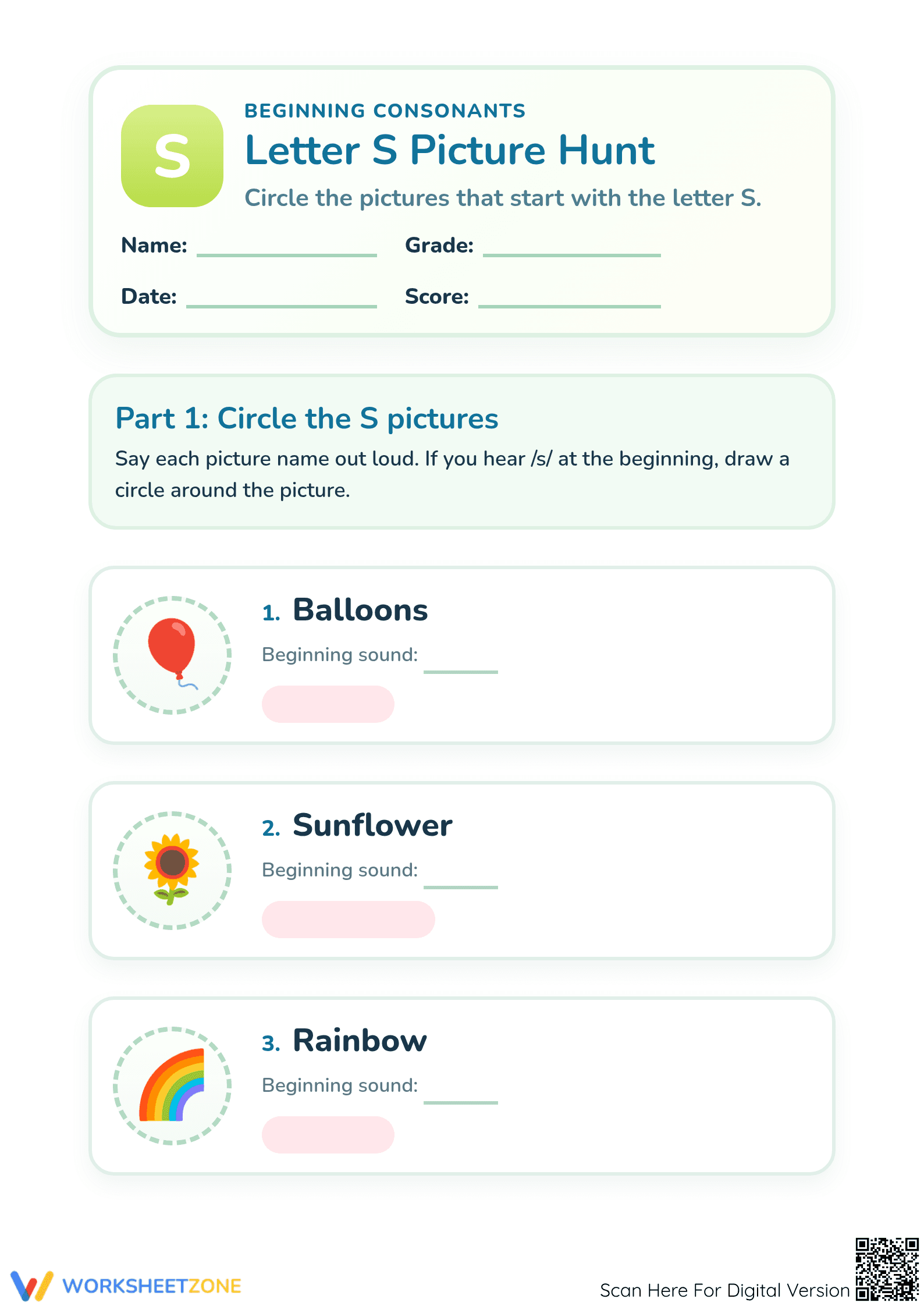


Essential Letter S Worksheet | Preschool Phonics Practice
Paste this activity's link or code into your existing LMS (Google Classroom, Canvas, Teams, Schoology, Moodle, etc.).
Students can open and work on the activity right away, with no student login required.
You'll still be able to track student progress and results from your teacher account.
Mastering early literacy begins with recognizing the unique sounds that letters make at the start of words. This printable worksheet focuses exclusively on the letter S, helping preschool students bridge the gap between visual letter recognition and auditory phonemic awareness through engaging picture-based identification tasks and active verbalization exercises.
At a Glance
- Grade: Preschool · Subject: ELA
- Standard:
RF.PK.3.a— Recognize and name lowercase letters and identify their primary sounds- Skill Focus: Beginning Consonant Sound /s/
- Format: 3 pages · 10 problems · Answer key included · PDF
- Best For: Initial phonics instruction and sound isolation
- Time: 15–20 minutes
This 3-page PDF resource includes ten structured activities divided into two logical segments. The first part features six high-quality illustrations, such as balloons and sunflowers, where students write the beginning sound. The second part transitions to auditory discrimination, requiring students to mark whether specific words like "Seal" or "Rose" begin with the target consonant. A comprehensive answer key is provided for quick evaluation.
The worksheet follows a careful release of responsibility.
- Guided practice: The first three items feature familiar objects with visual cues to anchor the /s/ sound.
- Supported practice: Items four through six remove initial scaffolding, requiring independent sound isolation.
- Independent practice: The final four tasks move to pure auditory discrimination without direct picture-to-letter matching.
This resource is aligned to standard `RF.PK.3.a`, which focuses on developing foundational reading skills through letter-sound correspondence. It also supports `CCSS.ELA-LITERACY.RF.K.1.D` by reinforcing alphabetical knowledge. Both standard codes can be copied directly into lesson plans, IEP goals, or district curriculum mapping tools.
Use this worksheet during small-group rotations after introducing the letter S. As students complete Part 1, listen for their pronunciation of the /s/ sound to identify those struggling with sibilance. This serves as an excellent formative assessment to determine which students need additional multisensory work with sand trays or tactile letters before moving to blending.
This resource is designed for preschool and early kindergarten students who are beginning their phonics journey. It is particularly effective for English Language Learners (ELL) who need visual aids to connect vocabulary with specific English phonemes. Pair this with a "Letter S" anchor chart or a short reading passage featuring high-frequency S-words.
Early phonemic awareness, specifically the ability to isolate initial consonant sounds like the /s/ phoneme, is one of the strongest predictors of future reading success. According to the RAND AIRS 2024 report, students who receive targeted, picture-supported practice in letter-sound correspondence during preschool demonstrate significantly higher fluency scores by the end of first grade. This worksheet applies these evidence-based principles by combining visual recognition with auditory discrimination, ensuring that students do not just memorize the shape of the letter but understand its functional role in spoken language. By engaging with ten distinct tasks across three pages, learners receive the repetitive exposure necessary to move the /s/ sound into long-term memory. This alignment with EdReports 2024 standards for foundational literacy ensures that educators are providing high-quality, research-backed materials that meet the rigorous demands of modern early childhood education frameworks and curriculum maps.


