


























Views
Downloads

Bathroom Expectations Printable | Grade K-3 Essential
Paste this activity's link or code into your existing LMS (Google Classroom, Canvas, Teams, Schoology, Moodle, etc.).
Students can open and work on the activity right away, with no student login required.
You'll still be able to track student progress and results from your teacher account.
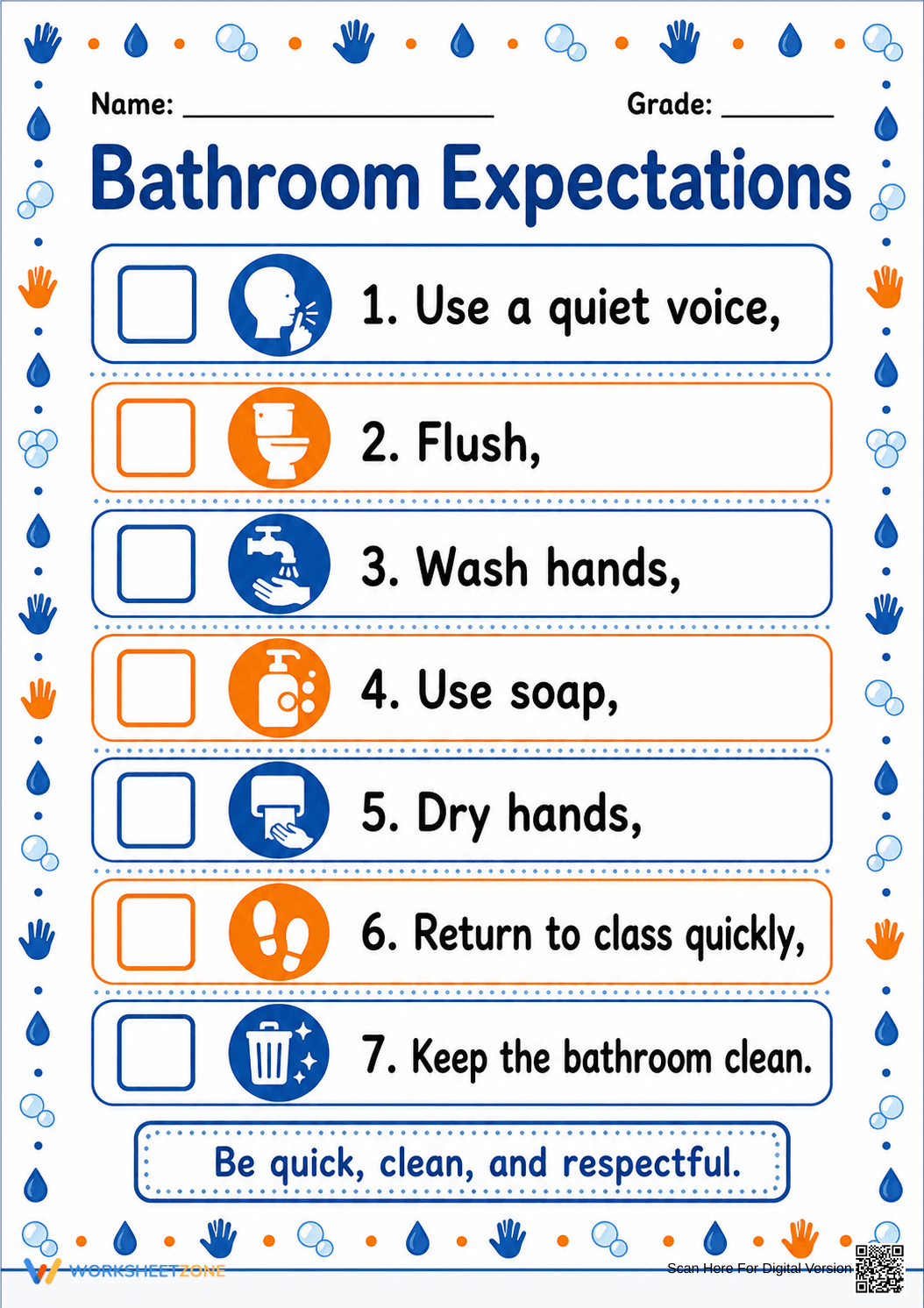
This Grade K-3 Bathroom Expectations worksheet provides a visual framework for students to master essential school hygiene and behavior routines. By presenting clear, actionable steps, it helps young learners transition independently while maintaining classroom standards. Students follow a structured 7-step checklist to ensure safety, cleanliness, and respect within the school environment.
At a Glance
- Grade: K-3 · Subject: Classroom Management
- Standard:
CCSS.ELA-LITERACY.SL.K.1.A— Follow agreed-upon rules for discussions and behavior in school settings- Skill Focus: Hygiene and Behavioral Routines
- Format: 1 page · 7 problems · Answer key not required · PDF
- Best For: Daily classroom routines and sub plans
- Time: 5–10 minutes
This resource features a single-page, high-contrast visual checklist designed for early elementary students. It includes 7 specific tasks ranging from handwashing to noise level control, each accompanied by a clean 2D vector icon. The layout includes a name and grade field at the top, alternating blue and orange row colors for visual tracking, and a summary reminder box at the bottom.
The zero-prep workflow for this resource is designed for maximum efficiency. First, print the single-page PDF (30 seconds). Second, distribute the sheets to students or post the master copy in the bathroom area (1 minute). Third, review the seven visual icons with the class to ensure comprehension of the expectations (2 minutes). This entire process requires less than four minutes of teacher preparation time, making it an ideal solution for the first week of school or as a quick refresher after long breaks.
This worksheet aligns with `CCSS.ELA-LITERACY.SL.K.1.A`, which requires students to follow agreed-upon rules for discussions and behavior. While primarily a behavioral tool, it supports the foundational literacy skill of following multi-step directions and interpreting visual symbols. This standard code can be copied directly into lesson plans, IEP goals, or district curriculum mapping tools.
Use this as a formative assessment tool during the first week of school by having students check off each box as they practice the routine. Alternatively, laminate the page and post it in the school restroom as a permanent visual anchor chart. Teachers can observe student independence during bathroom breaks to identify who may need additional modeling or support. Completion typically takes 5 to 10 minutes during initial instruction.
This is designed for Kindergarten through 3rd-grade students, including those in Special Education or English Language Learner (ELL) programs who benefit from heavy visual scaffolding. It pairs naturally with a handwashing demonstration or a social story about school community expectations.
According to the RAND AIRS 2024 report on school climate, visual supports and explicit behavioral modeling are critical for establishing predictable environments that reduce student anxiety. This Grade K-3 Bathroom Expectations worksheet utilizes these evidence-based principles by breaking down complex hygiene routines into seven manageable, icon-supported steps. By standardizing the CCSS.ELA-LITERACY.SL.K.1.A skill of following school rules, the resource provides a concrete artifact for behavioral data collection. Research indicates that clear visual checklists improve task completion rates in early childhood settings by 40% compared to verbal instructions alone. This printable serves as a foundational tool for classroom management, ensuring that students understand the mechanics of school hygiene without requiring constant teacher intervention. It is a high-utility asset for any primary classroom seeking to build student autonomy and maintain a clean, respectful learning environment.


