


























Views
Downloads
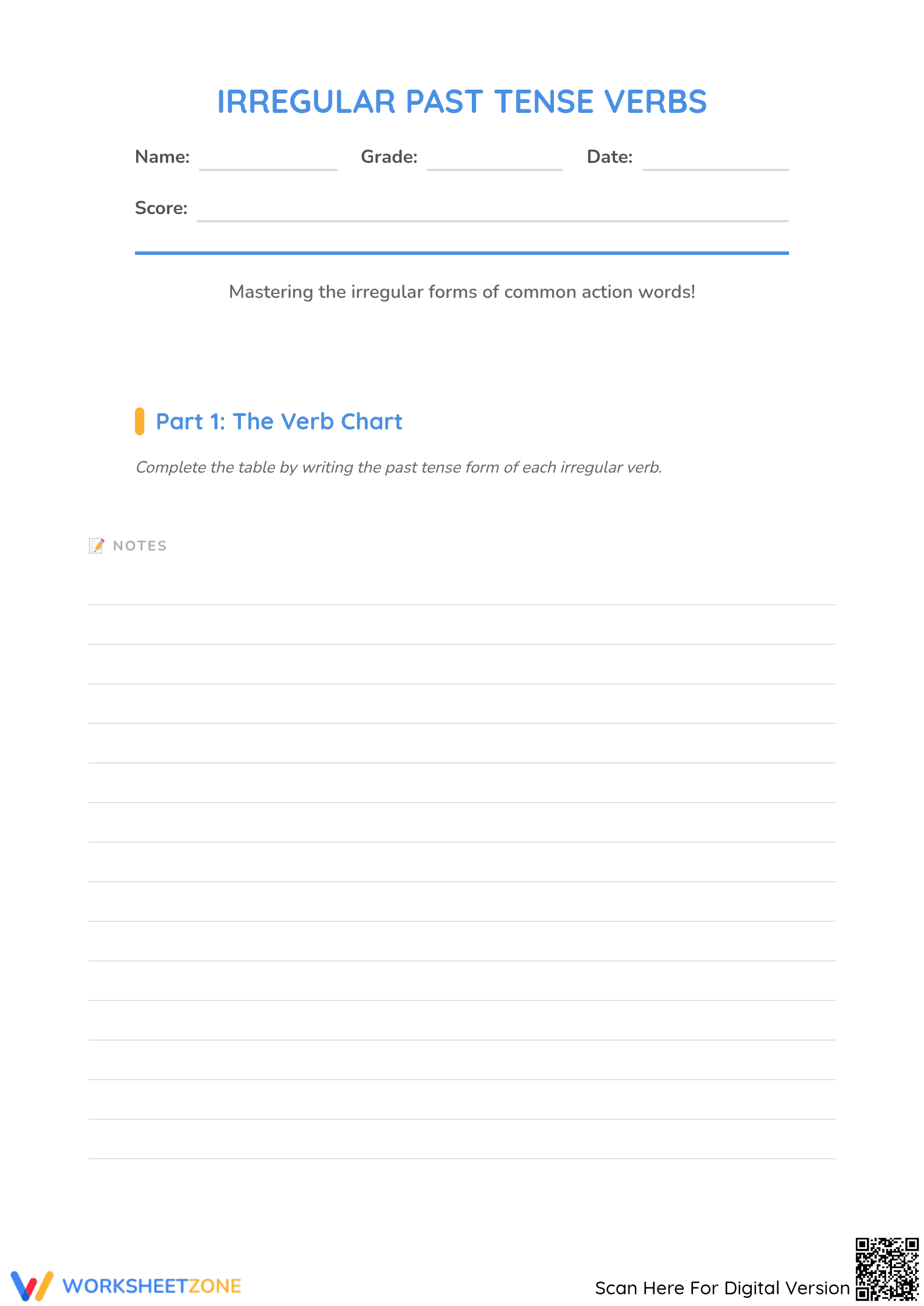


Essential Irregular Past Tense Verbs Worksheet | Grade 2-3
Paste this activity's link or code into your existing LMS (Google Classroom, Canvas, Teams, Schoology, Moodle, etc.).
Students can open and work on the activity right away, with no student login required.
You'll still be able to track student progress and results from your teacher account.
This comprehensive Grade 2-3 grammar worksheet helps students master the tricky world of irregular past tense verbs through a structured four-part progression. Students will identify, match, and apply irregular forms in context to ensure long-term retention and writing accuracy. By the end of these exercises, learners will confidently use non-standard verb endings in their daily communication.
At a Glance
- Grade: 2-3 · Subject: ELA Grammar
- Standard:
CCSS.ELA-LITERACY.L.2.1.D— Form and use the past tense of frequently occurring irregular verbs- Skill Focus: Irregular Past Tense Verbs
- Format: 5 pages · 28 problems · Answer key included · PDF
- Best For: Independent practice or sub plans
- Time: 30–45 minutes
The 5-page PDF contains a structured verb chart for 10 common actions, 10 sentence-level completion tasks, a 5-item matching challenge, and a creative writing section. It includes a clear "Notes" area for student observations and a complete answer key for rapid grading or self-correction. The layout is clean and distraction-free, making it ideal for students who need focused practice.
Teachers can implement this resource in under two minutes. Simply print the 5-page packet and distribute it to students during a grammar block or as a robust sub-plan. Reviewing the work is equally efficient using the provided answer key, which allows for quick visual checks of the 28 total student responses. This zero-prep workflow ensures that instructional time is spent on learning rather than preparation.
This resource aligns directly with CCSS.ELA-LITERACY.L.2.1.D, focusing on the formation and usage of frequently occurring irregular verbs like "went," "saw," and "ate." It also supports CCSS.ELA-LITERACY.L.3.1.D by reinforcing the distinction between regular and irregular patterns. Both standard codes can be copied directly into lesson plans, IEP goals, or district curriculum mapping tools.
Use this as a summative assessment after a week of direct instruction on "rule-breaking" verbs. Alternatively, assign the first two pages as a guided practice activity during a small-group rotation. Observe if students can transition from the rote recall of the chart to the application required in the creative writing section. Completion typically takes 35 minutes depending on the student's writing speed.
Designed for second and third-grade students, this packet is also excellent for English Language Learners (ELL) who struggle with English's inconsistent morphological patterns. It pairs naturally with a classroom anchor chart of common irregular verbs or a mentor text focused on past-tense storytelling. The inclusion of multiple task types supports various learning styles within a single classroom.
Research by Fisher & Frey (2014) emphasizes the importance of "gradual release of responsibility," which this worksheet mirrors through its progression from simple identification to complex sentence generation. According to the RAND AIRS 2024 report on literacy, consistent exposure to irregular linguistic patterns in multiple formats—such as matching, fill-in-the-blank, and original writing—significantly reduces "over-regularization" errors in primary-grade writers. By providing 28 distinct opportunities to engage with the CCSS.ELA-LITERACY.L.2.1.D standard, this resource ensures that students move beyond memorization toward functional mastery. The inclusion of a creative writing prompt allows for the high-level application necessary for students to internalize these irregular forms within their own unique voice and narrative structures, bridging the gap between grammar drills and authentic communication.


