


























0
Views
0
Downloads

0.0
0
Save
0 Likes
Share
Basic Emotions Reference Guide
0 Views
0 Downloads
Paste this activity's link or code into your existing LMS (Google Classroom, Canvas, Teams, Schoology, Moodle, etc.).
Students can open and work on the activity right away, with no student login required.
You'll still be able to track student progress and results from your teacher account.
Information
Description
What It Is:
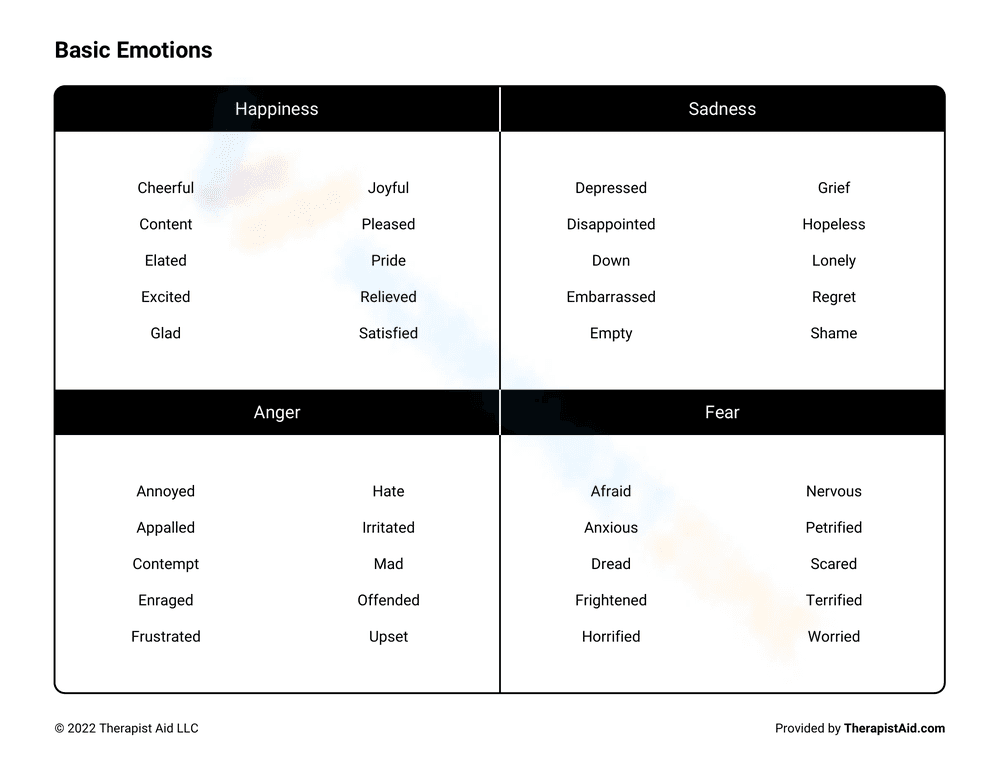
A worksheet titled 'Basic Emotions' that categorizes emotions into four main categories: Happiness, Sadness, Anger, and Fear. Under each category, a list of related words is provided, such as 'Cheerful,' 'Content,' 'Elated,' 'Excited,' and 'Glad' under Happiness, and 'Depressed,' 'Disappointed,' and 'Down' under Sadness. Similar lists are provided for Anger and Fear.
Grade Level Suitability:
Suitable for grades 2-5. The vocabulary is relatively simple, and the concept of categorizing emotions is appropriate for elementary-aged children who are learning to identify and understand different feelings. It could also be useful for older students who need a refresher on basic emotions.
Why Use It:
This worksheet helps students expand their vocabulary related to emotions and understand the nuances within each emotion category. It promotes emotional literacy and self-awareness by helping children identify and label their feelings. It can also be used to facilitate discussions about emotional responses and coping strategies.
How to Use It:
The worksheet can be used as a reference tool for students learning about emotions. Students can be asked to identify situations that might evoke each emotion. It can also be used as a starting point for writing activities or role-playing scenarios where students explore different emotional expressions. A teacher could also ask students to add more words to each category.
Target Users:
Elementary school students, special education students, students with social-emotional learning needs, and individuals in therapy settings who are working on emotional identification and expression. It can also be useful for parents and educators who want to teach children about emotions in a structured way.
A worksheet titled 'Basic Emotions' that categorizes emotions into four main categories: Happiness, Sadness, Anger, and Fear. Under each category, a list of related words is provided, such as 'Cheerful,' 'Content,' 'Elated,' 'Excited,' and 'Glad' under Happiness, and 'Depressed,' 'Disappointed,' and 'Down' under Sadness. Similar lists are provided for Anger and Fear.
Grade Level Suitability:
Suitable for grades 2-5. The vocabulary is relatively simple, and the concept of categorizing emotions is appropriate for elementary-aged children who are learning to identify and understand different feelings. It could also be useful for older students who need a refresher on basic emotions.
Why Use It:
This worksheet helps students expand their vocabulary related to emotions and understand the nuances within each emotion category. It promotes emotional literacy and self-awareness by helping children identify and label their feelings. It can also be used to facilitate discussions about emotional responses and coping strategies.
How to Use It:
The worksheet can be used as a reference tool for students learning about emotions. Students can be asked to identify situations that might evoke each emotion. It can also be used as a starting point for writing activities or role-playing scenarios where students explore different emotional expressions. A teacher could also ask students to add more words to each category.
Target Users:
Elementary school students, special education students, students with social-emotional learning needs, and individuals in therapy settings who are working on emotional identification and expression. It can also be useful for parents and educators who want to teach children about emotions in a structured way.


