




























Views
Downloads

"Backpack Full of Me" Icebreaker | Essential Grade K-3

Paste this activity's link or code into your existing LMS (Google Classroom, Canvas, Teams, Schoology, Moodle, etc.).
Students can open and work on the activity right away, with no student login required.
You'll still be able to track student progress and results from your teacher account.
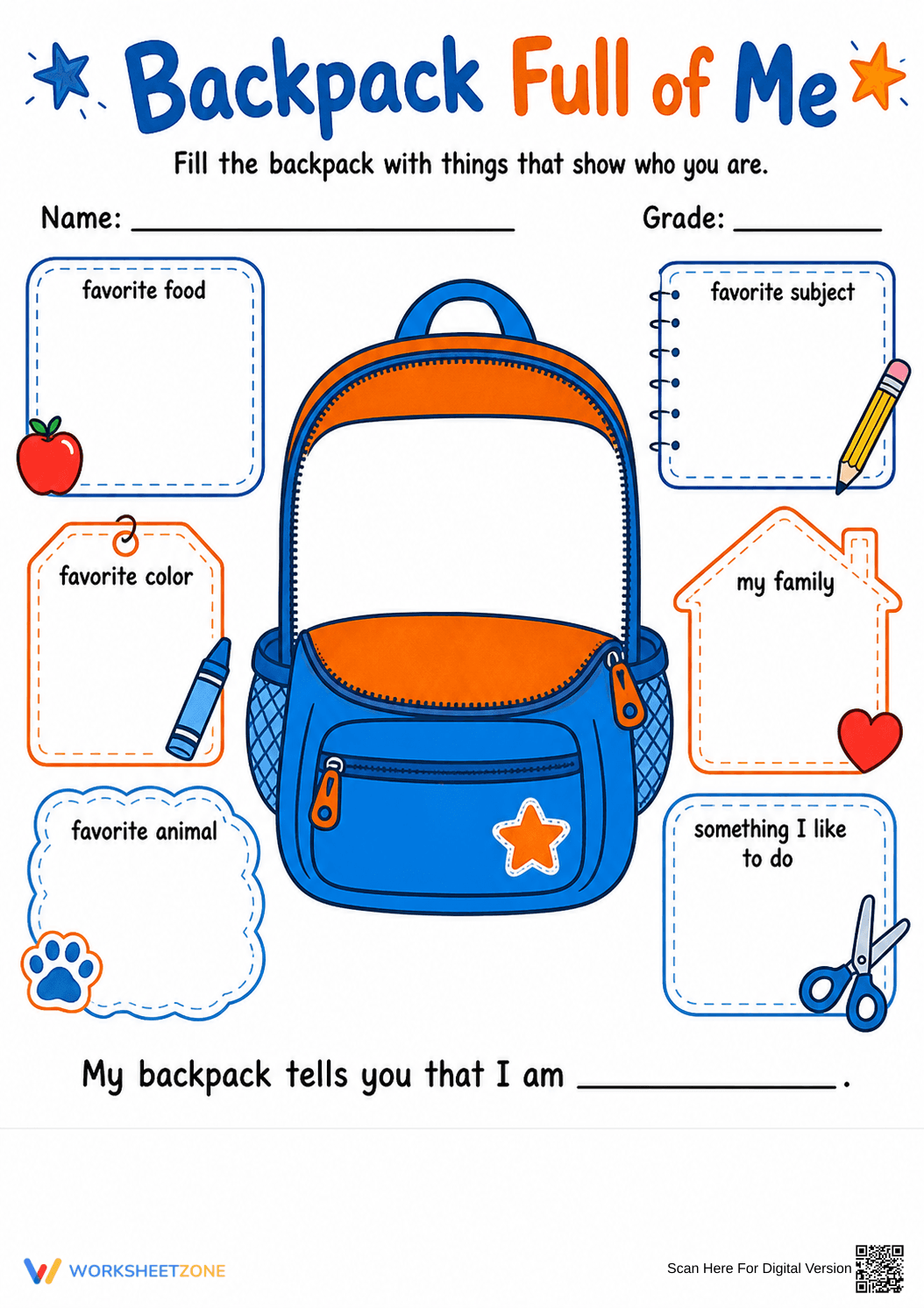
This Grade K-3 icebreaker worksheet helps students share their unique identities through drawing and simple writing. By identifying personal favorites and family connections, learners build self-awareness and communication skills. It provides a structured way for teachers to get to know new students during the first week of school while practicing foundational fine motor and literacy skills.
At a Glance
- Grade: K-3 · Subject: ELA / SEL
- Standard:
CCSS.ELA-LITERACY.SL.1.4— Describe familiar people, places, things, and events with relevant details- Skill Focus: Personal Identity & Self-Expression
- Format: 1 page · 7 prompts · No answer key · PDF
- Best For: First week of school icebreaker
- Time: 15–25 minutes
This single-page PDF features a large, central backpack graphic surrounded by six themed prompt boxes: favorite food, color, animal, subject, family, and a preferred activity. Each box uses a distinct visual border to help young learners distinguish between tasks. The worksheet concludes with a sentence-completion frame at the bottom, allowing students to summarize their identity in one cohesive statement.
The zero-prep workflow for this activity is designed for the busy first week of school. First, print the PDF and make enough copies for your class (30 seconds). Second, distribute the sheets along with crayons or markers (1 minute). Finally, walk around as students work, using the prompts as conversation starters to build immediate rapport (0 minutes prep). This resource is an ideal sub plan or morning-work activity requiring no teacher setup.
This resource aligns with `CCSS.ELA-LITERACY.SL.1.4`, which requires students to describe familiar people, places, things, and events with relevant details. It also supports `CCSS.ELA-LITERACY.W.K.2` by using a combination of drawing and writing to compose informative texts. Both standard codes can be copied directly into lesson plans, IEP goals, or district curriculum mapping tools.
Use this as a "First Day" desk activity to keep students engaged while you handle administrative tasks like attendance and bus schedules. Alternatively, use it as a formative assessment for fine motor skills and phonetic spelling. Observe how students hold their pencils and whether they use labels or full sentences in the prompt boxes. Completion typically takes 20 minutes.
This worksheet is designed for primary students in Kindergarten through 3rd Grade, including English Language Learners who can use the drawing spaces to communicate without language barriers. It pairs naturally with a "Getting to Know You" read-aloud or an anchor chart about classroom community and shared interests.
According to the RAND AIRS 2024 report, early childhood educators who prioritize social-emotional connection in the first ten days of school see a significant increase in student engagement. This worksheet facilitates that connection by providing a low-stakes, high-interest medium for self-disclosure. By utilizing CCSS.ELA-LITERACY.SL.1.4, the activity bridges the gap between personal narrative and academic standards, ensuring that icebreaker time remains instructionally relevant. Research from Fisher & Frey (2014) emphasizes that knowing the learner is the first step in effective scaffolding; this tool provides the data necessary for that pedagogical foundation. The visual nature of the backpack graphic serves as a non-linguistic representation of identity, which is a proven strategy for supporting diverse learners. This resource offers a reliable, research-backed method for establishing a positive classroom culture while meeting core literacy requirements for young students.


