


























Views
Downloads

Printable Back to School Bingo Card | Grades 1-5 Ready
Paste this activity's link or code into your existing LMS (Google Classroom, Canvas, Teams, Schoology, Moodle, etc.).
Students can open and work on the activity right away, with no student login required.
You'll still be able to track student progress and results from your teacher account.
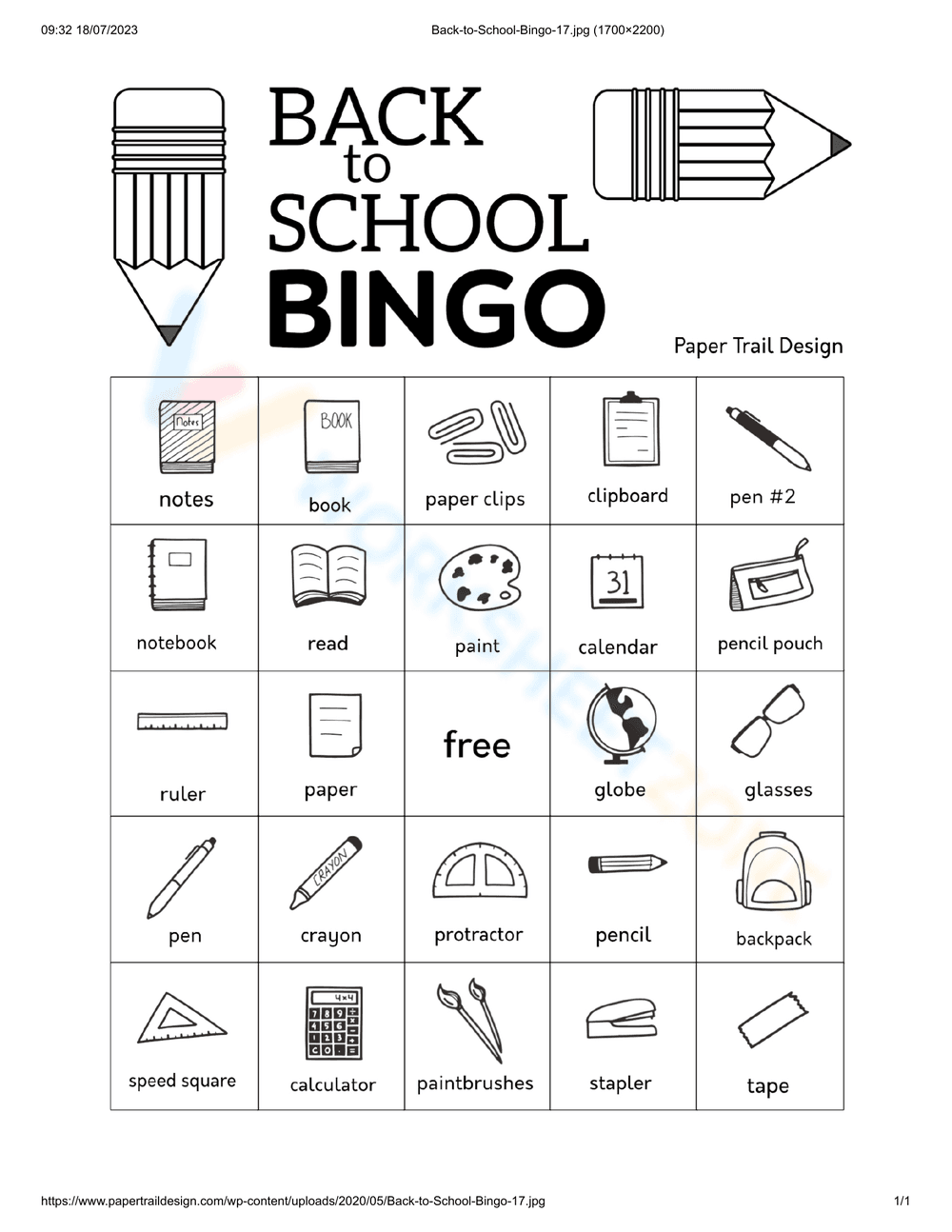
This printable Back to School Bingo card helps elementary students identify common classroom supplies while building essential social-emotional skills during the first week of school. By gamifying vocabulary recognition, students engage in low-stakes peer interaction that eases transition anxiety. This resource provides a structured way to familiarize learners with their new environment and required materials.
At a Glance
- Grade: 1-5 · Subject: ELA / Seasonal
- Standard:
CCSS.ELA-LITERACY.SL.3.1— Engage in collaborative discussions about school-related topics and materials- Skill Focus: Vocabulary & Listening
- Format: 1 page · 24 items · No-prep · PDF
- Best For: First week icebreaker activity
- Time: 15–20 minutes
Inside this single-page PDF, you will find one unique bingo card featuring 24 distinct school-themed illustrations and labels. The items range from basic supplies like "pencil" and "paper" to more specific tools like "protractor" and "speed square." Each square includes a clear black-and-white icon and the corresponding word, making it accessible for early readers and English Language Learners.
The zero-prep workflow for this activity is designed for the busy first days of the term. First, print the required number of copies for your class, which takes less than 60 seconds. Second, distribute the cards and markers (like beans or small scraps of paper) in under 1 minute. Finally, call out the items to review vocabulary and check for understanding as students play. Total teacher preparation time is under 2 minutes, making this an ideal emergency sub plan or transition activity.
This resource aligns with `CCSS.ELA-LITERACY.SL.3.1`, which requires students to engage effectively in a range of collaborative discussions with diverse partners. By participating in the bingo game, students practice active listening and follow multi-step oral directions. This standard code can be copied directly into lesson plans, IEP goals, or district curriculum mapping tools to document social-communication practice.
Use this card as a "Find Someone Who" activity where students must find a peer who has the item in their backpack, or as a traditional whole-group listening game. For a formative assessment, observe which students can independently match the spoken word to the visual icon. Expect the activity to take between 15 and 20 minutes depending on the game variation chosen.
This worksheet is designed for students in Grades 1 through 5, with visual supports that assist struggling readers. It is particularly effective for inclusive classrooms where students need concrete visual anchors for new vocabulary. Pair this bingo card with a classroom scavenger hunt or a "Meet the Teacher" presentation to reinforce the names of school locations and tools.
According to the RAND AIRS 2024 report on elementary engagement, gamified instructional tools significantly increase student participation during transitional periods like the start of a school year. This Back to School Bingo card utilizes visual-verbal pairing to reinforce CCSS.ELA-LITERACY.SL.3.1 standards, focusing on the plain-English skill of identifying and discussing classroom materials. Research from Fisher & Frey (2014) suggests that low-stakes social activities during the first week of school establish a positive classroom culture and reduce affective filters, which is critical for language acquisition and social-emotional development. By providing 24 specific vocabulary targets, this resource ensures that students are not only playing a game but are also building a functional lexicon for their academic environment. The inclusion of diverse items like "protractor" and "calculator" introduces higher-level academic vocabulary early, supporting long-term literacy goals across multiple grade levels.


