


























Views
Downloads
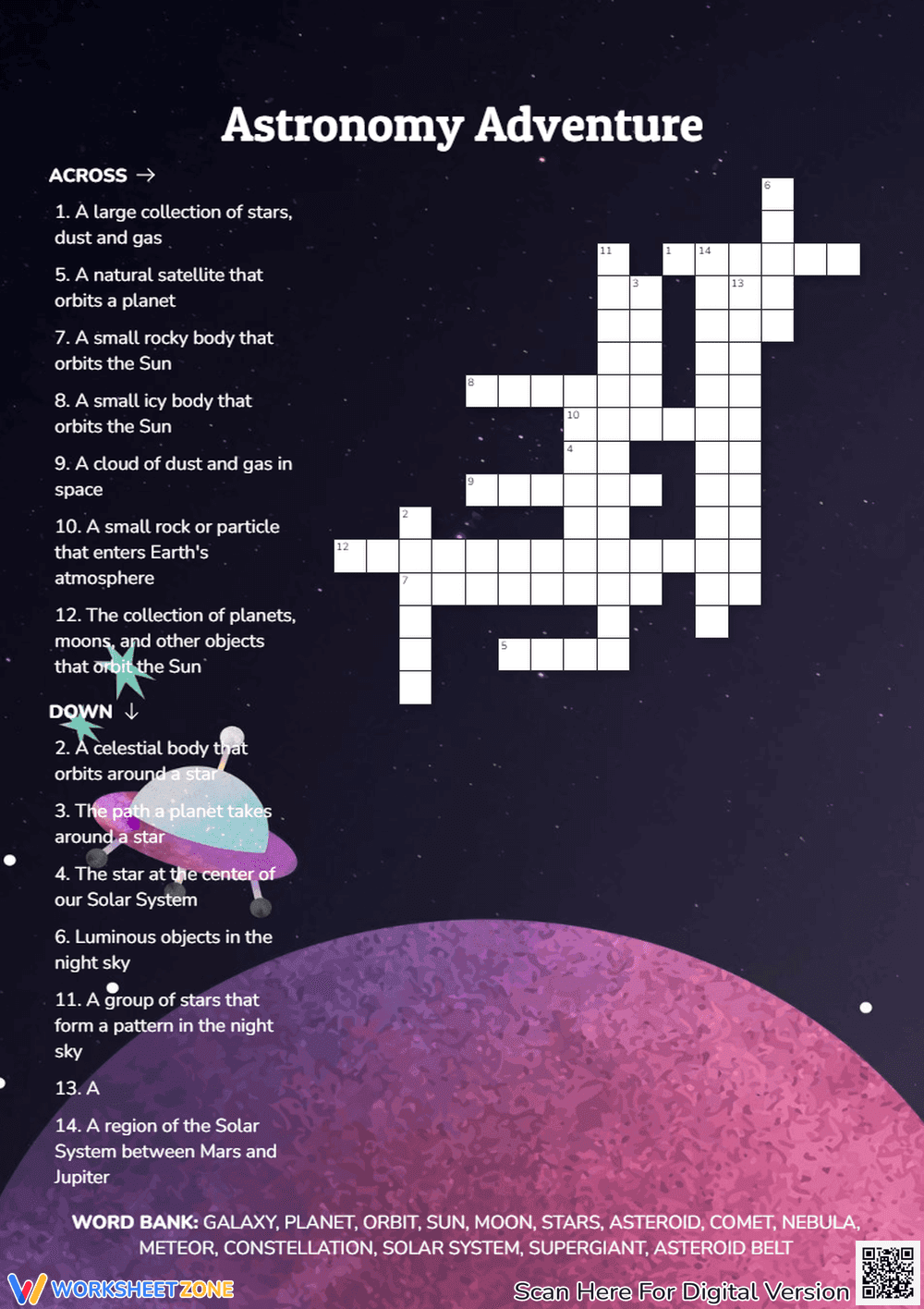

Printable Astronomy Crossword | Grade 5 Science
Paste this activity's link or code into your existing LMS (Google Classroom, Canvas, Teams, Schoology, Moodle, etc.).
Students can open and work on the activity right away, with no student login required.
You'll still be able to track student progress and results from your teacher account.
This printable astronomy crossword puzzle helps students master essential space science vocabulary while reinforcing their understanding of the solar system and universe. By matching 14 descriptive clues to terms like galaxy, asteroid, and nebula, learners build the foundational academic language needed to describe celestial bodies and their movements.
At a Glance
- Grade: 5 · Subject: Science
- Standard:
5-ESS1-2— Identify and describe celestial bodies in the solar system.- Skill Focus: Astronomy Vocabulary
- Format: 1 page · 14 problems · Answer key included · PDF
- Best For: Independent practice or sub plans
- Time: 15–20 minutes
This single-page resource features a visually engaging crossword puzzle with 14 distinct clues divided into across and down sections. A comprehensive word bank is provided at the bottom of the page, offering built-in scaffolding to help students correctly spell complex terms like constellation and supergiant. A complete answer key is included to ensure accurate grading and immediate feedback.
Zero-Prep Workflow
- Print (1 minute): Download the PDF and print a class set. The high-contrast design ensures clear reproduction.
- Distribute (1 minute): Hand out the puzzle alongside science journals. No additional teacher setup is required.
- Review (3 minutes): Use the included answer key to quickly check student work. Total teacher prep time is under two minutes, making this an ideal activity for emergency sub plans.
Standards Alignment
Aligned to primary standard 5-ESS1-2, this worksheet supports students as they represent data and describe patterns of celestial objects in the night sky. By defining terms like orbit, meteor, and comet, students build the conceptual framework necessary for more advanced earth and space science topics. Both standard codes can be copied directly into lesson plans, IEP goals, or district curriculum mapping tools.
How to Use It
This puzzle serves as an excellent formative assessment tool after direct instruction on the solar system. Teachers can assign it as independent seatwork to gauge vocabulary retention before moving on to complex concepts like planetary motion. Alternatively, use it as a collaborative warm-up activity where pairs of students race to complete the puzzle using their notes. While students work, observe which terms require the most reliance on the word bank to identify areas needing reteaching. Expected completion time is 15 to 20 minutes.
Who It's For
This resource is designed for upper elementary science students, particularly those in grades 3 through 5. The included word bank provides essential differentiation for English Language Learners and students who struggle with spelling, allowing them to focus on conceptual matching rather than rote memorization. It pairs perfectly with an introductory reading passage on the solar system or a visual anchor chart detailing the differences between meteors, asteroids, and comets.
Mastering domain-specific vocabulary is a critical component of science literacy, particularly when addressing complex topics like the universe and its stars. This worksheet aligns with 5-ESS1-2 by requiring students to identify and describe celestial bodies in the solar system through targeted vocabulary practice. According to an EdReports 2024 analysis of effective science curricula, explicit vocabulary instruction combined with interactive retrieval practices—such as crossword puzzles—significantly improves long-term retention of academic language. By engaging with terms like nebula, comet, and galaxy in a puzzle format, students actively retrieve definitions, strengthening their cognitive connections to the material. This structured approach ensures learners build the foundational knowledge necessary to articulate scientific arguments and comprehend advanced astronomical concepts in later grades. It provides a reliable method for educators to measure vocabulary acquisition.


