




























Views
Downloads
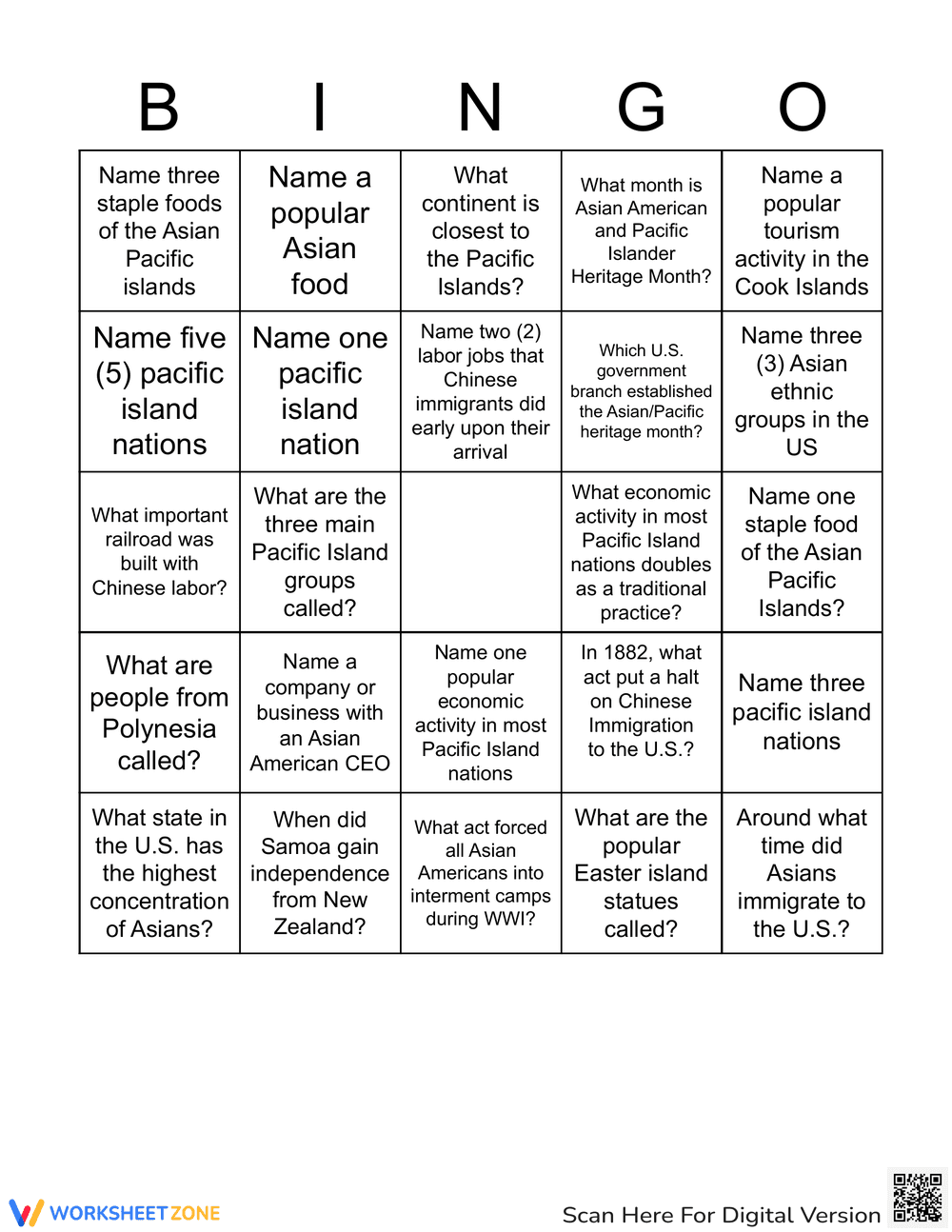

AAPI Heritage Month Bingo | Grade 1-3 Printable Guide

Paste this activity's link or code into your existing LMS (Google Classroom, Canvas, Teams, Schoology, Moodle, etc.).
Students can open and work on the activity right away, with no student login required.
You'll still be able to track student progress and results from your teacher account.
This AAPI Heritage Month Bingo worksheet provides a dynamic way for students to explore Asian American and Pacific Islander history, geography, and culture. By engaging with 24 specific prompts, learners build background knowledge and practice research skills while celebrating diverse achievements. It transforms traditional social studies facts into an interactive classroom activity.
At a Glance
- Grade: 1-3 · Subject: Social Studies
- Standard:
CCSS.ELA-LITERACY.RI.3.1— Ask and answer questions to demonstrate understanding of historical and cultural facts- Skill Focus: AAPI History & Culture
- Format: 1 page · 24 prompts · Answer key included · PDF
- Best For: Heritage Month celebration and cultural awareness
- Time: 20–30 minutes
The resource features a single-page Bingo grid containing 24 unique inquiry prompts. These questions cover a wide range of topics, including Pacific Island nations, significant historical acts like the Chinese Exclusion Act, and cultural staples like traditional foods. The layout is clean and professional, designed for immediate printing and distribution without additional teacher preparation.
Teachers can implement this activity in three simple steps. First, print the required number of copies for the class (1 minute). Second, distribute the sheets and explain the Bingo rules, encouraging students to use classroom resources or prior knowledge to fill the squares (2 minutes). Finally, review the answers as a whole group to reinforce learning (10 minutes). Total teacher prep time is under 2 minutes, making it an ideal sub plan or Friday activity.
This worksheet aligns with CCSS.ELA-LITERACY.RI.3.1, which requires students to ask and answer questions to demonstrate understanding of a text or topic. By researching the answers to the Bingo prompts, students practice identifying key details and citing evidence about AAPI history. Both standard codes can be copied directly into lesson plans, IEP goals, or district curriculum mapping tools.
Use this Bingo card as a summative activity at the end of a unit on Asian American and Pacific Islander Heritage Month. It also works well as a formative assessment tool; observe which categories students struggle with to identify areas needing further direct instruction. The activity typically takes 20 to 30 minutes depending on whether students are allowed to use research tools.
This resource is designed for elementary students in grades 1 through 3. It is particularly effective for inclusive classrooms looking to diversify their social studies curriculum. Pair this worksheet with a read-aloud about AAPI leaders or an anchor chart detailing Pacific Island geography to provide students with the necessary context to succeed.
According to the RAND AIRS 2024 report, integrating culturally responsive materials into elementary curricula significantly improves student engagement and sense of belonging. This worksheet addresses the CCSS.ELA-LITERACY.RI.3.1 standard by requiring students to process and recall specific cultural and historical information. By focusing on the plain-English skill of answering questions about diverse populations, the activity supports broader literacy goals while meeting social studies requirements. Research from Fisher & Frey (2014) emphasizes that interactive games like Bingo serve as effective scaffolds for vocabulary acquisition and fact retention in early childhood education. This resource provides a structured yet flexible framework for teachers to introduce complex topics such as immigration history and economic activities in a way that is accessible to young learners. It ensures that AAPI contributions are recognized through active participation rather than passive observation.


