


























Views
Downloads




April Fools’ Day Codebreaker Worksheet | Printable Ready
Paste this activity's link or code into your existing LMS (Google Classroom, Canvas, Teams, Schoology, Moodle, etc.).
Students can open and work on the activity right away, with no student login required.
You'll still be able to track student progress and results from your teacher account.
Kick off April Fools' Day with a fun, engaging decoding activity. This Grade 4 worksheet challenges students to use an emoji-to-letter key to reveal hidden messages, jokes, and thematic phrases. By cracking these 15 unique codes, students build critical thinking skills while celebrating the holiday in a structured, educational way that requires no teacher preparation.
At a Glance
- Grade: 4 · Subject: English Language Arts
- Standard:
CCSS.ELA-LITERACY.L.4.4— Use context and patterns to determine the meaning of coded phrases- Skill Focus: Decoding and Pattern Recognition
- Format: 5 pages · 15 problems · Answer key included · PDF
- Best For: Holiday classroom activity and sub plans
- Time: 25–40 minutes
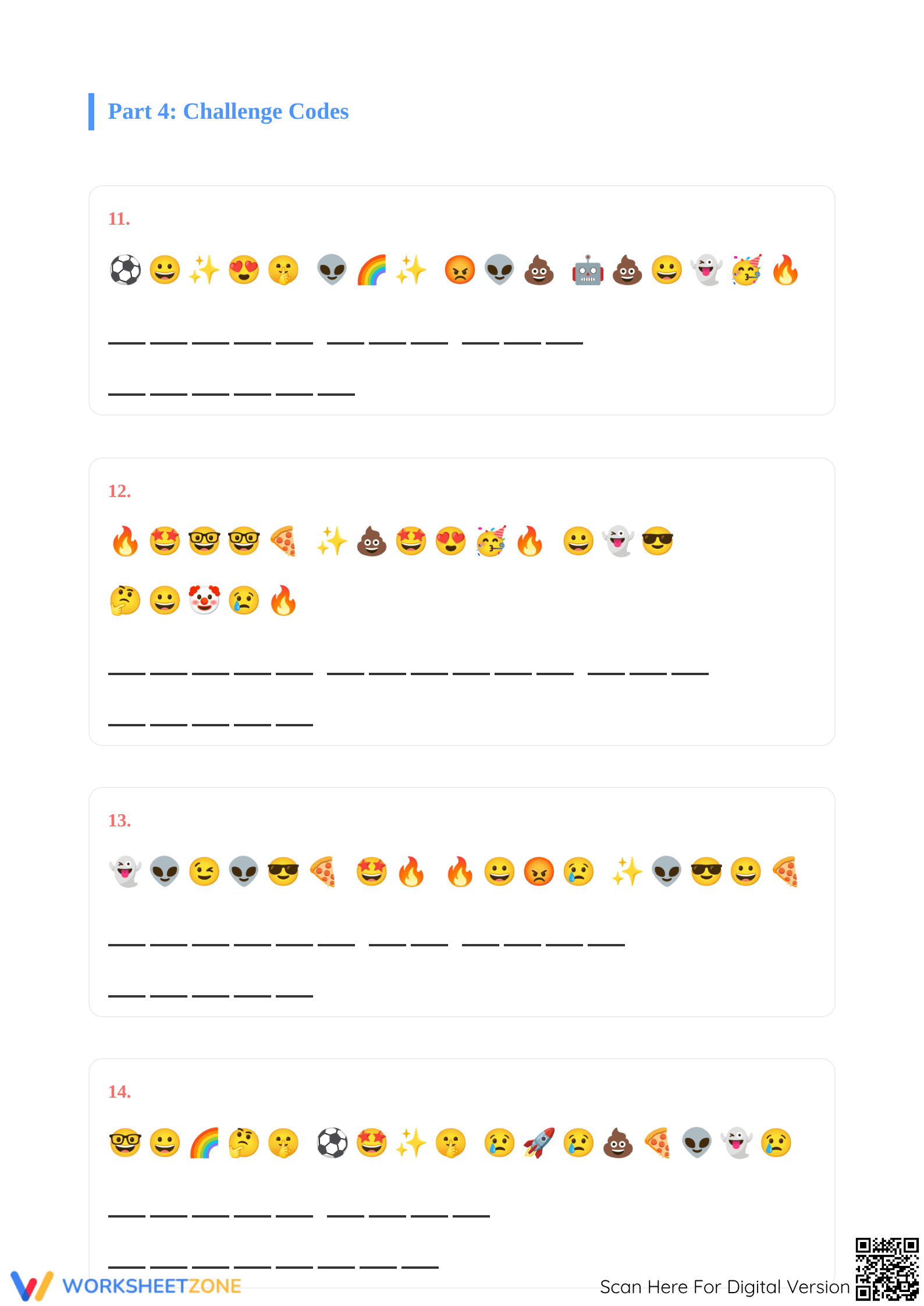
This comprehensive 5-page PDF contains a master emoji key and four distinct parts: Common Phrases, Pranks and Jokes, Trickster's Corner, and Challenge Codes. Each of the 15 tasks includes a sequence of vibrant emojis with dedicated blank lines for students to write the corresponding letters. The resource concludes with a complete answer key for rapid grading or student self-correction, ensuring a successful classroom experience.
Zero-Prep Workflow
- Print: Download and print the five-page packet for your class in under thirty seconds.
- Distribute: Briefly explain the emoji-to-letter substitution process and hand out the worksheets.
- Review: Students work independently to crack the codes, then check answers with the included key.
Total teacher preparation time is under two minutes from download to delivery.
Standards Alignment
This resource is aligned to `CCSS.ELA-LITERACY.L.4.4`, focusing on determining the meaning of phrases through the use of contextual keys and symbol substitution. By engaging with these decoding tasks, students practice the cognitive skills required to interpret non-standard text and clarify meaning through methodical analysis. This standard code can be copied directly into lesson plans, IEP goals, or curriculum mapping tools.
How to Use It
Use this worksheet as a focused bell-ringer on April 1st to settle students into their seats while maintaining a festive atmosphere. It also serves as an excellent formative assessment for attention to detail; observe which students methodically check the key versus those who attempt to predict words. The expected completion time is 30 minutes, making it an ideal supplemental activity for early finishers or a thematic rotation.
Who It's For
This activity is designed for upper elementary students in Grade 4, though its universal appeal makes it suitable for Grades 3 through 6. It is particularly effective for students who benefit from visual-spatial tasks or those who need high-engagement materials to stay on task. Pair this worksheet with an April Fools' Day reading passage or a short lesson on the history of the holiday for a complete thematic unit.
Research conducted by RAND AIRS 2024 emphasizes that thematic, holiday-specific activities significantly increase student engagement and persistence during independent practice sessions. By integrating symbol-substitution tasks like those found in the CCSS.ELA-LITERACY.L.4.4 aligned April Fools' Day Codebreaker, educators leverage the novelty effect to reinforce foundational cognitive skills such as decoding and pattern recognition. Fisher & Frey (2014) have noted that structured, print-and-go resources allow teachers to maximize instructional time by reducing administrative overhead while providing students with high-quality, scaffolded learning opportunities. This worksheet provides 15 structured problems that bridge the gap between recreational play and academic discipline, ensuring that even festive days are grounded in measurable student outcomes. Such resources are essential for maintaining curriculum momentum during seasonal transitions, providing a reliable bridge for students to apply logical reasoning to language-based puzzles within a 30-minute instructional block.


